
Solana vs Bitcoin is becoming a key market indicator as traders assess whether Solana is gaining a stronger position among risk-focused crypto assets ahead of Q3. The improving SOL/BTC ratio, rising network activity, and expanding real-world asset ecosystem are drawing attention as investors monitor whether the asset can continue outperforming Bitcoin.
- What does Solana vs Bitcoin indicate about the current market rotation?
- How is Solana’s ecosystem growth supporting its recent performance?
- Why is Solana showing strength while Ethereum struggles against Bitcoin?
- What does Solana’s payment growth reveal about network adoption?
- Can Solana maintain its momentum as Q3 approaches?
- Conclusion
- Glossary
- Frequently Asked Questions About Solana vs Bitcoin
The recent market movement follows Bitcoin’s recovery above $65,000, which encouraged capital rotation toward higher-beta crypto sectors. Solana recorded a 3.4% daily close above $71 on June 14, strengthening its market structure. However, the more significant signal has been the continued improvement in the SOL/BTC ratio, which reflects Solana’s growing relative strength against Bitcoin.
What does Solana vs Bitcoin indicate about the current market rotation?
The Solana vs Bitcoin comparison shows that capital movement within the crypto market is becoming more selective. While Bitcoin remains the main driver of the current cycle, Solana has started showing stronger performance as investors look toward alternative assets with higher growth potential. The SOL/BTC ratio extended last week’s 3.4% advance, posting its strongest weekly close since early May and signaling renewed momentum for Solana against Bitcoin on both daily and weekly charts.
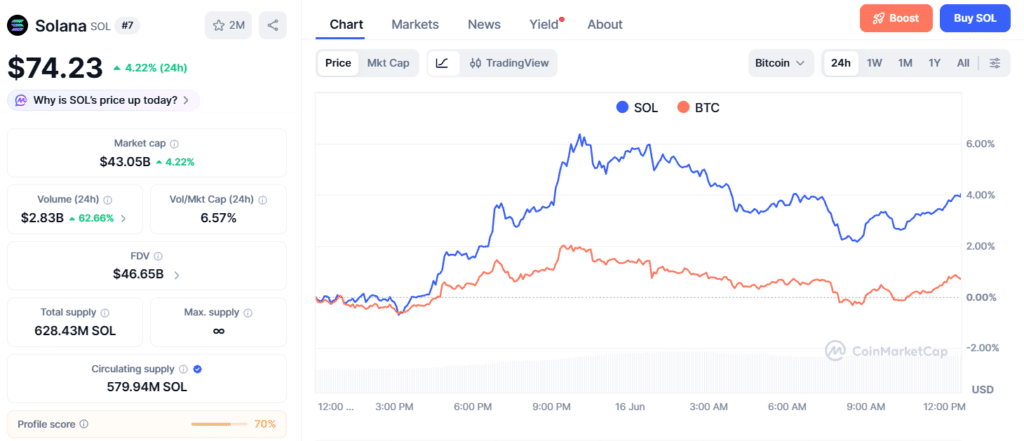
Solana is trading at $74.19, up 3.92% over the past 24 hours. Its market capitalization stands at $43.03 billion, reflecting a 3.96% increase, while its 24-hour trading volume has reached $2.83 billion after rising 62.68%. Bitcoin is currently trading at $66,418.45, showing a 0.91% gain over the same period. The SOL/BTC pair is trading at 0.0011163 BTC, increasing by 0.07% with a gain of 0.0000008 BTC.
TradingView data shows Solana’s Relative Strength Index (14) at 50.30, indicating a neutral position. The MACD Level (12, 26) is at −3.21 with a buy signal. However, Solana is trading below its key moving averages, with the 50-day simple moving average at $80.99 and the 100-day simple moving average at $83.46. Both indicators currently show sell signals.
How is Solana’s ecosystem growth supporting its recent performance?
Solana’s recent strength is being supported by increasing activity across its ecosystem. The market is not only focusing on price performance but also on developments linked to adoption and blockchain usage. Alatau City in Kazakhstan signed a memorandum of cooperation with the Solana Foundation, adding another ecosystem development connected with the network.
Meanwhile, Solana’s real-world asset ecosystem crossed a new all-time high of more than $3 billion in total value. The milestone highlights growing activity around tokenized financial products built on the blockchain. The tokenized equity sector has also expanded. SpaceX’s xStock (SPCX) became the most-traded tokenized stock on Solana after generating more than $36.5 million in volume since launch.
Backpack Securities launched SPCX on Solana on the same day SpaceX shares became available in traditional markets. The token surpassed $50 million in on-chain trading volume within its first 24 hours. These developments indicate that Solana’s market performance is being supported by wider network activity rather than price movement alone.
Why is Solana showing strength while Ethereum struggles against Bitcoin?
The difference between Solana and Ethereum’s performance against Bitcoin provides further insight into the current market environment. Historically, Ethereum has often acted as a bridge between Bitcoin and the wider altcoin market during periods of increasing risk appetite.
Strong Ethereum performance against Bitcoin has usually been associated with broader altcoin rallies. However, the ETH/BTC ratio has continued declining for ten consecutive weeks. This contrasts with the improving SOL/BTC ratio, showing that investors may be focusing on specific blockchain ecosystems rather than moving broadly into all altcoins.
For traders following Solana vs Bitcoin, the divergence between SOL/BTC strength and ETH/BTC weakness has become an important market signal. It suggests that capital rotation is currently favoring certain assets instead of the entire altcoin sector.
What does Solana’s payment growth reveal about network adoption?
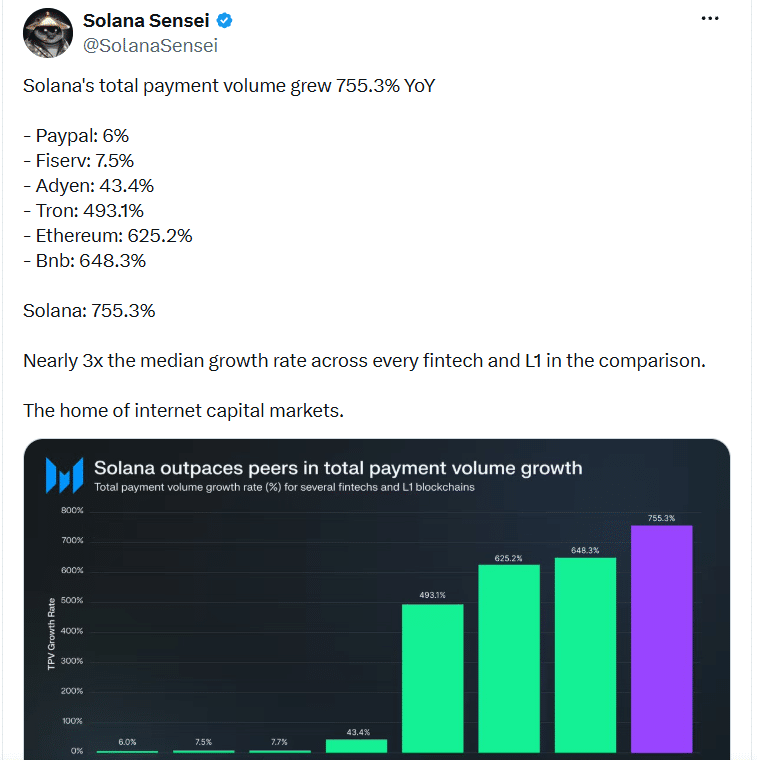
Solana’s payment activity has become another factor supporting attention around the blockchain. Data shared by Solana Sensei showed that Solana’s total payment volume grew 755.3% year over year. The comparison showed growth rates of 6% for PayPal, 7.5% for Fiserv, 43.4% for Adyen, 493.1% for Tron, 625.2% for Ethereum, and 648.3% for BNB.
Solana’s payment volume growth was nearly three times higher than the median growth rate across the fintech and Layer-1 blockchain comparison. The figures highlight the expansion of activity across Solana’s payment infrastructure. The growth in transaction activity provides additional context for investors evaluating Solana’s long-term position in the crypto market.
Can Solana maintain its momentum as Q3 approaches?
Solana enters the Q3 period with several factors supporting market interest, including a stronger SOL/BTC ratio, rising ecosystem activity, and increasing real-world asset adoption. However, traders are also monitoring technical resistance levels. Despite recent gains, Solana remains below its 50-day moving average of $80.99 and its 100-day moving average of $83.46.
These levels could become important checkpoints for confirming whether the current momentum can continue. The improving SOL/BTC ratio indicates stronger relative demand, but price performance will depend on whether Solana can overcome these technical barriers and maintain buying interest. The Solana vs Bitcoin trend will remain a key metric for understanding whether the current capital rotation develops into a broader market shift.
Conclusion
Solana vs Bitcoin has become an important measure of changing investor preference within the cryptocurrency market. Solana’s stronger relative performance, growing network activity, and expanding adoption show that market participants are paying closer attention to assets beyond Bitcoin. The current data does not confirm a permanent change in market leadership.
Rather, they point to a phase in which Solana is gaining relative strength while traders remain vigilant about risks and technical levels. As Q3 approaches, Solana’s capacity to sustain ecosystem growth, attract demand, and clear key resistance levels will determine whether the present trend matures into a durable shift in the crypto landscape.
Glossary
SOL/BTC Ratio: Solana’s performance compared with Bitcoin.
Capital Rotation: Money moving from one investment to another.
On-Chain Activity: Blockchain transactions and network usage.
Real-World Assets: Physical or traditional assets converted into tokens.
Tokenized Equity: A blockchain-based version of a company share.
Frequently Asked Questions About Solana vs Bitcoin
Why is Solana outperforming Bitcoin?
Solana is gaining strength due to growing network activity and rising investor interest.
How large is Solana’s RWA ecosystem?
Solana’s real-world asset ecosystem has grown to more than $3 billion in value.
Why are investors watching Solana ahead of Q3?
Investors are watching Solana because its market strength has been improving against Bitcoin.
What is SPCX on Solana?
SPCX is a tokenized version of SpaceX stock that trades on the Solana blockchain.
What is driving Solana’s recent rally?
Strong on-chain activity and growth in tokenized assets are supporting the rally.