
This article was first published on Deythere.
- Why the Anthropic Case Matters Beyond One AI Company
- AI Companies Are Fighting a Bigger Copyright War
- What Yakovenko’s Comments Could Mean for Blockchain
- The Next Court Decisions Could Shape AI for Years
- Conclusion
- Glossary
- Frequently Asked Questions About AI Training Fair Use
- Why did Anatoly Yakovenko comment on AI training fair use?
- Does the Anthropic settlement make AI training legal?
- Why is blockchain relevant to this issue?
- References
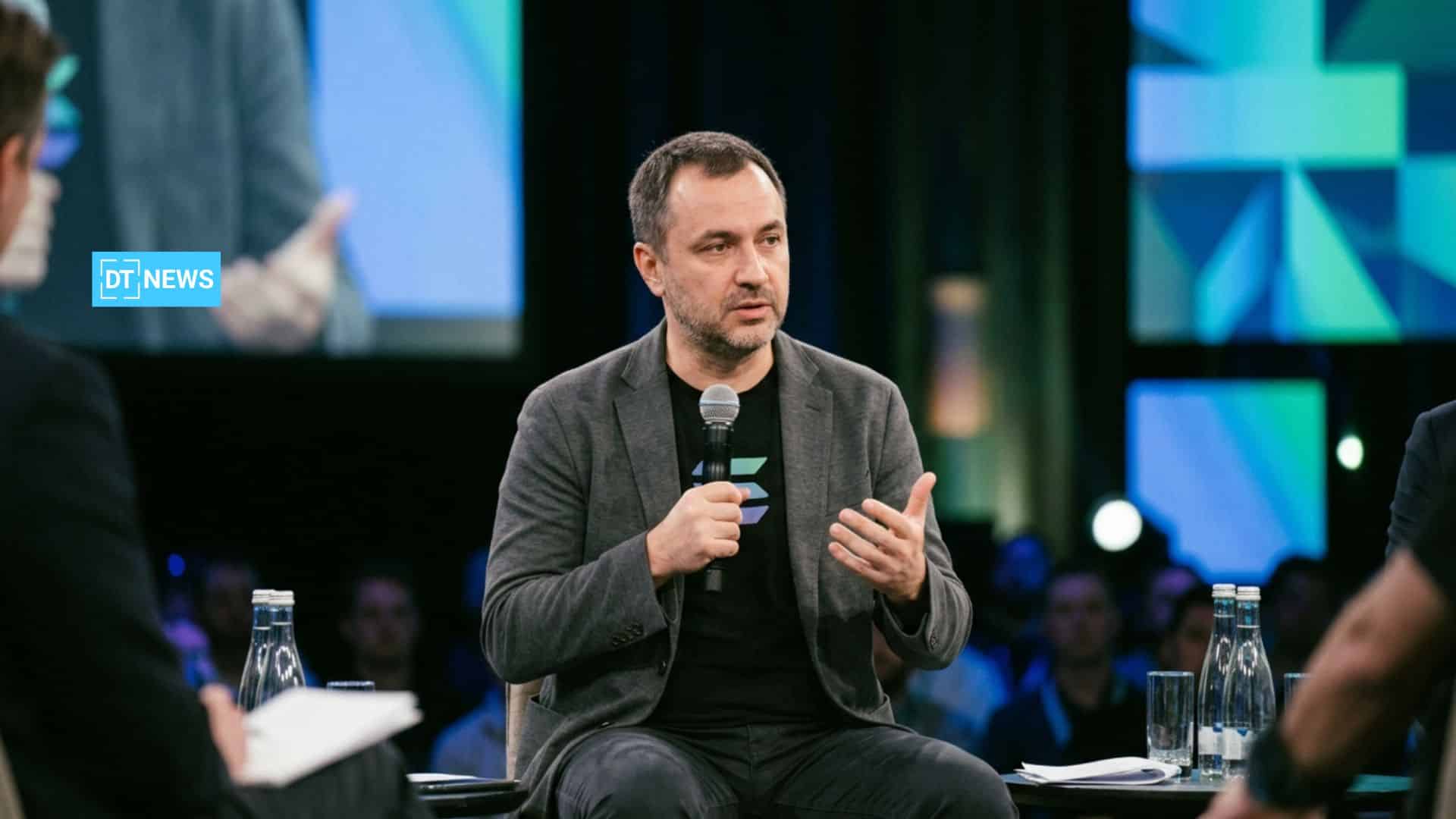
Solana’s co-founder Anatoly Yakovenko has argued that AI companies should generally be allowed to train on information people voluntarily publish online. His comments followed the approval of Anthropic’s $1.5 billion copyright settlement, the largest known copyright settlement in U.S. history, involving claims over books used to train the company’s Claude chatbot.
Although Yakovenko’s comments were brief, they touch on one of the most consequential legal questions facing both the AI and blockchain industries: where fair use ends and copyright liability begins.
Why the Anthropic Case Matters Beyond One AI Company
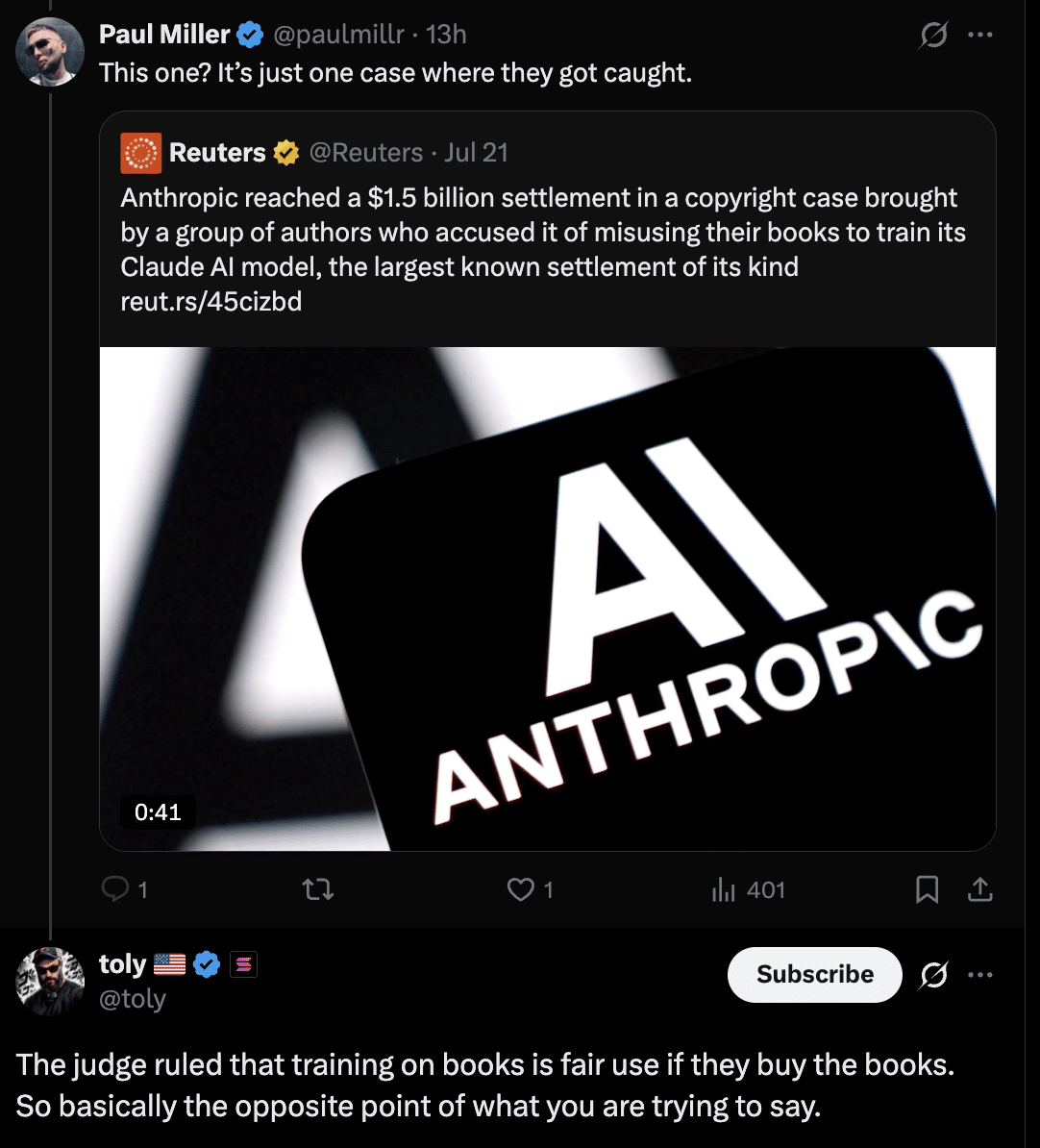
Yakovenko pointed to an earlier court finding that training AI on legally acquired books could qualify as fair use, arguing that the ruling supports AI learning from publicly available information. His interpretation, however, captures only part of what courts are examining.
The Anthropic litigation has become a source of reference because it separates AI training from how training material was obtained.
U.S. District Judge Araceli Martínez-Olguín approved the settlement after earlier rulings established that using lawfully obtained books for model training may qualify as fair use, while storing millions of pirated books in a centralized library raised separate copyright concerns.
The settlement resolved claims involving hundreds of thousands of works without overturning that distinction.
This explains why many legal observers see the case as a guide for how developers collect data before training even begins.
AI Companies Are Fighting a Bigger Copyright War
Anthropic is one of several AI developers facing copyright lawsuits from authors, publishers and media organizations.
Similar disputes involving OpenAI, Meta and other AI firms continue through U.S. courts, making the Anthropic case the first major settlement.
OpenAI continues defending claims brought by The New York Times and other publishers. Meta is battling lawsuits from major academic publishers and authors over books allegedly used to train Llama. Google is also confronting new litigation alleging Gemini was trained on copyrighted works without authorization.
What has changed over the past year is the legal focus.
Early public debate centered on whether AI-generated content copied existing works. Current litigation now asks different questions: Was the training data licensed? Was it legally purchased? Was it scraped from public websites? Was it copied from unauthorized repositories?
All of these are important because U.S. copyright law evaluates fair use using several factors, including the purpose of the use, the nature of the copyrighted work, the amount used and its impact on the original market.
Courts are applying those principles to AI on a case-by-case basis instead of creating a general rule that covers every dataset or training method.
This means future compliance may be a factor of both documenting data sources and improving model performance.
What Yakovenko’s Comments Could Mean for Blockchain
Yakovenko did not announce an AI product, partnership or Solana initiative. Even so, his comments point to an intersection between blockchain infrastructure and AI governance.
If courts continue distinguishing between legally sourced and improperly obtained training data, demand could increase for systems that verify provenance, ownership and licensing records before information enters AI datasets.
That is an area where blockchain technology already offers practical advantages.
Immutable ledgers can create auditable records showing when digital content was created, who owns it and whether permission was granted for commercial use.
Instead of replacing copyright law, blockchain could become one tool for demonstrating compliance as regulators and courts demand greater transparency from AI developers.
Conversely, if courts ultimately adopt a general interpretation of fair use for publicly available online material, the commercial need for comprehensive licensing systems could reduce for some categories of content.
The Next Court Decisions Could Shape AI for Years
The Anthropic settlement closes one chapter but leaves many unanswered questions.
Because the case settled, appellate courts have not yet issued a definitive nationwide interpretation of how fair use should apply across every form of AI training.
Other lawsuits involving different datasets, different acquisition methods and different business models could produce narrower or broader legal standards in the years to come.
For AI companies, that uncertainty explains why many continue pursuing licensing agreements even while defending fair-use arguments in court. Depending solely on litigation outcomes carries legal and commercial risks that negotiated licensing can reduce.
For blockchain developers, the debate presents a different opportunity. As AI models consume ever-larger datasets, tools that authenticate ownership, permissions and attribution may become more valuable regardless of which side ultimately prevails in court.
Yakovenko’s comments therefore resonate beyond Solana. They reveal a bigger industry issue about balancing innovation with intellectual property rights in this era where AI systems are trained on volumes of digital information.
Conclusion
AI training fair use is now focusing on accountability as much as innovation. Anatoly Yakovenko’s defense of AI learning from publicly available content aligns with one interpretation of U.S. copyright law, but the Anthropic settlement shows that courts are placing equal weight on how training data is acquired.
As lawsuits against multiple AI developers continue, future rulings are likely to mould licensing practices, data governance and the part blockchain could take in verifying ownership and provenance across the AI ecosystem.
Glossary
Fair Use: A legal rule allowing limited use of copyrighted material without permission under certain circumstances.
Data Provenance: Documentation showing where data originated and how it has been collected or transferred.
Foundation Model: A large AI model trained on large datasets that can be adapted for many tasks.
Copyright Infringement: The unauthorized use or reproduction of protected creative works.
Blockchain: A distributed digital ledger used to securely record transactions and ownership information.
Frequently Asked Questions About AI Training Fair Use
Why did Anatoly Yakovenko comment on AI training fair use?
He argued that AI companies should generally be permitted to learn from information people voluntarily publish online, citing the principle of fair use.
Does the Anthropic settlement make AI training legal?
Not entirely. The settlement resolved one lawsuit, while courts continue evaluating how copyright law applies to different datasets and methods of acquiring training material.
Why is blockchain relevant to this issue?
If AI developers are required to prove where training data came from, blockchain systems could help document ownership, licensing and provenance in a transparent and tamper-resistant way.