

BitMine staking revenue has become the company’s dominant source of income, with the latest regulatory filing showing that Ethereum staking and validation generated almost all of its reported quarterly revenue. The disclosure also reveals that the company’s Ethereum strategy is supported by a long-term operational arrangement whose financial obligations may continue even if management responsibilities change before the agreement expires.
- How does BitMine staking revenue reflect the company’s changing business model?
- Why is Ethereum Tower central to BitMine’s staking operations?
- Why could replacing the current operator become costly?
- What risks could affect future earnings?
- How does the latest company update support the quarterly filing?
- Why does the management agreement remain significant for BitMine’s Ethereum strategy?
- Conclusion
- Glossary
- Frequently Asked Questions About BitMine Staking Revenue
While the filing highlights the scale of BitMine’s staking business through its MAVAN validator network, it also underscores how closely the company’s financial performance is tied to Ethereum staking economics. Together, these details show that BitMine’s reported growth is accompanied by contractual commitments and operational dependencies that investors may also need to consider.
How does BitMine staking revenue reflect the company’s changing business model?
BitMine staking revenue shows that Ethereum staking has become the company’s principal business activity during the latest reporting period. For the three months ended May 31, 2026, BitMine reported total revenue of $46.535 million. Staking and validation contributed $45.743 million, representing 98.3% of total revenue, according to the company’s Form 10-Q filed on July 14.
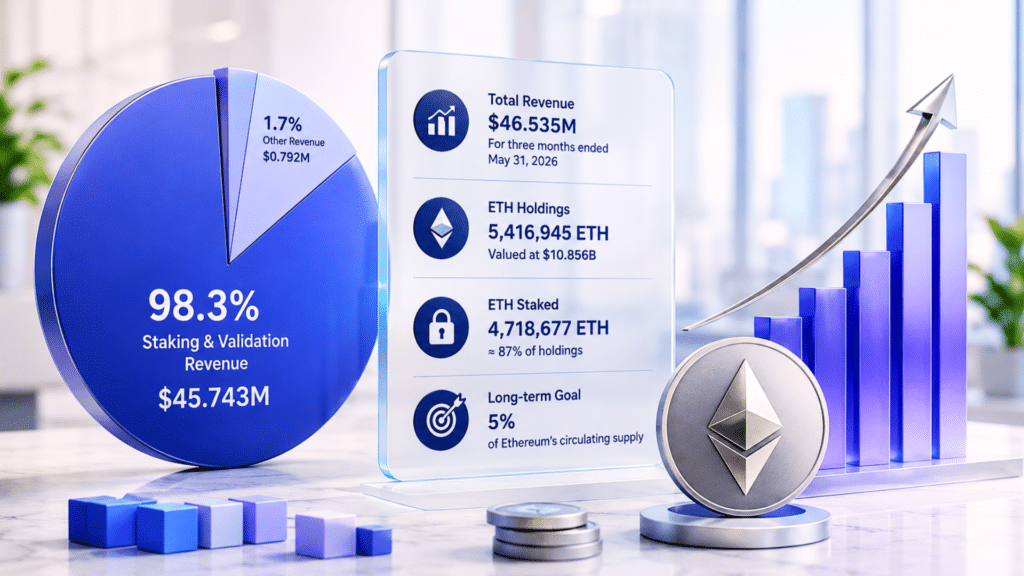
This means nearly all of the company’s reported quarterly revenue came from MAVAN, its Made in America VAlidator Network. Other activities contributed only about $0.8 million during the quarter, illustrating how concentrated the company’s revenue base has become. The filing also provides a longer-term trend. During the first nine months of the fiscal year, staking and validation generated approximately $56.9 million, accounting for about 95% of total revenue over that period. Compared with the prior year, when staking revenue was absent, the latest filing reflects a significant change in the company’s operating model.
At the end of the quarter, BitMine held 5,416,945 ETH valued at $10.856 billion. In a separate company update released on June 1, BitMine reported holding 5,416,901 ETH, of which 4,718,677 ETH had been staked, representing roughly 87% of its Ethereum holdings. The company also reiterated its long-term goal of acquiring 5% of Ethereum’s circulating supply, although that objective remains forward-looking.

Why is Ethereum Tower central to BitMine’s staking operations?
Ethereum Tower plays an important operational role in supporting BitMine’s staking business through a long-term management agreement. BitMine owns 98% of MAVAN Holdings, while Ethereum Tower owns the remaining 2% as a noncontrolling interest. Under the Management Services Agreement that became effective on March 24, 2026, Ethereum Tower performs delegated strategic planning together with day-to-day work across native staking, validator infrastructure and technology systems.
BitMine subsidiary BMNR remains the formal manager and retains reserved powers under the agreement. Ethereum Tower also receives monthly revenue participation from BitMine’s native staking operations. However, the agreement specifically states that it has no entitlement to any revenue generated from third-party staking operations carried out by the company or its subsidiaries.
One of the agreement’s most significant provisions is that Ethereum Tower’s 2% membership interest is irrevocable. The filing states that this ownership interest survives termination or expiration of the agreement unless it is sold or assigned, making it an ongoing economic right regardless of whether management services continue.
Why could replacing the current operator become costly?
The management agreement gives BitMine flexibility to replace its operator, but doing so could still create continuing financial obligations. The contract has an initial term of 10 years. BitMine subsidiary BMNR may terminate the agreement for convenience by providing 180 days’ prior written notice. If the agreement ends early for reasons other than specified cause events such as material breach, insolvency or misconduct by Ethereum Tower, the service provider may choose between two economic outcomes.
Ethereum Tower may continue receiving its revenue participation for the remainder of the contract even after it stops providing management services. Alternatively, it can elect a lump-sum payment equal to 85% of its highest monthly fee during the previous 12 months, or the shorter elapsed period, multiplied by the number of months remaining under the agreement. The filing notes that the revenue allocation is contained in a redacted schedule.
As a result, the public filing does not provide enough information to calculate the dollar cost of an early operator exit. If BitMine replaces Ethereum Tower, the agreement requires the service provider to stop providing management services and cooperate during the transition while BitMine or its designee assumes responsibility for validator and technology operations. Even after such a transition, Ethereum Tower’s irrevocable 2% ownership interest would remain, while either continuing revenue participation or the formula-based payment could still apply.
What risks could affect future earnings?
BitMine staking revenue also highlights how dependent the company’s reported results have become on Ethereum staking economics. The Form 10-Q states that BitMine’s operating results substantially depend on MAVAN and favorable Ethereum staking conditions. Lower staking yields, validator downtime, slashing events or adverse protocol changes could reduce both revenue and cash flow. Because staking and validation supplied 98.3% of quarterly revenue, any weakness in those areas would directly affect the company’s main reported revenue line.
The filing therefore presents revenue concentration as one of the key considerations alongside the company’s expanding Ethereum strategy. The filing does not report that MAVAN or Ethereum Tower has underperformed. Instead, it identifies potential operational and market risks that could influence future financial performance as staking continues to account for nearly all reported revenue.
How does the latest company update support the quarterly filing?
BitMine staking revenue is supported by the company’s broader strategy of expanding its Ethereum treasury while increasing staking activity through MAVAN. In its June 1 announcement, BitMine reported total crypto, cash and strategic investment holdings of $11.6 billion. These included 5,416,901 ETH, 203 BTC, $446 million in cash, a $180 million stake in Beast Industries and a $93 million investment in Eightco Holdings. The company also said its Ethereum holdings represented 4.49% of the total 120.7 million ETH supply.
Chairman Thomas “Tom” Lee stated that BitMine acquired an additional 26,497 ETH during the previous week and said the company expects to reach its long-term objective of the “alchemy of 5%” sometime in 2026. He also said 4,718,677 ETH, representing approximately $9.5 billion at an ETH price of $2,003, had already been staked through MAVAN. Lee further stated that BitMine’s own staking operations generated a seven-day annualized yield of 2.73%.
Based on those figures, projected annualized ETH staking rewards could reach $296 million once BitMine’s ETH holdings are fully staked through MAVAN and its staking partners. He also projected annualized staking revenue of $258 million. These figures represent company projections and should be distinguished from reported financial results. The company described MAVAN as an institutional-grade staking platform initially developed to support BitMine’s own Ethereum treasury, with plans to expand services to institutional investors, custodians and ecosystem partners.
Why does the management agreement remain significant for BitMine’s Ethereum strategy?
BitMine staking revenue is closely connected to the contractual framework supporting the company’s validator operations, making the management agreement an important part of its broader Ethereum strategy. While BitMine subsidiary BMNR retains formal managerial authority, Ethereum Tower continues to hold an irrevocable 2% membership interest that survives termination or expiration unless it is sold or assigned.

The agreement also limits Ethereum Tower’s revenue participation to BitMine’s native staking operations and specifically excludes any entitlement to revenue generated from third-party staking activities. If an operator transition takes place, Ethereum Tower must cooperate in handing over validator and technology responsibilities.
However, the agreement allows its economic rights to continue through either ongoing revenue participation or a formula-based payment, depending on the circumstances of the termination. Those provisions mean the company’s Ethereum strategy remains linked not only to staking performance but also to contractual commitments that may outlast an operational separation.
Conclusion
BitMine staking revenue illustrates how the company’s financial performance has become increasingly tied to Ethereum staking, with staking and validation now accounting for almost all reported revenue. The latest filing also shows that operational relationships extend beyond day-to-day management because contractual rights and economic interests may continue even after an early change in service providers.
At the same time, the company has not reported operational shortcomings at MAVAN or Ethereum Tower, although it acknowledges that changes in staking economics, validator performance or Ethereum network conditions could materially affect future results. BitMine staking revenue therefore reflects both the strength of the company’s staking business and the long-term contractual structure that supports its primary source of revenue.
Glossary
MAVAN: BitMine’s Ethereum staking and validator platform.
Ethereum Tower: BitMine’s staking operations manager.
Proof of Stake (PoS): A system that secures Ethereum through staking.
Staking Rewards: Income earned from staking cryptocurrency.
Form 10-Q: A company’s quarterly financial filing.
Frequently Asked Questions About BitMine Staking Revenue
How much staking revenue did BitMine report?
BitMine reported $45.743 million in staking and validation revenue for the latest quarter.
What percentage of BitMine’s revenue came from staking?
Staking and validation generated 98.3% of BitMine’s total quarterly revenue.
How much Ethereum does BitMine hold?
BitMine held more than 5.4 million ETH at the end of the reported quarter.
What could affect BitMine staking revenue?
Lower staking rewards, validator issues, or Ethereum network changes could reduce BitMine’s revenue.
Can BitMine replace Ethereum Tower?
Yes. BitMine can replace Ethereum Tower, but the agreement may require ongoing payments.