



Ethereum treasury strategies are becoming one of the defining trends in corporate crypto finance. While many companies remain cautious about digital assets, BitMine continues to move aggressively in the opposite direction. Despite carrying billions of dollars in unrealized losses, the company is seeking fresh capital to expand its Ethereum holdings, signaling confidence in the network’s long-term future.
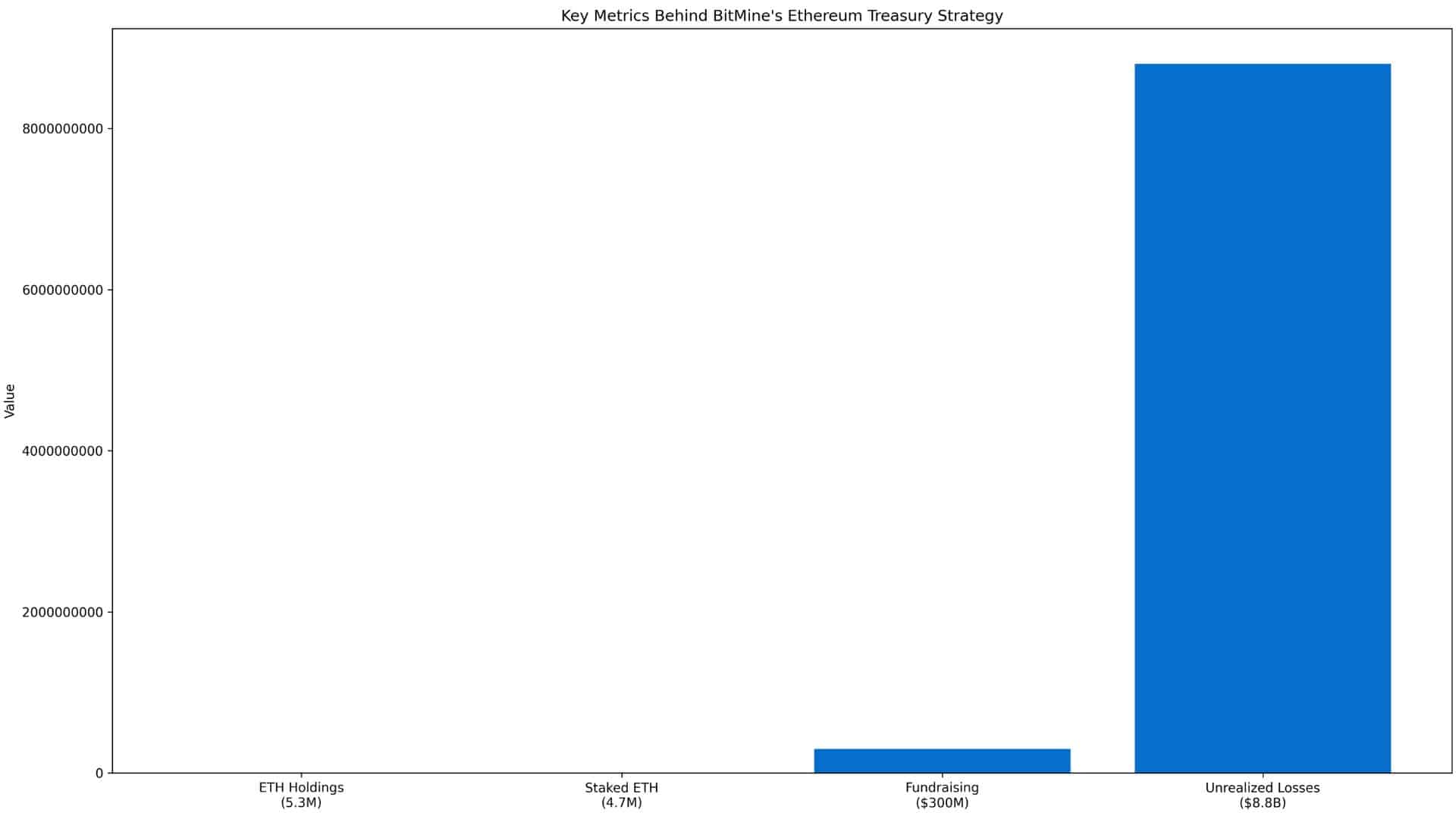
According to the source, BitMine Immersion Technologies (NYSE: BMNR), chaired by prominent Wall Street analyst Tom Lee, has filed with the U.S. Securities and Exchange Commission to offer 3 million shares of 9.5% Series A Perpetual Preferred Stock. The offering could raise up to $300 million and follows an effective shelf registration statement. The company plans to use the proceeds to strengthen its growing Ethereum treasury, expand staking operations, and support general corporate needs.
A Strategy-Inspired Funding Model Targets Ethereum Growth
The fundraising structure closely mirrors the playbook used by Strategy, formerly known as MicroStrategy. Instead of relying on traditional debt or issuing large amounts of common stock, companies tap capital markets and deploy funds into digital assets.
For BitMine, that asset is Ethereum. The preferred shares carry a fixed cumulative dividend rate of 9.5% annually, with payments potentially made weekly in cash if declared by the board. Weekly payouts are uncommon in preferred stock offerings, making this feature stand out among traditional financing structures.
The securities are expected to trade on the New York Stock Exchange under the ticker symbol BMNP, subject to approval, with trading potentially beginning within 30 days of issuance. Moelis & Company and Cantor Fitzgerald are acting as joint lead bookrunners.
By using preferred equity, BitMine can expand its Ethereum treasury without immediately diluting common shareholders or taking on restrictive debt obligations.
The World’s Largest Ethereum Treasury Faces Growing Scrutiny
The company’s Ethereum treasury has reached a scale few firms can match. BitMine currently holds more than 5.3 million ETH, representing roughly 4.5% of Ethereum’s circulating supply. That position has helped establish it as the world’s largest Ethereum treasury company.
However, the timing of those purchases has created significant challenges. The value of the company’s holdings has dropped below $10 billion, resulting in paper losses that exceed $8.8 billion. Much of the ETH was acquired when prices traded between $3,700 and $4,000.
Importantly, these losses are largely tied to mark-to-market accounting adjustments. This means the company must report changes in asset values based on current market prices, even when those assets remain unsold. As a result, much of the reported loss remains unrealized.

Why BitMine Continues Buying While Others Remain Cautious
Even as losses mounted, BitMine continued purchasing Ethereum and adding to its Ethereum treasury. That decision has divided market observers. Critics question whether such concentration creates excessive risk, while supporters view the strategy as a long-term bet on Ethereum adoption.
Investor skepticism has also been reflected in BMNR shares, which have fallen sharply from previous highs. Despite the decline, management insists there is no immediate pressure to liquidate ETH holdings. Instead, the company remains focused on long-term appreciation and staking income as key drivers of future value.
Can Staking Income Support a 9.5% Dividend?
A major portion of the new capital will support MAVAN, or Made in America Validator Network, BitMine’s institutional staking platform. The network already supports more than 4.7 million staked ETH and serves both internal treasury operations and external institutional clients. The company already stakes a significant portion of its holdings, generating annual yields estimated in the hundreds of millions of dollars.
MAVAN is central to the company’s Ethereum treasury strategy because staking generates recurring rewards. However, one challenge remains. The preferred shares offer a 9.5% annual dividend, while Ethereum staking typically produces yields between 3% and 5%, depending on market conditions.
This creates a gap between dividend obligations and staking income. BitMine believes continued ETH appreciation, staking expansion, and broader business growth can help bridge that difference over time.
The preferred shares also include redemption provisions that allow the company to repurchase them at declining premiums. In addition, preferred shareholders receive priority over common shareholders for dividend payments and liquidation proceeds, giving them greater protection if financial conditions deteriorate.
Conclusion
BitMine’s latest fundraising effort highlights the rapid evolution of crypto corporate finance. Rather than treating Ethereum as a speculative asset, the company is building an entire business model around an Ethereum treasury, institutional staking infrastructure, and capital market access.
The strategy carries meaningful risks, particularly as losses remain elevated and dividend obligations exceed typical staking yields. Yet it also reflects growing institutional confidence in Ethereum’s long-term role within global finance. Whether BitMine’s approach becomes a blueprint for future treasury companies or a cautionary tale will depend on how successfully it balances growth, income generation, and market volatility.
Glossary of Key Terms
Ethereum Treasury: Corporate reserves primarily held in Ethereum.
Preferred Stock: A class of shares that typically receives dividend priority over common stock.
Mark-to-Market Accounting: A method that values assets based on current market prices.
Staking: Locking cryptocurrency to help secure a blockchain network and earn rewards.
MAVAN: BitMine’s Made in America Validator Network for institutional staking services.
FAQs About Ethereum Treasury
What is BitMine raising funds for?
The company plans to use the capital for Ethereum purchases, staking expansion, and general corporate operations.
How much could the preferred stock offering raise?
BitMine aims to raise up to $300 million through the sale of preferred shares.
Why are BitMine’s losses considered unrealized?
Most losses stem from mark-to-market accounting adjustments rather than actual sales of ETH holdings.
What makes the dividend structure unique?
The preferred shares carry a 9.5% annual dividend that may be paid weekly in cash if approved by the board.
Why is MAVAN important to BitMine’s strategy?
MAVAN generates staking rewards and supports both internal treasury management and institutional clients.