

Cardano is under fresh pressure after short positions took over nearly 75% of ADA market exposure, a signal that traders are leaning hard against a near-term recovery. The move comes after ADA lost key support in mid-May and extended its decline by roughly 10%, leaving investors to ask whether the weakness is only a technical shakeout or a deeper loss of confidence. For any Cardano price prediction, the answer now depends less on hope and more on whether buyers return with real volume.
Cardano price prediction Turns Cautious as Shorts Dominate
The sharp rise in short exposure shows that traders are not just nervous, they are actively positioning for more downside. In derivatives markets, this matters because leverage can speed up price moves in both directions. When too many traders stand on one side of the boat, even a small wave can tip the market.
That is why Cardano price prediction has become more difficult in the short term. A heavy short build-up can reflect weak confidence, but it can also create the conditions for a short squeeze if ADA suddenly breaks above resistance. For now, the market is not giving buyers much room to celebrate.

ADA’s loss of its recent EMA support zone also damaged the chart. An EMA, or exponential moving average, tracks price trends while giving more weight to recent moves. When price falls below that line, traders often read it as a sign that momentum has shifted away from buyers.
Activity Is Rising, but Demand Still Looks Thin
Cardano’s network activity has not disappeared. Weekly average active wallets reportedly stayed between 12,000 and 20,000 over the past two weeks. That is not a dead network, but activity alone does not save a token price. The key question is whether those wallets are driving demand, fees, liquidity, and stronger decentralized app use.
A careful Cardano price prediction must separate movement from conviction. A wallet can move funds, interact with a protocol, or rebalance holdings without creating the kind of buying pressure needed for a price recovery. Traders want to see higher spot demand, stronger DEX volume, and improving liquidity before calling a bottom.
That gap is where Cardano is struggling. The project still has a loyal community and a long-term technical identity, but markets do not pay for reputation forever. They pay for usage, revenue, liquidity, and growth that can be seen on-chain.
The Bigger Issue Is Ecosystem Confidence
Cardano’s challenge is no longer just a red candle on the chart. Investors are watching whether the ecosystem can produce stronger DApp traction, deeper DeFi activity, and more developer-led demand. In plain terms, ADA needs more reasons for people to use it, not only hold it.
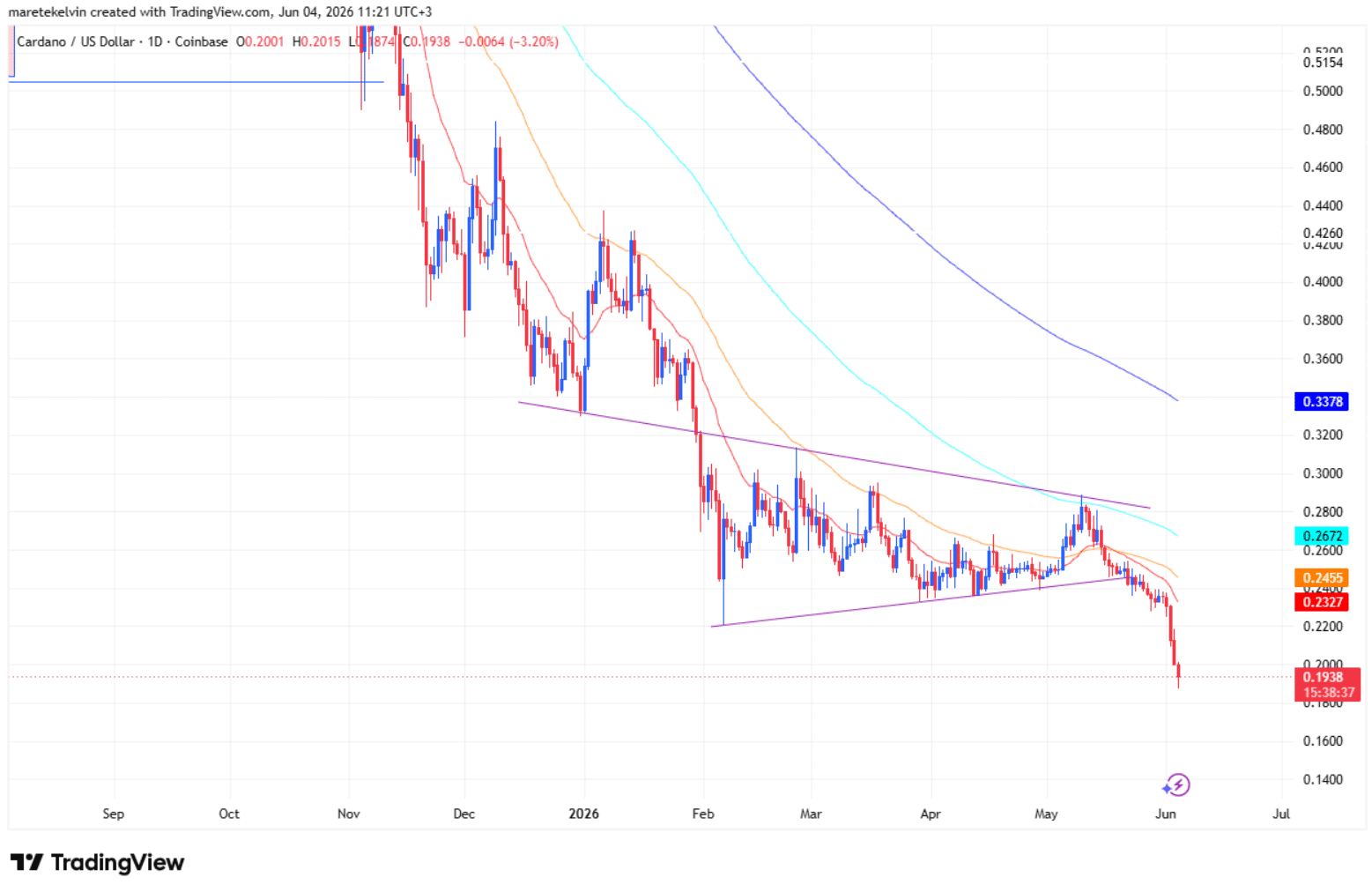
Cardano price prediction now depends on whether the network can turn community strength into measurable growth. If active wallets rise while DeFi volumes remain weak, traders may continue to discount the token. If usage starts to improve across applications, sentiment could shift faster than expected.
This is the same test many older layer-1 networks face. They have brand recognition, strong communities, and years of development behind them. Still, newer chains are fighting for liquidity every day. In crypto, capital moves quickly when investors believe another ecosystem offers better yield, better apps, or cleaner momentum.
What ADA Needs for a Recovery
For readers looking at Cardano price prediction, the first level to watch is whether ADA can reclaim its lost support area with strong volume. A weak bounce may only invite more short selling. A strong move above resistance, backed by spot buying, would be a better sign that traders are being forced to rethink their bearish view.
The second signal is derivatives balance. If shorts remain too crowded, ADA could see a fast squeeze, but that would not automatically mean a lasting recovery. Sustainable upside needs steady buying, not only liquidations.
The third signal is on-chain demand. Active addresses, transaction growth, DEX activity, and total value locked help show whether Cardano is attracting real economic use. Without that, price action can remain stuck between rallies and selloffs.
Conclusion
Cardano is not finished, but ADA is clearly in a tougher phase. With shorts controlling nearly 75% of exposure, traders are showing little patience and even less confidence. The setup could still flip if buyers return with force, yet the burden of proof is now on the bulls.
A realistic Cardano price prediction should stay balanced. ADA may recover if it reclaims support, improves liquidity, and shows stronger ecosystem use. Until then, bearish traders appear to have the upper hand, and the market will need more than loyal community support to change its mind.
Frequently Asked Questions
What does this mean for Cardano price prediction?
It means Cardano price prediction has turned cautious because traders are heavily shorting ADA, which shows weak near-term confidence.
Can ADA still recover from this level?
Yes, ADA can recover if buyers return, short positions unwind, and the token breaks back above key resistance with strong volume.
Why are shorts important for ADA?
Shorts show how many traders expect price to fall. When short exposure becomes crowded, it can either confirm bearish pressure or set up a squeeze.
Glossary of Key Terms
Short Position: A trade that profits when the price falls.
EMA: A moving average that gives more importance to recent prices.
Active Wallets: Wallet addresses that send, receive, or interact on-chain.
Short Squeeze: A fast rally caused when bearish traders are forced to close losing positions.
DApp: A decentralized application built on a blockchain.
Sources
Disclaimer: This article is for informational purposes only and does not provide financial advice. Cryptocurrency markets are volatile, and readers should do independent research before making investment decisions.