

Hyperliquid vs Solana is shaping one of the most closely watched market comparisons as capital flows shift between a derivatives-focused trading protocol and a large-scale institutional Layer-1 blockchain, with both assets reacting differently to ongoing risk-off conditions in the crypto market.
- Hyperliquid vs Solana: what is the core structural distinction?
- Why does FDV distortion matter in Hyperliquid vs Solana?
- What did the $1.1 billion liquidation event reveal?
- How do revenue models differ in HYPE vs SOL
- What do analysts and traders say about Hyperliquid vs Solana?
- What does derivatives data show in HYPE vs SOL?
- Is Hyperliquid vs Solana a realistic flippening scenario?
- Conclusion
- Glossary
- Frequently Asked Questions About Hyperliquid vs Solana
Hyperliquid is currently trading around $61.40, down 15.66% in the last 24 hours. Solana is currently trading around $66.20, down 6.03% over the same period. While both assets are under pressure, Hyperliquid vs Solana continues to attract attention due to deeper structural differences in valuation, liquidity, and ecosystem design.
Hyperliquid vs Solana: what is the core structural distinction?
Hyperliquid vs Solana represents two fundamentally different crypto architectures competing for capital under very different market assumptions. Hyperliquid is a specialized perpetual futures DEX chain designed for high-speed execution and leveraged trading.
Its valuation is tightly linked to derivatives activity and trader engagement. Solana is a general-purpose Layer-1 blockchain supporting DeFi, payments, NFTs, and institutional settlement infrastructure. Its value is distributed across multiple ecosystem layers rather than a single use case.
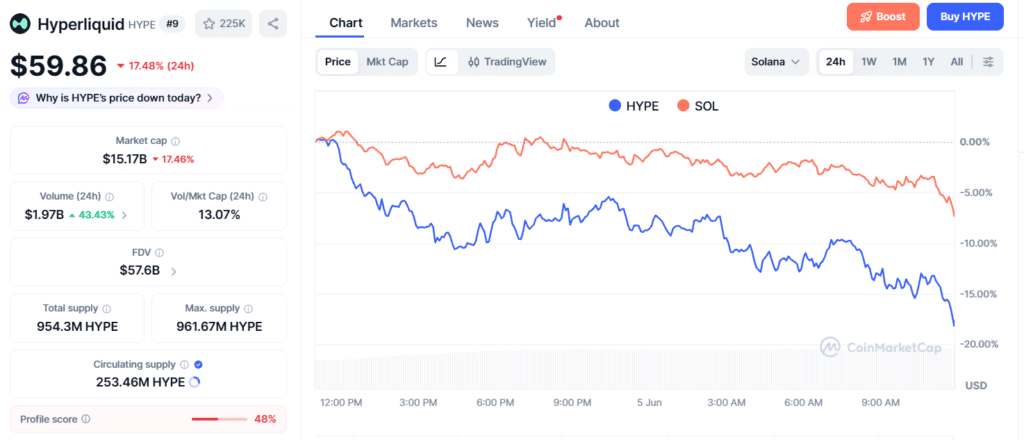
Solana’s circulating market cap stands at $38.33 billion, compared to Hyperliquid at $15.57 billion. In Hyperliquid vs Solana comparisons, this gap highlights the difference between a mature institutional ecosystem and an emerging trading-focused network.
Why does FDV distortion matter in Hyperliquid vs Solana?
Hyperliquid vs Solana comparisons are often skewed by how valuation is measured. A major issue is the reliance on fully diluted valuation for Hyperliquid rather than circulating market cap. This creates a misleading impression of scale in flippening narratives.
For HYPE to genuinely overtake SOL on a circulating basis, it would need to sustain its price while absorbing significant token unlocks over the next 2 to 4 years, introducing a dilution curve that Solana has already largely worked through post-2022. This makes Hyperliquid vs Solana less about price momentum and more about structural supply absorption over time.
What did the $1.1 billion liquidation event reveal?
Hyperliquid vs Solana also reflects how each system behaves under extreme market stress. During a $1.1 billion market-wide liquidation event, Hyperliquid’s protocol remained operational and stable. However, the event showed that its risk infrastructure is still being stress-tested in real time under large-scale deleveraging.
Solana, in comparison, absorbed similar volatility without structural disruption due to deeper liquidity and more established market infrastructure. This difference is central when evaluating resilience in Hyperliquid vs Solana.
How do revenue models differ in HYPE vs SOL
Hyperliquid vs Solana diverges significantly in how each protocol generates and sustains revenue. Solana’s ecosystem revenue is diversified across payments, DePIN protocols, NFTs, and thousands of active applications. It can withstand sharp declines in derivatives activity, including hypothetical drops of 40%, without structural breakdown in its revenue base.
Hyperliquid, however, relies heavily on sustained leverage demand and perpetual trading volume. Its revenue model is therefore more sensitive to changes in market risk appetite and derivatives activity cycles.
Solana’s network effects include Visa integrations, DePIN protocols, and thousands of active applications, forming a broad fee-generating economy that a perps-focused chain cannot easily replicate in HYPE vs SOL comparisons.
What do analysts and traders say about Hyperliquid vs Solana?
Hyperliquid vs Solana has drawn contrasting views from institutional observers and market participants. Syncracy Capital’s Daniel Cheung described Hyperliquid as “the main chain where trading activity is happening” and emphasized that it is “bringing new users into crypto right now,” pointing to its 24/7 trading structure as a key advantage over traditional market-hour-limited venues.
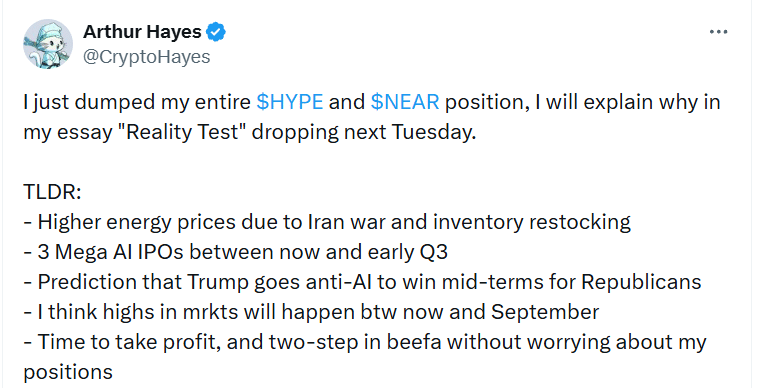
Arthur Hayes, a key early supporter of HYPE, recently stated he exited his entire position. He cited higher energy prices linked to Iran-related tensions, three major AI IPOs expected before early Q3, potential political shifts around AI ahead of midterms, and expectations that market highs may occur between now and September.
What does derivatives data show in HYPE vs SOL?
Hyperliquid vs Solana also shows a clear divergence in derivatives positioning and trader sentiment. Hyperliquid recorded around $9.47 billion in futures volume with approximately $2.58 billion in open interest, alongside roughly $43 million in liquidations.
Solana posted about $12.65 billion in futures volume and $4.71 billion in open interest, with approximately $28 million in liquidations. Positioning data shows a notable split. Top traders hold a 4.15 long/short ratio on Solana, indicating a strong bullish bias among larger participants.
In contrast, Hyperliquid shows a 0.79 ratio among top traders, reflecting a more cautious or short-leaning stance. This divergence is a key signal in Hyperliquid vs Solana market structure analysis.
Is Hyperliquid vs Solana a realistic flippening scenario?
HYPE vs SOL flippening discussions remain largely narrative-driven rather than structurally supported. While Hyperliquid has demonstrated strong momentum in derivatives markets, Solana’s $38+ billion valuation is supported by institutional integration, ecosystem breadth, and diversified revenue streams.

Hyperliquid’s growth remains closely tied to leverage cycles, whereas Solana benefits from multiple independent demand drivers across its ecosystem. This makes HYPE vs SOL more of a comparison between speculative trading infrastructure and institutional blockchain settlement architecture rather than a direct competitive race.
Conclusion
Hyperliquid vs Solana highlights a clear divide between a high-performance derivatives trading chain and a diversified Layer-1 ecosystem with deep institutional integration.
The comparison shows that short-term capital rotation can amplify niche trading platforms, but long-term valuation stability continues to depend on ecosystem diversity, supply structure, and institutional adoption. Ultimately, Hyperliquid vs Solana reflects two different market models operating under very different structural assumptions rather than a single converging trajectory.
Glossary
Solana: Fast Layer-1 blockchain for DeFi, NFTs, payments, and crypto apps.
Hyperliquid: Perp DEX chain for fast, leveraged crypto trading.
FDV: Total value if all tokens are fully unlocked.
Circulating Market Cap: Value of tokens currently in circulation.
Perpetual DEX: Exchange for nonstop leveraged trading without expiry.
Frequently Asked Questions About Hyperliquid vs Solana
Why is Hyperliquid price rising faster than Solana?
Hyperliquid is rising faster because it is getting strong demand from active trading and derivatives volume.
What is Hyperliquid used for?
Hyperliquid is used for fast, leveraged trading of crypto derivatives.
What is Solana used for?
Solana is used for DeFi, NFTs, payments, and many blockchain applications
How are Solana and Hyperliquid different?
Solana is a general blockchain platform, while Hyperliquid focuses only on trading and derivatives.
Which is more stable, Solana or Hyperliquid?
Solana is more stable because it has a wider network and stronger long-term ecosystem support.