



This article was first published on Deythere.
- Bitcoin From Two Major Seizures Passed Through Fresh Wallets
- Ethereum Ends Up On Coinbase Prime But Takes A Different Route
- The Strategic Bitcoin Reserve Complicates The Narrative
- US Government Bitcoin Holdings Top $20 Billion
- Conclusion
- Glossary
- Frequently Asked Questions About US Government Bitcoin Holdings
- Did The US Government Sell The Bitcoin?
- Why Is Coinbase Prime Important?
- How Much Crypto Does The US Government Still Hold?
- Does The Strategic Bitcoin Reserve Prevent Sales?
- References
The US Government just moved approximately $288 million in seized Bitcoin and Ethereum over to Coinbase Prime on July 14.
Blockchain intelligence firm Arkham picked up on these movements in a roughly 12 hour span on Monday, showing a number of government controlled wallets sending out assets that originated from past criminal seizures to Coinbase’s high-end trading platform.
The transactions immediately raised eyebrows because they come more than a year after President Donald Trump signed an executive order creating the Strategic Bitcoin Reserve, a framework designed to stop the government from selling Bitcoin that has been confiscated in the past.
Now, exchange transfers don’t automatically mean a sale is imminent , but when government wallets start moving assets from cold storage to exchanges, people tend to think it’s likely a sign that the government is getting ready to sell off some of those assets, convert them into something else or reorganize how they’re being stored.
Bitcoin From Two Major Seizures Passed Through Fresh Wallets
The biggest transfer was connected to the Ryan Farace case which in crypto circles is probably best known as the ‘xanaxman’ seizure.
These government-controlled addresses moved 2,875 BTC, worth roughly $178 million to completely new wallets before sending the whole amount off to Coinbase Prime in minutes.
A similar pattern followed with assets connected to the collapsed BTC-e exchange. Authorities took 925.512 BTC worth around $57 million out of seizure wallets and sent it through fresh addresses before sending to Coinbase Prime.
Both of these middlemen wallets got emptied out straight away which could mean that they were just temporary staging addresses along the way before being sent to the final destination.
Blockchain experts tend to think of this sort of wallet layering as a security measure to keep past seizure addresses separate from the institutional custody.
Combined, the two Bitcoin transfers accounted for roughly $235 million of the total movement.

Ethereum Ends Up On Coinbase Prime But Takes A Different Route
Unlike the Bitcoin transfers, the Ethereum transaction went from the wallet related to Brian Krewson, a former Oracle employee involved in a $54 million money laundering case, over to Coinbase Prime with no middlemen in the way.
This direct transfer stood out in a big way compared to the complex route taken with Bitcoin.
Arkham’s tracking of the blockchain also picked up on another transaction involving 140.214 BTC being moved between government linked Coinbase Prime wallets and Coinbase’s cold storage.
However, since the same amount appeared on both the inflows and the outflows, it’s likely this was just an internal rebalancing of custody and not a big market move.
Coinbase Prime does more than just act as an exchange. They offer institutional custody, collateral management, and asset staging services for big clients like government agencies and corporations.
The Strategic Bitcoin Reserve Complicates The Narrative
The transfers inevitably revived questions surrounding the Strategic Bitcoin Reserve established in March 2025.
Under Executive Order 14233, Bitcoin that’s been forfeited through criminal and civil cases and put into the reserve can’t be sold and is supposed to be kept as a reserve asset for the US government.
The White House essentially made the case that the reserve in question is the digital equivalent of Fort Knox . They even declared Bitcoin a strategic national asset and not a source of government revenue.
However the executive order also lets Treasury officials and agencies exercise authority in certain situations including victim restitution, legal obligations and managing other non-Bitcoin digital assets.
This may explain why the controversy over Ethereum transfers wasn’t as bad as it was over Bitcoin transactions
As it stands, no federal agency has confirmed whether these assets are headed for sale, being transferred for custody purposes or being shuffled around for some other administrative reason
US Government Bitcoin Holdings Top $20 Billion
Even with the controversy over the transfer of $288 million in Bitcoin, the government’s overall crypto reserves remain almost unaffected.
The government still holds the equivalent of $20.65 billion in digital assets including 324,552 BTC, 28,394 ETH and 145.549 million USDT.
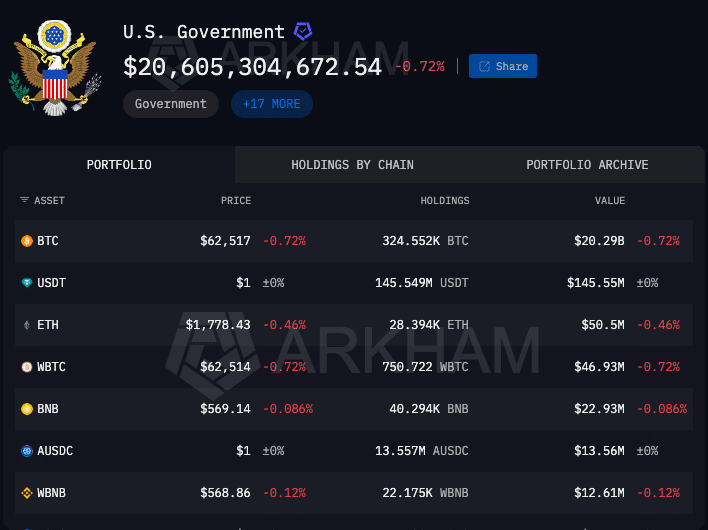
In essence, this week’s transfer is a small fraction compared to the overall portfolio. In fact the assets that were moved amount to less than a rounding error in percentage terms.
Still, markets are always keeping a close eye on US Government Bitcoin Holdings because it has been shown that big transactions involving sovereigns can have a big impact on short-term market sentiment
For traders already dealing with a fragile market environment, the details of where these coins end up may be almost as important as the fact that they were moved at all
Conclusion
The US government Bitcoin holdings is still one of the largest sovereign crypto reserves in the world even if this week’s $288 million transfer to Coinbase Prime has stirred controversy.
The routing patterns involving the Farace and BTC-e seizures, alongside the direct Ethereum transfer from the Krewson case, suggest preparation for custody management or potential asset restructuring rather than immediate liquidation.
Until there is further clarification from agencies, the market will keep treating government wallet activity as an important signal for overall crypto sentiment.
Glossary
Coinbase Prime: Coinbase’s institutional platform for handling custody, financing and trading for their biggest clients.
Strategic Bitcoin Reserve: The US government’s reserve of forfeited Bitcoin which is kept under an Executive Order that was signed in 2025.
Cold Wallet: A secure crypto wallet that stays offline to avoid getting hacked.
Asset Forfeiture: The legal seizure of property connected to criminal activity.
On-Chain Data: Transaction data that gets stored right on a blockchain network.
Frequently Asked Questions About US Government Bitcoin Holdings
Did The US Government Sell The Bitcoin?
No sale has been confirmed, just some of the Bitcoin got moved to Coinbase Prime addresses
Why Is Coinbase Prime Important?
Coinbase Prime provides services including secure custody of clients’ crypto and even financing options
How Much Crypto Does The US Government Still Hold?
Government wallets are still holding about $20.65 billion in digital assets.
Does The Strategic Bitcoin Reserve Prevent Sales?
According to the executive order signed in 2025, the reserve is supposed to be in place to prevent the sale of any Bitcoin placed in it except in very specific circumstances.