

Crypto market outlook enters one of its most closely watched weeks of 2026 as monetary policy, economic data and crypto regulation converge over the next several days. Bitcoin is trading near $60k, down roughly 30% year to date and more than 50% below its October record, leaving market participants focused on developments that could influence liquidity and investor sentiment.
- How does the crypto market outlook define this week’s key themes?
- Why is Kevin Warsh’s testimony the week’s biggest market event?
- Can inflation data change expectations for digital assets?
- Why is the CLARITY Act approaching a decisive moment?
- What does the GENIUS Act deadline mean for the stablecoin market?
- What will bank earnings reveal about institutional crypto activity?
- Can WebX Tokyo provide a different signal for the industry?
- Conclusion
- Glossary
- Frequently Asked Questions About Crypto Market Outlook
Between July 13 and July 19, Federal Reserve Chair Kevin Warsh’s congressional testimony, June inflation reports, major U.S. bank earnings and key legislative milestones will unfold within the same week. Rather than relying on a single catalyst, investors are assessing how these events may interact, with outcomes likely to shape both near-term price action and expectations for the broader digital asset market.
How does the crypto market outlook define this week’s key themes?
The crypto market outlook is centered on two questions. The first is whether the Federal Reserve reinforces expectations that interest rates will remain restrictive. The second is whether lawmakers can advance the CLARITY Act before Congress heads into its August recess.
Both issues carry significant implications for digital assets. Bitcoin and other cryptocurrencies have remained under pressure throughout 2026 as tighter financial conditions reduced demand for liquidity-sensitive assets. At the same time, the industry continues to wait for a clearer regulatory framework in the United States, making legislative developments almost as important as macroeconomic data.
Why is Kevin Warsh’s testimony the week’s biggest market event?
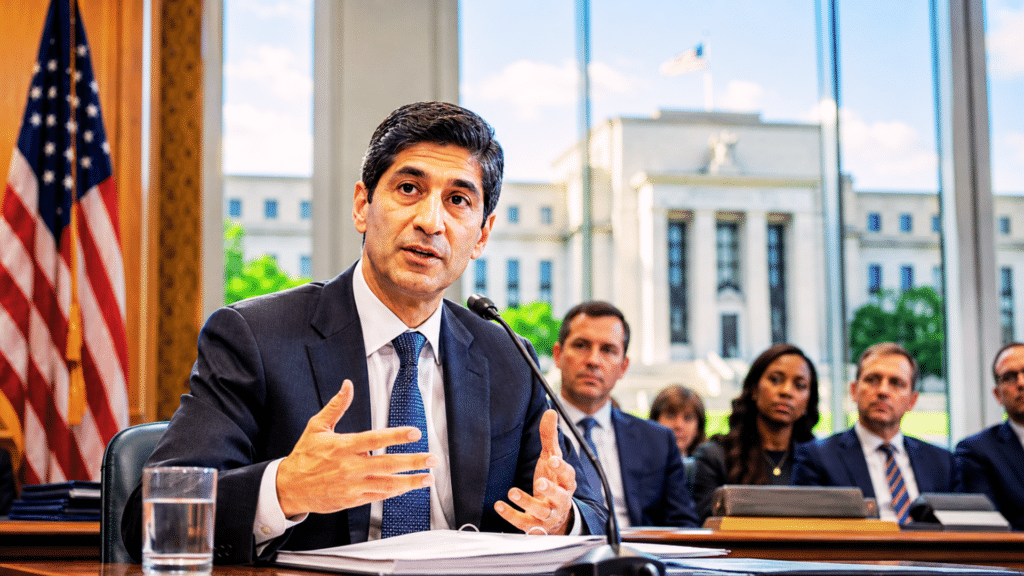
Federal Reserve Chair Kevin Warsh will testify before the House Financial Services Committee on Tuesday and the Senate Banking Committee on Wednesday at 10 a.m. ET, marking his first semiannual appearance before Congress since becoming Fed chair in May. Markets are watching closely because his first Federal Open Market Committee meeting in June significantly changed expectations for the rest of the year.
The Federal Reserve left interest rates unchanged, removed forward guidance and shifted its dot plot toward the possibility of future rate increases. That combination effectively ended the market’s remaining expectations for interest-rate cuts in 2026 and contributed to renewed weakness in Bitcoin. Attention now turns to whether Warsh maintains that position or adopts a more balanced tone.
One possibility is that he leans further into his view that productivity gains driven by artificial intelligence could help cool inflation over time, supporting eventual policy easing if economic conditions improve. The alternative is a firmer emphasis on inflation risks. Core inflation remains near a three-year high of 4.2%, and stronger language around persistent price pressures could reinforce the view that interest rates may need to stay elevated for longer.
The hearings are also expected to include crypto-specific discussions. Senator Elizabeth Warren is likely to question Warsh regarding his personal digital asset holdings and his previous criticism of a U.S. central bank digital currency, adding another layer of attention for the industry.
Can inflation data change expectations for digital assets?
The week’s economic calendar has the potential to reshape expectations ahead of the Federal Reserve’s next policy meeting on July 28-29. June Consumer Price Index and Producer Price Index reports headline the schedule alongside retail sales, the Empire State Manufacturing Survey, the Philadelphia Fed Manufacturing Index and, the Federal Reserve’s Beige Book.
For cryptocurrencies, the impact is closely tied to interest-rate expectations. If inflation remains stronger than expected, it would reinforce the higher-for-longer policy narrative and could keep pressure on liquidity-sensitive assets such as Bitcoin. If inflation moderates and retail sales show signs of slowing following June’s softer employment data, markets may begin pricing in a greater likelihood that the Federal Reserve’s next move is to hold rates rather than consider another increase.
Such an outcome could improve sentiment across risk assets. consecutive weekly gains.Broader macro developments are also contributing to uncertainty. Rising tensions between the United States and Iran have pushed oil prices higher, increasing inflation concerns, while U.S. equities have continued to perform strongly, with the S&P 500 approaching record levels and both the S&P 500 and Nasdaq posting consecutive weekly gains.
Several Federal Reserve officials, including Christopher Waller, Austan Goolsbee, John Williams, Lorie Logan and Philip Jefferson, are also scheduled to deliver public remarks during the week, offering additional insight into policymakers’ views on inflation and economic conditions.
Why is the CLARITY Act approaching a decisive moment?
The crypto market outlook also depends on whether Congress can maintain momentum behind the CLARITY Act before lawmakers leave Washington for the August recess. A merged version of the legislation, combining proposals from the Senate Banking Committee and Senate Agriculture Committee, is expected during the week. Senate floor consideration is targeted for the week of July 20, leaving a limited period for lawmakers to reach agreement before the August 8 recess begins.
Several issues remain unresolved, including an ethics dispute involving government officials’ crypto holdings, debate surrounding Section 604 on developer protections and concerns over federal and state regulatory authority. Senator Elizabeth Warren has also argued that parts of the proposal could increase sanctions-related risks, highlighting the continuing differences between supporters and critics.
The legislative timetable adds another layer of uncertainty. This week is widely viewed as the final realistic opportunity to align the bill before the recess. If lawmakers fail to advance the reconciled draft during this window, the legislation could slip until late Q3 or after the midterm elections, extending the industry’s period of regulation-by-enforcement. Even if the Senate advances the bill, lawmakers must still reconcile it with the House version which passed in July 2025 by a 294-134 vote, before it can move to the president’s desk.
What does the GENIUS Act deadline mean for the stablecoin market?
Another development drawing attention is the July 18 rulemaking deadline under the GENIUS Act, the federal stablecoin law. Several agencies, including the Federal Reserve are still expected to finalize parts of the regulatory framework covering reserves, disclosures and bank participation. The outcome matters because the stablecoin market is now worth more than $300 billion.
Any clarity around reserve standards and operating requirements could influence issuers seeking a regulated pathway in the United States. However, the market is also watching for the opposite outcome. Delays in rulemaking or unexpected regulatory requirements could create additional uncertainty for issuers and the exchanges that rely on stablecoins for trading activity. While the legislation provides a legal framework, the implementation details will determine how competitive the market becomes over time.
What will bank earnings reveal about institutional crypto activity?
Second-quarter earnings from the largest U.S. financial institutions will provide another important signal, not because of traditional banking performance alone but because of what executives say about digital assets. JPMorgan Chase, Bank of America, Citigroup, Wells Fargo and Goldman Sachs are scheduled to report on Tuesday, followed by Morgan Stanley and BlackRock on Wednesday.
Crypto investors are expected to focus on two institutional indicators. The first is ETF flow sentiment. BlackRock’s executive commentary is likely to serve as a key measure of demand for spot Bitcoin and Ethereum exchange-traded funds after capital inflows cooled during the recent market decline. Any indication that institutional demand is stabilizing or weakening could influence broader market sentiment.
Investors will also monitor updates from JPMorgan on its tokenized fund framework and Goldman Sachs on the expansion of its digital asset initiatives. Continued investment in blockchain infrastructure would suggest institutions remain focused on long-term development despite weaker cryptocurrency prices. Limited updates or a more cautious tone, however, could reinforce concerns that institutional activity is slowing alongside the broader market.
Can WebX Tokyo provide a different signal for the industry?
While most attention remains on Washington, Asia will also contribute to this week’s crypto calendar. WebX 2026 takes place in Tokyo on July 13 and 14, bringing together companies, investors, developers and policymakers to discuss tokenization, decentralized finance, stablecoins and institutional adoption. The conference comes as many market participants view Asia as an increasingly important region for blockchain innovation.

With Binance continuing to expand across parts of Asia while regulatory conditions remain challenging elsewhere, announcements involving partnerships or new products could provide a counterbalance to the cautious sentiment surrounding U.S. macroeconomic developments. Even so, WebX is expected to remain a secondary market catalyst. Any announcements from Tokyo are likely to complement rather than outweigh, the influence of Federal Reserve policy and U.S. legislative developments.
Conclusion
Crypto market outlook now depends on how these macroeconomic and regulatory events unfold together rather than on any single headline. Bitcoin remains near $60k, reflecting a market that is down roughly 30% this year and still more than 50% below its October record. That backdrop leaves little room for disappointment as investors assess whether policy signals improve or worsen market conditions.
A dovish shift in Warsh’s testimony, softer inflation readings or meaningful progress on the CLARITY Act could provide the relief that some market participants have been anticipating. Conversely, a hawkish policy stance, stronger inflation data or stalled legislation would likely reinforce the cautious mood that has defined much of 2026.
With the GENIUS Act deadline approaching, institutional commentary from major financial firms and legislative developments unfolding alongside key economic data, the crypto market outlook is expected to remain highly sensitive to confirmed policy signals. The coming days may not determine the year’s final direction, but they are likely to shape expectations for liquidity, regulation and institutional participation well beyond this week.
Glossary
Federal Reserve: The U.S. central bank that sets monetary policy.
Kevin Warsh: Federal Reserve Chair whose remarks can influence financial markets.
CPI: Consumer Price Index, a key measure of inflation.
PPI: Producer Price Index, which measures producer inflation.
WebX Tokyo: A leading Asian Web3 event focused on blockchain and digital assets.
Frequently Asked Questions About Crypto Market Outlook
Why is Kevin Warsh’s testimony important for crypto?
Kevin Warsh’s comments may influence interest rate expectations, which can affect Bitcoin and other cryptocurrencies.
How can inflation data affect Bitcoin?
Higher inflation may put pressure on Bitcoin while lower inflation could improve market confidence.
Why do bank earnings matter for the crypto market?
Bank earnings can show how institutional investors view financial markets and digital assets.
What could move Bitcoin this week?
Federal Reserve policy, inflation data, crypto regulation, and bank earnings could all move Bitcoin this week.
Why should crypto investors follow this week’s events?
These events could shape market sentiment and influence the short-term direction of Bitcoin and altcoins.