
Crypto wallet transfer has become significantly more user-friendly in 2026, but it still demands careful attention at every stage. As blockchain networks continue to expand across multiple ecosystems, users now have more flexibility when moving digital assets.
- What makes a crypto wallet transfer secure in 2026?
- How does the transfer process work from start to finish?
- Why is sending a test transaction considered the safest practice?
- Which wallet applications provide stronger transfer protection?
- What mistakes should users avoid before confirming a transaction?
- Why do security and compliance matter beyond the transaction itself?
- Conclusion
- Glossary
- Frequently Asked Questions About Crypto Wallet Transfer 2026
At the same time, choosing the wrong network, entering an incorrect wallet address, or overlooking transaction fees can still result in irreversible losses. Modern wallet applications have introduced smarter safety features to reduce these risks, yet secure transfers ultimately depend on careful verification and disciplined habits rather than technology alone.
What makes a crypto wallet transfer secure in 2026?
A crypto wallet transfer starts with a blockchain transaction that contains the recipient’s wallet address, the amount being sent, and the required network fee. The wallet signs the transaction using the sender’s private key before broadcasting it to the blockchain, where validators or miners confirm it and permanently record it on the distributed ledger.
Because blockchain transactions cannot be reversed after confirmation, every transfer requires careful review before approval. Unlike traditional payment systems, there is no mechanism to recover funds sent to an incorrect address or unsupported network.
How does the transfer process work from start to finish?
The safest way to move cryptocurrency begins long before pressing the send button. Users should first ensure they have a compatible wallet or exchange account with sufficient funds available, including enough of the blockchain’s native token to cover network fees. They should also confirm the recipient’s address, enable two-factor authentication, and verify that both wallets support the same blockchain network.
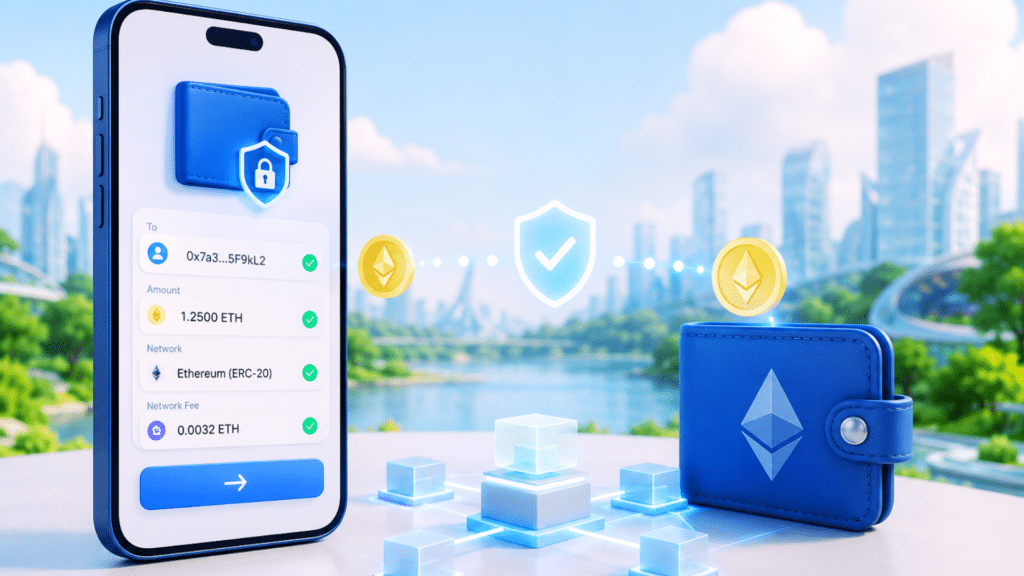
Once everything is prepared, the sender selects the cryptocurrency, chooses the matching network, pastes the recipient’s address, reviews the amount and transaction fee, completes authentication, and confirms the transaction. After submission, the transaction can be monitored through the appropriate blockchain explorer. Ethereum transfers can be tracked through Etherscan, Tron transactions through TRONSCAN, and Solana transactions through Solscan using the transaction hash or recipient address.
Why is sending a test transaction considered the safest practice?
Security professionals and experienced traders consistently recommend one habit above all others, which is sending a small test amount before transferring the full balance. Even sending $1 first allows users to verify that the destination wallet, blockchain network, and displayed balance are all correct.
Although this requires paying an additional network fee, the extra cost is generally minimal across most networks in 2026 compared with the financial impact of sending an entire balance incorrectly. Industry participants widely regard this simple precaution as one of the most effective ways to avoid permanent transfer mistakes.
Which wallet applications provide stronger transfer protection?
Several wallet providers have introduced features designed to reduce user error while improving transaction visibility. Trust Wallet now offers unlimited free USD1 and U transfers on BNB Smart Chain through its extended zero-fee carnival running until February 2026. The application also displays network selection clearly and warns users about known scam addresses before transactions are confirmed.
Brighty App combines traditional financial services with digital assets through an account that includes a stablecoin wallet linked to its own IBAN alongside a crypto vault offering up to 10% APY. The platform operates under a Swiss VQF license and publishes proof-of-reserves audits.
Bitget Wallet supports multiple blockchain networks, including TRC-20, BEP-20, and Arbitrum. Bitcoin withdrawals begin from 0.00001 BTC, while Tether withdrawals start from 0.001 USDT, depending on the selected network. Dynamic fee adjustments also help users avoid unnecessary transaction costs during periods of lower congestion.
MetaMask and Rabby have strengthened transaction safety through simulation technology that previews exactly which assets will leave and enter the wallet before users approve a transaction. Rabby additionally displays risk prompts designed to identify potentially malicious smart contract interactions.
For Solana users, Phantom delivers near-instant transaction finality while supporting embedded wallets created directly inside decentralized applications. Hardware wallets such as Ledger and OneKey continue to provide an additional security layer for large holdings, with OneKey supporting low-trace chains such as Hyperliquid for bulk USDT transfers. Users are advised to verify transaction details directly on the physical device rather than relying on blind signing.
What mistakes should users avoid before confirming a transaction?
Several common errors continue to account for most cryptocurrency transfer losses. Choosing the wrong blockchain remains one of the biggest risks. Stablecoins such as USDT are available on Ethereum, Tron, BNB Chain, Solana, and several other networks. Sending tokens across incompatible networks may permanently prevent recipients from accessing the funds.
Users are also encouraged never to type wallet addresses manually. Copying and pasting the address while checking both the first four and last four characters helps defend against clipboard malware that secretly replaces wallet addresses during the copying process.
Another essential step involves confirming sufficient funds for network fees. Ethereum transactions require ETH, Solana requires SOL, BNB Chain requires BNB, and Tron requires TRX to process transfers. Many wallets also provide different transaction speed options, allowing users to reduce costs when transfers are not time-sensitive.
Why do security and compliance matter beyond the transaction itself?
Protecting digital assets extends beyond sending cryptocurrency correctly. Maintaining two-factor authentication, avoiding public Wi-Fi during transfers, keeping wallet software updated, and safeguarding private keys all reduce exposure to cyber threats.
Private keys should never be shared because they provide complete control over wallet assets. Regulatory awareness also plays an increasingly important role in 2026. Many jurisdictions have strengthened Know Your Customer and Anti-Money Laundering requirements for larger cryptocurrency transactions.
Users transferring substantial amounts may also need to understand applicable reporting obligations and local tax rules before initiating transfers. As blockchain ecosystems continue evolving, staying informed about changing compliance requirements has become an essential part of responsible cryptocurrency management.
Conclusion
Crypto wallet transfer is safer today because wallet providers have introduced smarter security tools, clearer network detection, transaction simulation, and address verification features. Even so, technology cannot eliminate human error. The most reliable approach combines careful preparation with disciplined verification.
Confirm the blockchain network, review wallet addresses, maintain sufficient funds for transaction fees, and always perform a small test transfer before moving larger amounts. These practices help reduce unnecessary risks and support secure cryptocurrency transfers as blockchain technology continues to mature in 2026.
Glossary
Crypto Wallet Transfer: Moving crypto between wallets.
Wallet Address: A unique address for sending or receiving crypto.
Blockchain Explorer: A tool to track blockchain transactions
Transaction Hash (TXID): A unique ID for a blockchain transaction.
Two-Factor Authentication (2FA): An extra layer of account security.
Frequently Asked Questions About Crypto Wallet Transfer 2026
Is a crypto wallet transfer safe?
Yes, a crypto wallet transfer is safe if you use the correct wallet address, blockchain network, and security settings.
Can I cancel a crypto wallet transfer?
No, you usually cannot cancel a crypto wallet transfer after the blockchain confirms the transaction.
What happens if I send crypto to the wrong wallet address?
If you send crypto to the wrong wallet address, the funds are usually not recoverable.
How can I track my crypto wallet transfer?
You can track your crypto wallet transfer by entering the transaction hash (TXID) into a blockchain explorer.
Why is choosing the correct blockchain network important?
Choosing the correct blockchain network helps ensure your cryptocurrency reaches the right wallet safely.