



This article was first published on Deythere.
- Fresh US-Iran Escalation Sends Oil Through The Roof
- Bitcoin Holds Strong at Critical Support Levels
- ETF Demand Helps Wash Away Macro Pressure
- Can Bitcoin Continue Ignoring Global Risks?
- Conclusion
- Glossary
- Frequently Asked Questions About Bitcoin Price
- Why is Bitcoin price still holding steady despite the US-Iran conflict?
- What price range is Bitcoin trading in right now?
- How do oil prices affect Bitcoin?
- Are Bitcoin ETFs seeing inflows again?
- References
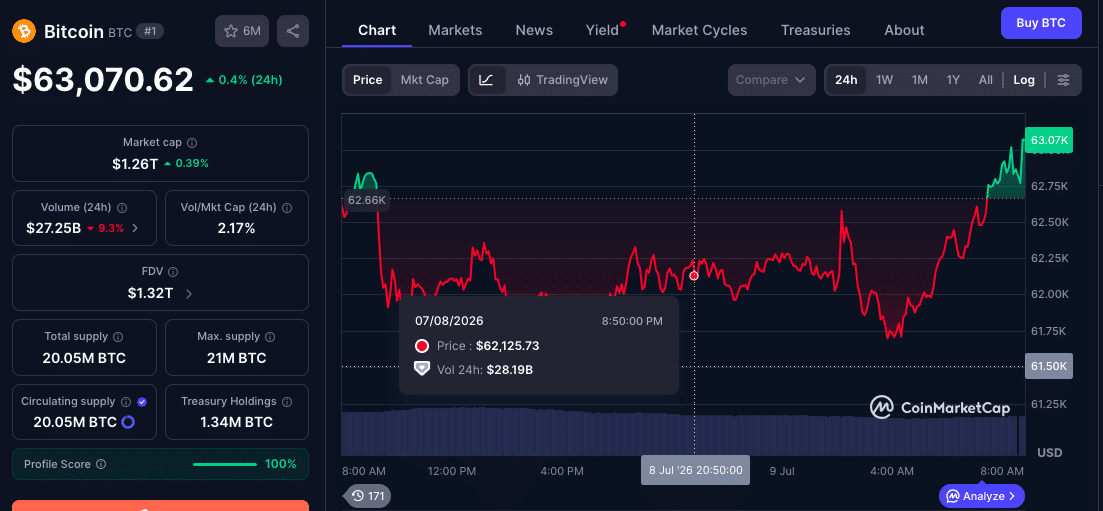
Bitcoin Price currently hangs on tight as geopolitical tensions heat up again. Despite fresh US military strikes against Iran and growing worries over disrupted energy supplies, Bitcoin stays stubbornly close to the $62,500 – $63,000 mark, and not showing much in terms of volatility.
As at press time, Bitcoin price hovers around the $63,000 mark, maintaining a tight trading range even as investors rush towards traditional safe havens such as gold and crude oil prices shot up. Trading volumes stayed healthy, with over $26 billion changing hands in the previous 24 hours, according to market data.
Fresh US-Iran Escalation Sends Oil Through The Roof
The latest dose of market instability kicked in after President Donald Trump declared the fragile ceasefire with Iran was over which led to a new round of US military strikes on Iranian facilities and military infrastructure.
Reports suggested that American forces targeted dozens of Iranian military sites, and that included missile facilities, drone infrastructure and air defense systems. Iran subsequently responded with attacks on US linked targets in the Gulf region, which brought back fears of wider regional conflict.
Financial markets reacted in an instant. Oil prices for Brent crude shot up to almost $79 a barrel while US crude approached $74, as traders started pricing in the possibility of disruptions through the Strait of Hormuz. Nearly 20% of the world’s oil and liquefied natural gas shipments normally go through this place.
Meanwhile, all the major stock indices slipped and investors started rotating back into gold and government bonds. Normally, under these circumstances, one would expect risk-sensitive assets such as cryptocurrencies to take a much bigger hit. Instead, Bitcoin price barely moved.

Bitcoin Holds Strong at Critical Support Levels
Bitcoin price dipped briefly after the latest headlines but it quickly leveled out at around $62,500.
Over the course of the previous 24 hours, BTC was trading in a tight corridor between around $61,500 and $63,000. Some exchanges recorded temporary moves towards $62,038, but then buyers stepped back into the market.
Ethereum and several large cap altcoins followed Bitcoin’s behavior, avoiding the aggressive liquidation events that was seen during earlier geopolitical shocks in 2025 and early 2026.
The crypto market capitalization held up reasonably at around $2.3 trillion despite all the uncertainty seen in traditional financial markets.
This growing resilience is forcing some institutional investors to take a new look at how they view digital assets during periods of geopolitical instability.
While Bitcoin is still behaving like a risk asset in major liquidity events, the recent results do suggest that its investors are treating it as a macro hedge.
ETF Demand Helps Wash Away Macro Pressure
Another factor giving Bitcoin price a helping hand has been the return of institutional demand through spot exchange-traded funds.
Just a few weeks ago, Bitcoin ETFs saw their longest withdrawal streak since they first got launched in early 2024. However, that trend has started to improve.
US spot Bitcoin ETFs pulled in $265.69 million last week, the biggest single-day inflow in over a month. BlackRock’s IBIT alone accounted for $209.4 million of that while other funds like ARKB and Grayscale’s mini Bitcoin fund also saw positive trading.
Yet, despite that inflow of capital, it has not completely erased the overall weakness.
Bitcoin ETFs still experienced net weekly withdrawals of approximately $526.6 million over the previous reporting period, an eighth straight week of outflows in fact.
Still, the return of buyers has managed to mitigate the impact of the latest Middle East developments on Bitcoin. Without the ETFs to back it up, a lot of analysts think that could have been much worse.
Can Bitcoin Continue Ignoring Global Risks?
Investors are now asking themselves whether this resilience will last. Market watchers are warning that a prolonged conflict could eventually create conditions that become just too much for risk assets to ignore.
A big surge in oil prices, for instance, would likely push inflation expectations up, forcing central banks to keep interest rates high for longer.
Supply chain disruptions could also start to dampen global growth and reduce investor appetite for volatile assets like Bitcoin.
But recent market behavior is giving the hope that Bitcoin is entering a new phase of maturity.
When the US-Iran ceasefire agreement was announced in June, Bitcoin price rallied all the way to $65,500, as oil prices fell and investor sentiment improved.
The fact that BTC is now holding relatively firm despite the reversal in geopolitical conditions indicates stronger demand than earlier in the year.
For now, traders seem happy to treat the $61,500 to $63,000 range as the market’s sweet spot, at least, for the short term.
Conclusion
Bitcoin price action is reacting differently from what is going on in traditional markets.
Oil prices are going up, equities are struggling and geopolitical uncertainty has returned to the Middle East but Bitcoin is still trading quietly near $63,000 with strong liquidity and modest volatility.
The situation could change fast if energy markets get worse or the conflict spreads. Until then, Bitcoin’s ability to take a beating from geopolitics without breaking down may become very important in the second half of 2026.
Glossary
Bitcoin ETF: An exchange traded fund that one invest in Bitcoin in a regulated way.
Strait of Hormuz: A key shipping route that a lot of the world’s oil supplies go through.
Risk Asset: An investment whose value is sensitive to economic growth and investor sentiment.
Safe-Haven Asset: Assets like gold or government bonds that investors buy during uncertainty.
Market Capitalization: The total combined value of all the Bitcoin in circulation.
Frequently Asked Questions About Bitcoin Price
Why is Bitcoin price still holding steady despite the US-Iran conflict?
ETF inflows and improving institutional demand have helped offset geopolitical fears and push prices.
What price range is Bitcoin trading in right now?
Bitcoin has been trading between $61,500 and $63,000 over the last 24 hours.
How do oil prices affect Bitcoin?
Higher oil prices tend to increase inflation expectations and reduce appetite for risk assets like cryptocurrencies.
Are Bitcoin ETFs seeing inflows again?
Yes, they are. US spot Bitcoin ETFs recently recorded $265.69 million in daily inflows after weeks of outflows.