
This article was first published on Deythere.
- Solana’s Tokenized Economy Is Moving Faster Than Expected
- xStocks Introduced a New Type of User
- Institutions Are Still Building the Foundation
- Ethereum Still Leads But Solana’s Taking a Different Approach
- Conclusion
- Glossary
- Frequently Asked Questions About Solana RWA Growth
- What is Solana’s current RWA transfer volume?
- How much did Solana’s RWA transfer volume actually grow?
- How many RWA holders are on Solana right now?
- What is the biggest RWA product on Solana?
- Why is transfer volume such a big deal for RWAs?
- References
For years, the crypto industry measured the adoption of real-world assets by the amount of value that was sitting on-chain. But now, Solana’s latest numbers suggest that this might be changing.
Solana RWA Growth took off in early July after transfer volume of tokenized assets jumped to $8.68 billion over the course of 30 days, a massive 105.76% increase from the month before.
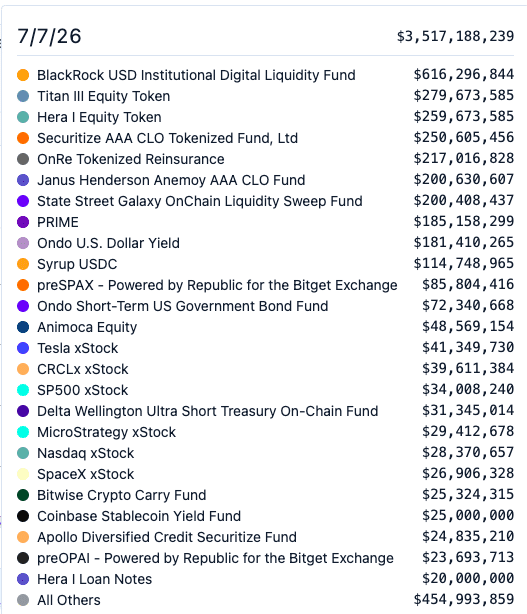
Additionally, the total value of the assets being held on Solana rose 36.27% to $3.48 billion, according to the latest data from RWA.xyz, published on July 6.
The fact remains that issuing tokenized assets can push a blockchain’s asset value but transfer activity is what really shows whether investors, institutions and platforms are actually using those assets to trade, use as collateral, lend or settle.
In Solana’s case, the answer seems to be a resounding yes.
Solana’s Tokenized Economy Is Moving Faster Than Expected
The latest surge in activity followed an explosive second quarter for tokenized markets on Solana.
Data from the network showed that the amount of trading on decentralized exchanges for tokenized assets went up from $2.69 billion in Q1 to $5.77 billion in Q2 which just happens to be a brand new quarterly record. Just one year ago, that market was almost non-existent.
The growth really became visible in June.
For the first time in Solana’s history, tokenized equities ended up generating more trading activity than meme coins on certain days. On June 24 alone, tokenized stock trading reached a new all-time high of $644 million. The final week of the quarter also recorded $1.42 billion in volume.
This is what many blockchain advocates have been arguing would eventually happen and is what they believe will eventually unlock real-world adoption.

xStocks Introduced a New Type of User
Some of the Solana RWA growth that has been seen came from a market segment that usually had very little overlap with crypto and that is the average retail equity trader.
The launch of tokenized xStocks on Solana back in 2025 introduced blockchain-based versions of popular U.S. equities and indexes through Backed Finance and these products linked to companies like Tesla and Nvidia. They quickly attracted traders looking to get exposure to familiar assets without having to leave the crypto infrastructure.
Unlike tokenized Treasury products which tend to just sit inside institutional portfolios, equity tokens tend to get traded around regularly. Investors buy and sell them, use them as collateral, swap between positions, and react to earnings announcements and market news which all generates more settlement and transfer activity.
Data from RWA.xyz showed that Solana’s ecosystem expanded to include 293,558 RWA holders, a rise of 7.83% over the course of 30 days, and across 2,119 tracked assets.
While holder growth wasn’t as big as transfer growth, it was still good to see that activity was going up alongside adoption, rather than just being driven by a few large wallets.
Institutions Are Still Building the Foundation
Retail participation may be driving the volume, but institutions remain responsible for most of the scale.
The largest tokenized asset still operating on Solana is BlackRock’s BUIDL fund which now holds $615 million in assets on the network. Ondo’s USDY is another big one, contributing another $181 million and Securitize-linked products account for almost $300 million in additional assets under management.
This institutional footprint just keeps on growing. Last week, Securitize, a tokenization firm made its debut on the New York Stock Exchange, and announced plans to make 15% of its average trading volume available on Solana.
The challenge however is, many institutional products operate with permissioned structures that have investor restrictions and compliance requirements.
Unlike tokenized equities market, these products don’t tend to get moved around a lot even if they hold big balances. That is why transfer volume has become a more meaningful metric than total value locked.
Academic research published this year reached a similar conclusion, warning that high asset values alone can hide liquidity concentration and low market activity in tokenized asset markets.
Ethereum Still Leads But Solana’s Taking a Different Approach
Ethereum remains the dominant blockchain for tokenized assets and institutional fund activity.
Large financial firms including BlackRock and JPMorgan initially built many of their tokenization experiments on Ethereum because of its regulatory familiarity and established infrastructure.
Solana is taking a different tack.
Its main selling point is that it has really low transaction fees, quick settlement times, and infrastructure that is geared up to handle high-frequency transfers rather than just passive ownership. That model becomes more attractive when assets are used for lending, collateral management, payments, and active trading rather than simple storage.
The network’s stablecoin ecosystem strengthens that advantage.
As of July 6, Solana was hosting $16.02B in stablecoin market capitalization alongside $541.34B in 30-day stablecoin transfer volume. That is the kind of liquidity that is needed to make trading and settlement flows work smoothly.
Conclusion
The recent surge is no guarantee of long term success.
Permissioned funds, private credit products and tokenized equities all have very different rules and restrictions in place which means that activity is still concentrated in a relatively small number of products.
The next phase will be a factor of whether tokenized assets start spreading into more lending, collateral and settlement markets.
Solana RWA Growth is now being measured by assets issued on-chain and how often those assets move.
Glossary
RWA: Real-World Assets represented as blockchain tokens.
Tokenization: The process of turning traditional assets into digital blockchain based representations.
BUIDL: BUIDL is BlackRock’s tokenized money market fund.
xStocks: Tokenized versions of traditional stocks issued on blockchain networks.
Settlement: The process of completing and recording a financial transaction.
Collateral: Assets pledged to secure loans or financial obligations.
Stablecoin: A cryptocurrency designed to maintain a stable value, usually pegged to fiat currency.
Frequently Asked Questions About Solana RWA Growth
What is Solana’s current RWA transfer volume?
Solana’s 30-day RWA transfer volume reached $8.68B as of July 6, 2026.
How much did Solana’s RWA transfer volume actually grow?
It shot up by 105.76% compared with the previous 30-day period.
How many RWA holders are on Solana right now?
About 293,558 holders across 2,119 tokenized assets.
What is the biggest RWA product on Solana?
BlackRock’s BUIDL fund is the largest tokenized asset on Solana with $615m in assets.
Why is transfer volume such a big deal for RWAs?
Because it actually measures trading, settlement, collateral, lending and all the rest rather than simply counting how many assets get issued on-chain.