

Bitcoin death calls are once again circulating across the crypto market as traders react to fading momentum and uneven sentiment. The narrative has returned during a phase where price action remains under pressure and liquidity trends appear mixed across major assets.
- Bitcoin death calls: Why does this narrative return in every cycle?
- Why sentiment is weakening in the current market phase?
- Are traders shifting away from Bitcoin during this phase?
- Why critics’ predictions often diverge from long-term performance?
- What does the market behavior indicate?
- Conclusion
- Glossary
- Frequently Asked Questions About Bitcoin Death Calls
Bitcoin continues to face short-term hesitation, even as its long-term history shows repeated recoveries after similar conditions. Market participants are now closely watching whether this cycle follows the same pattern or breaks from its historical rhythm.
Bitcoin death calls: Why does this narrative return in every cycle?
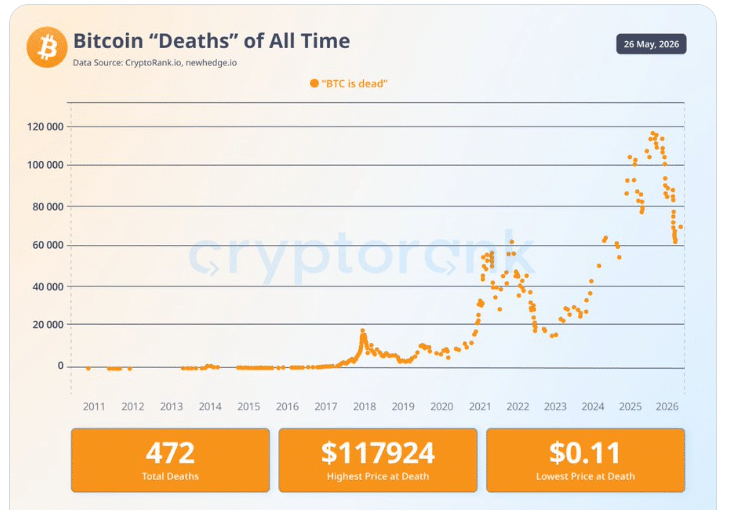
Bitcoin death calls have become a repeated theme across every major market phase marked by volatility and uncertainty. Over time, Bitcoin has been declared “dead” 472 times since 2011, covering periods from early valuations near $0.11 to highs above $117,000. During this entire period, Bitcoin has grown from around $0.11 to above $117,000, marking gains of over 70 million percent.

These declarations have consistently emerged during fear-driven phases, often when price corrections or sideways movement weaken market confidence. Despite this, Bitcoin has continued to operate through multiple cycles, showing that Bitcoin death calls tend to reflect sentiment shifts rather than structural failure. The recurrence highlights how emotional reactions often intensify during downturns.
Why sentiment is weakening in the current market phase?
Bitcoin death calls are resurfacing as traders respond to softer market conditions, lower trading volumes, and reduced overall participation across major assets. Price action has also struggled to hold higher levels after multiple failed attempts to sustain upward momentum. The broader market environment has leaned cautious, with weaker volumes and hesitant capital inflows shaping sentiment.
Overall market activity has remained subdued, with reduced volatility and cautious trading behavior dominating short-term flows. In such conditions, death calls tend to reappear as confidence weakens and short-term expectations turn defensive. The narrative gains visibility not because of structural breakdown, but due to slower movement and fading enthusiasm.
In May 2026, Bitcoin moved in a choppy range between roughly $75,000 and $82,000, with short-lived rallies repeatedly fading and pullbacks following each move higher. The pattern reinforced the broader sideways structure rather than a sustained trend.
Are traders shifting away from Bitcoin during this phase?
Bitcoin death calls are appearing alongside visible rotation into alternative crypto assets. Exchange data shows rising participation in smaller altcoins outside the top five crypto assets by market capitalization, Bitcoin [BTC], Ethereum [ETH], Solana [SOL], XRP, and Binance Coin [BNB]. This shift suggests that traders are not fully exiting the market but are instead reallocating capital into lower-cap assets.
Bitcoin death calls in this environment reflect hesitation, yet trading behavior indicates continued engagement rather than withdrawal. Broader market activity has stayed muted, with thinner volumes and cautious participation across major assets. Such phases often emerge when investors prepare for potential movement while waiting for clearer direction.
Why critics’ predictions often diverge from long-term performance?
Bitcoin death calls have consistently clashed with the asset’s long-term performance across multiple cycles. High-profile critics, including investors like Warren Buffett and economist Peter Schiff, have repeatedly issued negative outlooks on Bitcoin over the years.
These claims usually appear in uncertain phases, but death calls haven’t matched its long-term price trend. The asset has recovered through multiple downturns as market participation and integration have grown. Overall, this reflects extreme sentiment rather than real fundamentals.
What does the market behavior indicate?
Bitcoin death calls are increasing while price movement remains subdued and structurally intact. Market behavior suggests consolidation under pressure rather than collapse. Buyers have not reasserted decisive control and sellers continue to limit upside attempts.

Repeated failures to sustain higher levels imply Bitcoin is not deeply oversold but is trading below a neutral momentum threshold. Historical cycles indicate similar conditions have often preceded stabilization phases.
Conclusion
Bitcoin death calls continue to reappear whenever the market enters periods of hesitation and reduced confidence. The pattern shows how quickly sentiment shifts during downturns, even when long-term structures remain intact. In the current phase, they reflect cautious trading behavior, softer momentum, and selective capital rotation across assets.
They also highlight how fear-driven narratives tend to strengthen during consolidation phases. Ultimately, Bitcoin death calls once again underline the gap between short-term sentiment and long-term market resilience. But history shows that similar setups have usually led to consolidation and recovery, not prolonged breakdowns.
Glossary
Bitcoin Death Calls: Claims Bitcoin is “dead” during dips despite recovery.
Altcoin Rotation: Money moving from Bitcoin into smaller coins.
Liquidity: How easily an asset can be bought or sold.
Capital Inflow: New money entering the market.
Consolidation: Price moving sideways before a breakout.
Frequently Asked Questions About Bitcoin Death Calls
What was Bitcoin’s price range in May 2026?
Bitcoin mostly traded between about $75,000 and $82,000 during May 2026.
How many times has Bitcoin been called dead?
Bitcoin has been called “dead” around 472 times since 2011.
Why are altcoins rising during Bitcoin weakness?
Altcoins often gain attention when Bitcoin is moving slowly or trading sideways.
What does history say about Bitcoin death calls?
History shows that Bitcoin has survived every major “death call” phase and recovered.
Is Bitcoin currently in a strong trend?
Bitcoin is currently showing weak and sideways market movement without a clear trend.