
Ripple Labs has been expanding its institutional finance ambitions at a rapid pace in 2026. However, XRP’s price and sentiment have taken a hit, leaving a lot of traders feeling down.
New filings by Ripple reveal plans to offer all the classic financial tools but this time built on a blockchain: treasury management, prime brokerage, hedge fund services, and clearing.
Meanwhile, Ripple closed major deals (Hidden Road, GTreasury) and integrated with SWIFT’s messaging network, cementing its place in corporate treasury operations.
Despite all that, XRP’s market action hasn’t responded exactly as expected. Instead, retail traders are looking at big losses and the overall mood is quite bearish.
Retail Traders Brace for Losses
Recent data from blockchain analytics firm Santiment reports that wallets active over the past year are down about 41- 47% on average, levels not seen since late 2022.
Such a deeply negative Market-Value-to-Realized-Value (MVRV) ratio indicates “blood in the streets” conditions, where most short-term holders are underwater.
Crypto almost never trades higher until this wave of forced selling eases.
As reports point out, XRP’s 30 day MVRV has reached its lowest point since Dec 2020, meaning extreme trader capitulation.
To put this in context, social sentiment has also flipped. Santiment’s “bull to bear” ratio for XRP is currently at about 1.1:1. Speculative enthusiasm has gone away.
In a nutshell, most casual investors have given up all hope leaving only the most committed or long term holders in the game. The XRP market at the moment has all the conditions that typically precede short term sell-offs.
Crypto strategist Kevin Svenson says that this extreme bearishness can actually be an opportunity. When most short term holders are in pain, the chances of them selling and making the market go down even further are lower. However, Svenson also points out that sentiment is just one thing, fresh buying is needed to turn the market around
Derivatives Selling Meets Spot Absorption
There’s a big disconnect opening up between leverage markets and spot trading. On centralized exchanges, futures open interest exploded in late May.
Looking at the numbers from CryptoQuant, Binance and Bybit saw 25.6m and 54.0m new XRP futures positions added on May 22 and another 28.9m and 42.9m on May 26; that is over $200m in new futures positions.
Compared to the spot market, Centralized Spot CVD comes in at a positive $397M. Spot buyers are stepping in to absorb the futures selling. Notably, US spot XRP ETFs have seen a record inflow.
Data from SoSoValue shows that May 2026 inflows clocked in about $117 million, the strongest month of the year yet, extending a 13 day streak of ETF inflows alive. These funds have now pulled in over $1.12 Billion this year.
Analysis
Retail and futures traders are in retreat mode, but institutional finance and ETF demand remains strong. XRP’s current price weakness is being met with cash from investors with longer term prospects. In effect, Spot demand (ETFs, institutional buyers) is offsetting most of the selling that’s driven by derivatives. This creates a market mismatch, where momentum traders see a breakdown, while more patient investors see a buying opportunity.
Ripple’s Institutional Push
Meanwhile, Ripple itself is busy building out an institutional finance ecosystem. On May 26, Ripple filed two new US trademark applications, covering a bunch of traditional finance services. The filings specifically mention treasury management, prime brokerage, securities lending, hedge fund management, and even clearinghouse services. In other words, Ripple is moving on from payments to the core of Wall Street.
This goes in line with Ripple’s recent purchases. Late last year, Ripple completed a $1.25 billion acquisition of Hidden Road, rebranding it as Ripple Prime, the first crypto-run multi-asset prime broker.
Ripple Prime offers clearing, trading, financing and tokenized asset services to hedge funds and asset managers. At about the same time, Ripple secured GTreasury for $1 billion, integrating blockchain capabilities into the treasury management space.
Ripple has also integrated with SWIFT. After acquiring GTreasury, Ripple joined SWIFT’s Certified Partner Program. Its new Ripple Treasury platform (the old GTreasury system) can now handle SWIFT messaging, IBAN lookups and settle cross-border funds using XRP or a stablecoin.
Early trials, especially in Asia are suggesting that using XRP could cut cross-border costs by around 60% compared to SWIFT (yen transfers, etc.).
All in all, Ripple is building out its infrastructure. As of late 2025, it had built Ripple Prime (trading desk), Ripple Custody (institutional custody), Ripple Payments (On-Demand Liquidity service), and Ripple Treasury (after GTreasury acquisition). XRP and the stablecoin Ripple USD (RLUSD) are the internal liquidity rails between these different divisions.
Regulatory Clarity and Institutional Deals
Regulation has been slowly changing and moving into institutional finance over the past few months. The change came into focus in 2025 when the U.S. SEC finally wrapped up its litigation with Ripple, acknowledging that sales on secondary markets of XRP are not actually considered securities (Ripple ended up paying a $125M fine, however).
This has brought a lot of major firms back to the table, looking to do business with Ripple again. In April 2026, Ripple announced a major deal with Standard Chartered, a $200m credit facility for Ripple Prime and since then, Ripple Prime has reportedly closed over 10 smaller institutional deals to offer prime services.
The market’s response has been telling. Institutional interest in XRP is starting to pick up, even as the price of XRP doesn’t seem to budge. Meanwhile, XRP trading volume on institutional venues has jumped (CME futures have seen billions in notional value in their first year).
Outlook and Analysis
So what does all this mean for XRP?
The Bull case: If all these institutional finance projects start bearing fruit, then XRP could see a ‘multiple expansion’ over time. This has happened a couple of times before (in 2019 and 2024 when there was a big surge in ledger activity).
Proponents argue that if XRP can establish a strong base around current levels, then long-term targets of $7 – $8 could be achievable as more capital starts flowing in. Also, if ETF inflows and Wall Street engagement keep up, then XRP’s utility could get a whole new boost.
The Bear case: Right now, the market is quite subdued and the price action on XRP is currently sitting around $1.30 after failing to hold $1.50. Much of Ripple’s institutional finance partnerships moves are infrastructure growth rather than immediate price changes. Until real volume is seen, then the gap between the utility and the reality of retail traders is going to keep getting wider.
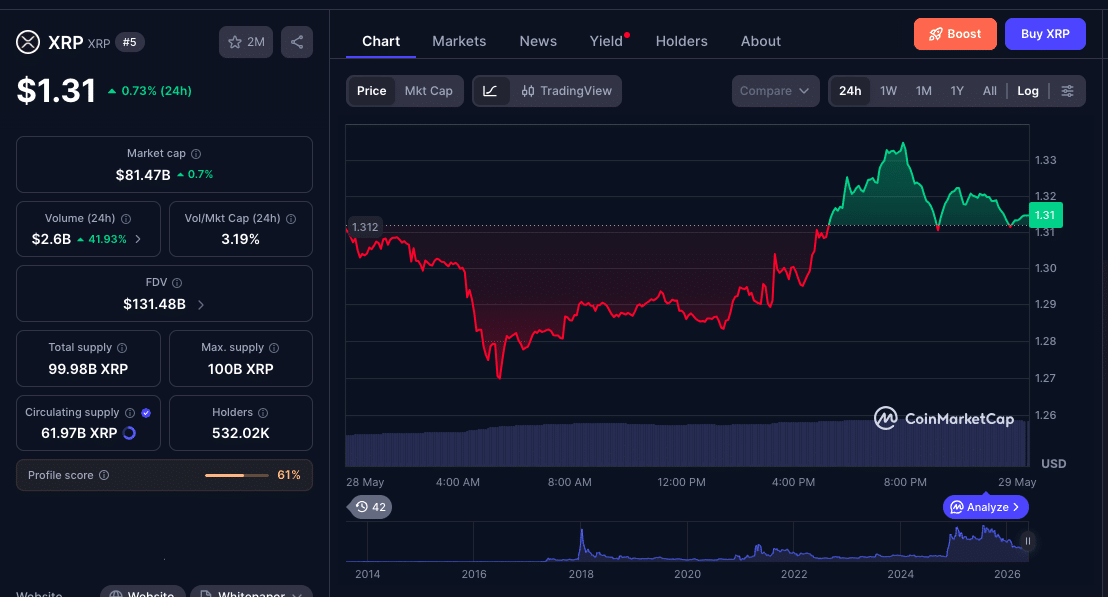
Most importantly, none of Ripple’s initiatives automatically guarantees an XRP price spike. Traders shorting XRP may stay cautious until they see actual evidence of on-chain usage translate into liquidity.
Data suggests that the selling pressure may be near exhaustion. Deeply negative MVRV, extreme pessimism, and stretched futures shorts historically point to a potential change.
If spot buyers (ETFs, institutions etc) keep on absorbing selling pressure, then the market might actually be heading into a protracted accumulation phase. However, if even those institutional flows start to wane, then XRP might just end up consolidating even lower until it sees some really clear signs of life.
Expert Strategist Alejandra Ramos notes that the institutional finance expansion is a ‘forward-looking catalyst’, meaning that it may take a while to start seeing the benefits. In the shorter term, XRP traders will be keeping an eye out for any decisive signs of buyer conviction such as a big breakout above resistance or a rapid decline in interest.
Conclusion
Ripple institutional finance trends are heading in one direction, but XRP’s near-term performance is going in a different one. Ripple’s push into treasury management, prime brokerage, and cross-border infrastructure creates a long-term adoption map for XRP.
However, in the short run, XRP traders are taking a cautious approach because prices have dropped and bearish sentiment is all over.
If institutional finance capital keeps absorbing selling, the current weakness might be a long-term accumulation opportunity; if not, XRP could just keep on sliding lower. Either way, Ripple’s expanding institutional ambitions are going to fine-tune XRP’s fundamentals for years to come, even if that doesn’t immediately translate into higher spot prices.
Glossary
Institutional Finance: Services and markets tailored for big organizations (banks, hedge funds, corporations).
Prime Brokerage: A service for institutions that includes custody, clearing, financing, and execution.
Exchange-Traded Fund (ETF): A fund traded on stock exchanges that holds assets like cryptocurrencies. XRP ETFs hold XRP and let investors get exposure to XRP on regulated markets.
Derivatives (Futures): Contracts whose value derives from an underlying asset.
Stablecoin (RLUSD): A cryptocurrency pegged to a fiat currency. RLUSD is Ripple’s U.S. dollar stablecoin, used internally in Ripple Prime and Ripple Treasury systems to provide liquidity.
Frequently Asked Questions About Ripple Institutional Finance and XRP price Clash
What institutional finance moves has Ripple made recently?
Ripple has been busy lately, launching several initiatives targeting institutional finance. In 2025 it acquired GTreasury (a treasury management software) and Hidden Road (a prime brokerage business), creating Ripple Prime. It also filed U.S. trademarks in May 2026 covering a range of services including treasury operations, prime brokerage, hedge fund management, and clearinghouse services. Ripple’s Treasury (derived from GTreasury) now integrates with SWIFT messaging, and Ripple also has some big name partnerships too like a $200M credit line from Standard Chartered for Ripple Prime.
Why are many XRP traders losing confidence?
XRP price has taken a hit, falling from its 2025 peak ($3.17) to around $1.30 in May 2026. According to on-chain data, the average recent XRP holder has lost around 40-47% which is the lowest MVRV since late 2022. This extreme pullback has really shaken up retail sentiment. Futures traders have also been shorting XRP (record negative CVD), implying most new leverage bets are pessimistic.
How are XRP exchange-traded funds (ETFs) performing?
XRP ETFs in the U.S. have seen some inflows in 2026. Data show that in May, XRP ETFs in the U.S. got about $117 million, which is one of the strongest monthly inflow totals, and also recorded a 13 day inflow streak. These funds have now collected over $1.12B year to date.
Does Ripple’s push into institutional finance mean XRP will rise soon?
Not necessarily anytime soon. Ripple’s moves into institutional finance (acquisitions, platform upgrades, partnerships) are building a foundation for long term adoption. However, the price is going to respond to supply and demand right now, and currently speculative demand is pretty weak.
References
Disclaimer: Crypto markets are highly volatile. This article is for informational purposes only and does not constitute financial advice. Past performance is not indicative of future results. Investors should perform their own due diligence and consider consulting a financial advisor.