

Bitcoin institutional adoption is taking on greater importance as the cryptocurrency’s expanding market size changes what it takes to fuel another strong rally. Bitcoin is currently trading around $63,000 after falling nearly 50% from the all-time high above $126,000 recorded last October. Analysis released by CryptoQuant argues that the market now needs substantially larger capital inflows to generate the kind of gains seen in earlier bull cycles.
- How is Bitcoin institutional adoption changing Bitcoin’s market structure?
- Why has Bitcoin’s capital efficiency declined?
- Why are ETF outflows creating challenges?
- Can broader institutional participation offset weaker ETF demand?
- What other factors are competing for institutional capital?
- What could determine Bitcoin’s next major rally?
- Conclusion
- Glossary
- Frequently Asked Questions About Bitcoin Institutional Adoption
The analysis indicates that Bitcoin’s growing market size has reduced its capital efficiency, meaning substantially larger capital inflows are now required to generate meaningful price appreciation. At the same time, weakening ETF flows and growing competition from other investment opportunities have raised questions about whether enough large investors will commit capital to support another major rally.
How is Bitcoin institutional adoption changing Bitcoin’s market structure?
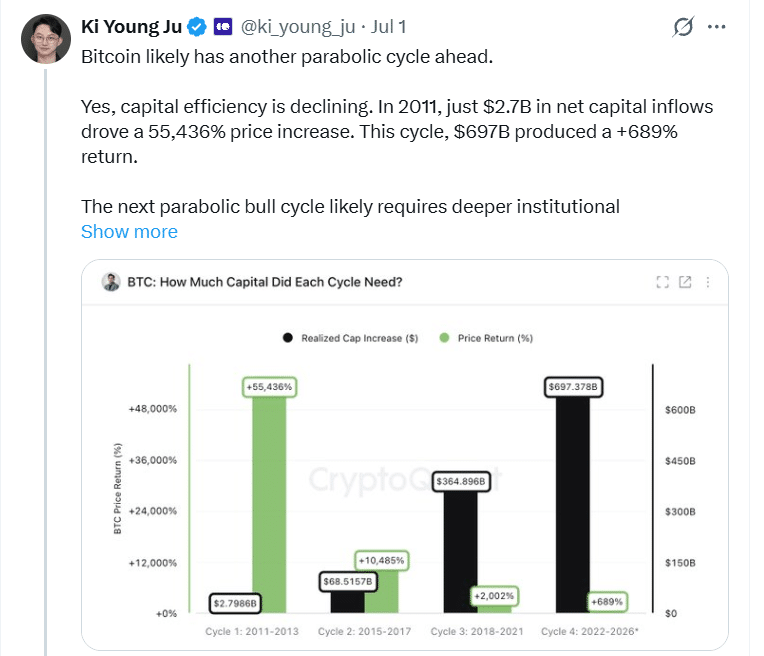
Bitcoin institutional adoption has become a central discussion because Bitcoin is no longer a relatively small market that can be moved by modest inflows. As the asset has matured its larger market size has changed the relationship between fresh capital entering the network and subsequent price gains. CryptoQuant Chief Executive Ki Young Ju explained that every bull cycle has required significantly more capital while delivering progressively smaller percentage returns.

His analysis uses Bitcoin’s realized capitalization, which values coins based on the price at which they last moved on-chain and is commonly used to estimate the amount of capital absorbed by the network. The analysis suggests that Bitcoin’s next cycle is increasingly tied to whether larger balance sheets are prepared to make recurring allocations rather than relying primarily on retail participation.
Why has Bitcoin’s capital efficiency declined?
The answer lies in Bitcoin’s expanding market size. Ju noted that during the 2011 market cycle roughly $2.7 billion in net capital inflows corresponded with a price increase of approximately 55,000%. In comparison, the current cycle has absorbed around $697 billion while producing gains of about 689%. He also pointed out that nearly $5 million in new capital was enough to double Bitcoin’s price in 2011.
During the current cycle, that figure has climbed to roughly $101 billion. Ju said another major rally remains possible if Bitcoin develops into a deeper macro allocation instead of depending mainly on retail-led ETF participation. He wrote that Bitcoin “needs to be a core macro asset,” while noting that such a shift has not been invalidated but remains in its early stages.
Why are ETF outflows creating challenges?
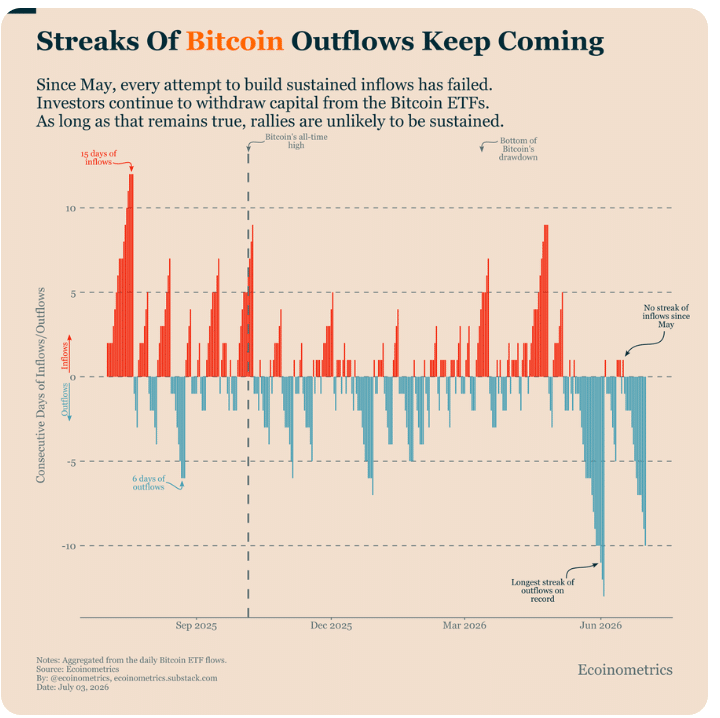
ETF demand has weakened at a time when broader institutional participation is becoming increasingly important. Santiment data shows that U.S. spot Bitcoin ETFs have recorded nearly $10 billion in outflows since early May, while the 12 spot ETF products have entered an eight-week outflow streak.
Commenting on those figures, Ecoinometrics said attempts to rebuild buying momentum have repeatedly stalled, with Bitcoin ETFs failing to sustain more than a single consecutive day of inflows before additional outflows followed. The research platform added that one positive trading session may lift prices temporarily, but durable rallies require sustained demand over several weeks.
Those observations relate specifically to ETF flow trends rather than serving as a broader conclusion about the overall market. The recent pattern suggests that ETF access by itself has not been enough to support another sustained move higher.
Can broader institutional participation offset weaker ETF demand?
The answer remains uncertain because institutional allocation typically follows a slower and more structured process than retail participation. This stage of Bitcoin institutional adoption depends on whether advisers, corporations, banks, insurers, asset managers and sovereign investors gradually expand their allocations.
These investors generally require liquidity, regulated custody, governance standards, portfolio mandates, compliance approvals and defined risk management before making long-term investment decisions. Coinbase’s January 2026 survey conducted with EY-Parthenon provides additional context. Among 351 institutional decision-makers, nearly three-quarters planned to increase crypto allocations while 74% expected crypto prices to rise over the following 12 months.
The survey also found that 49% had increased their focus on liquidity, risk management and position sizing. Meanwhile, 66% already held exposure through spot crypto ETFs or exchange-traded products, while 81% preferred accessing spot exposure through registered investment vehicles. The findings indicate that regulated investment vehicles remain important for institutional participation, although recent ETF weakness continues to be viewed as a pressure point for broader allocation.
What other factors are competing for institutional capital?
Bitcoin is now competing with a wider range of investment opportunities for the same pool of institutional capital. The analysis states that Bitcoin institutional adoption increasingly depends on attracting investors who are also evaluating artificial intelligence-linked assets, private infrastructure investments, credit products, commodities and other macro trades.
It also argues that Bitcoin has become large enough to enter mainstream portfolio allocation discussions. At the same time, that means it is increasingly judged alongside every other major use of capital rather than only against other digital assets. This competitive environment raises the threshold for attracting fresh institutional demand and makes future capital allocation decisions more complex.
What could determine Bitcoin’s next major rally?
Future price performance is expected to depend on a broader combination of demand sources rather than a single catalyst. Michael Saylor, Executive Chairman of Strategy, said Bitcoin’s long-term trajectory will increasingly be driven by capital flows across ETFs, corporate treasuries, sovereign reserves, bank credit, insurance markets, derivatives, structured credit and global savings rather than miner issuance alone.

His view reflects the broader argument that Bitcoin’s issuance schedule and halving cycle are already well understood. As a result, any future repricing would likely require demand channels capable of supporting a market valued at more than $1 trillion.
That process could involve advisers adding Bitcoin to model portfolios, companies expanding balance-sheet exposure, banks developing financial products around the asset, insurers and asset managers treating it as a macro allocation and sovereign entities considering long-term exposure. Even so the transition may develop more gradually than previous retail-driven cycles and remains exposed to regulatory delays, liquidity conditions and competition from other markets.
Conclusion
Bitcoin institutional adoption remains central to discussions about Bitcoin’s next market cycle, but the latest analysis presents a balanced outlook rather than a guaranteed path higher. Bitcoin’s larger market size means substantially greater capital is now required to generate meaningful price gains. While institutional investors continue to evaluate the asset through regulated investment vehicles, recent ETF outflows show that access alone has not produced sustained demand.
The next major rally may ultimately depend on whether advisers, corporations, banks, insurers, asset managers and sovereign investors allocate capital consistently while Bitcoin competes with AI-linked assets, private infrastructure deals, credit products, commodities and other macro investments for the same institutional capital pool.
Glossary
Bitcoin Institutional Adoption: Increased Bitcoin use by major financial institutions.
Capital Inflows: New investment entering the Bitcoin market.
Bitcoin ETF: A fund that gives investors Bitcoin exposure.
Realized Capitalization: Bitcoin’s value based on its last on-chain movement.
Spot Bitcoin ETF: A fund backed by actual Bitcoin holdings.
Portfolio Allocation: The portion of investments placed in Bitcoin.
Frequently Asked Questions About Bitcoin Institutional Adoption
Why does Bitcoin need more capital now?
Bitcoin is much larger than before, so it needs more money to move its price higher.
What did CryptoQuant say about Bitcoin?
CryptoQuant said Bitcoin now needs much more capital to achieve gains like past bull markets.
Why do institutions invest more slowly than retail investors?
Institutions usually follow strict rules, risk checks, and approval processes before investing.
What could drive Bitcoin’s next bull run?
Stronger institutional demand and steady capital inflows could help drive Bitcoin’s next bull run.
How do ETF outflows affect Bitcoin?
ETF outflows can reduce buying demand and make it harder for Bitcoin to rally.