



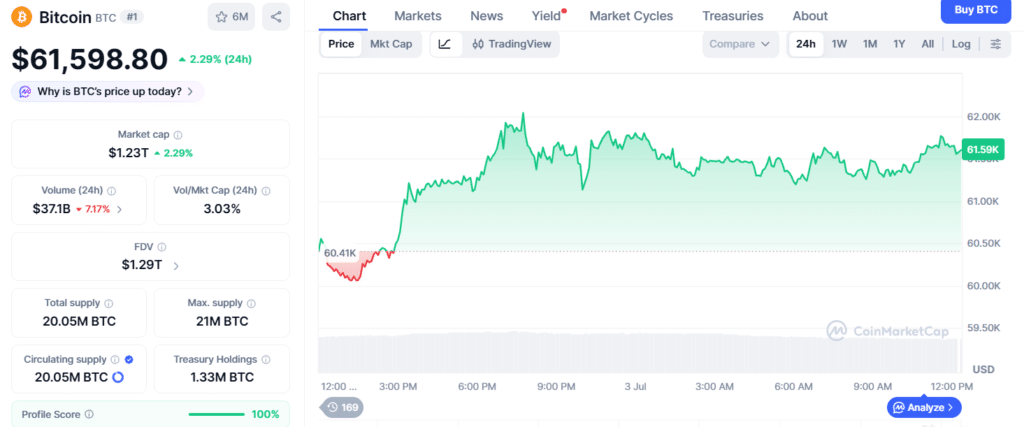
Bitcoin price outlook is drawing renewed attention after Bitcoin recovered from a sharp decline that briefly pushed it to its lowest level in 21 months. The asset is currently trading around $61,560.60, up 1.76% over the past 24 hours and 2.4% over the last week, following a rebound that came as markets reacted to comments surrounding persistent U.S. inflation.
- What does the Bitcoin price outlook reveal after the latest rebound?
- Why are analysts offering different views on Bitcoin’s direction?
- How are institutional flows shaping market sentiment?
- Why has SharpLink restarted its Ether accumulation?
- Which factors could decide Bitcoin’s next move?
- Conclusion
- Glossary
- Frequently Asked Questions About Bitcoin Price Outlook
While the recovery has improved short-term sentiment, analysts remain divided on whether Bitcoin is building momentum for a move toward $65,000 or simply staging a temporary relief rally before another leg lower. Bitcoin’s market capitalization stands at $1.23 trillion, while 24-hour trading volume is $37.34 billion, down 6.1%, with a volume-to-market cap ratio of 3.02%.
What does the Bitcoin price outlook reveal after the latest rebound?
The Bitcoin price outlook reflects a market attempting to recover while still facing significant uncertainty. Bitcoin briefly fell to $57,737, its lowest level in 21 months, before rebounding to around $61,560.60. Ether gained 3% during the same period, while Solana advanced 4.85%, indicating broader strength across major digital assets.
The recovery came after market participants assessed comments from Federal Reserve Chair Kevin Warsh on persistent inflation. Even so, traders remain cautious because rising Treasury yields and continued earnings strength in technology stocks offer investors attractive alternatives to non-yielding assets such as Bitcoin and other cryptocurrencies.
The U.S. five-year Treasury yield climbed to 4.22%, reflecting stronger demand for returns from government bonds. Although WTI crude oil prices have fallen to a four-month low and inflation is expected to moderate over time, investors continue to monitor monetary policy alongside Treasury debt issuance, both of which could influence liquidity across financial markets. As a result, the market remains undecided on whether the recent rebound marks the beginning of a broader recovery or simply a bull trap before another decline.
Why are analysts offering different views on Bitcoin’s direction?
The market remains divided because technical indicators supporting a recovery are competing with longer-term signals that still point to downside risks. Crypto analyst Michaël van de Poppe believes investors should avoid relying on consensus expectations. In a recent post, he wrote, “In 2029, we’ll look back and wish we’ve bought more Bitcoin at $69,000.”
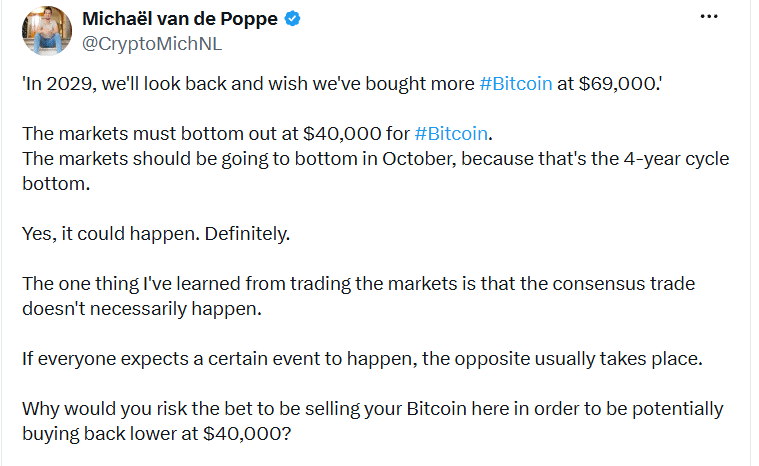
Van de Poppe argued that although many traders expect Bitcoin to revisit $40,000, markets often move against the majority view. He said several on-chain indicators are now showing conditions similar to previous bear market bottoms. He also noted that this market cycle has unfolded differently after Bitcoin reached a new all-time high before the halving and recorded a BTC-to-gold peak in December 2024 rather than alongside the BTC/USD bottom.
He added that several technical indicators point to a possible trend reversal and described buying Bitcoin at current levels as a compelling long-term opportunity. Van de Poppe also highlighted that Michael Saylor’s STRC recovered about 30% following the announcement of the Digital Credit Framework and said he does not expect another major decline.
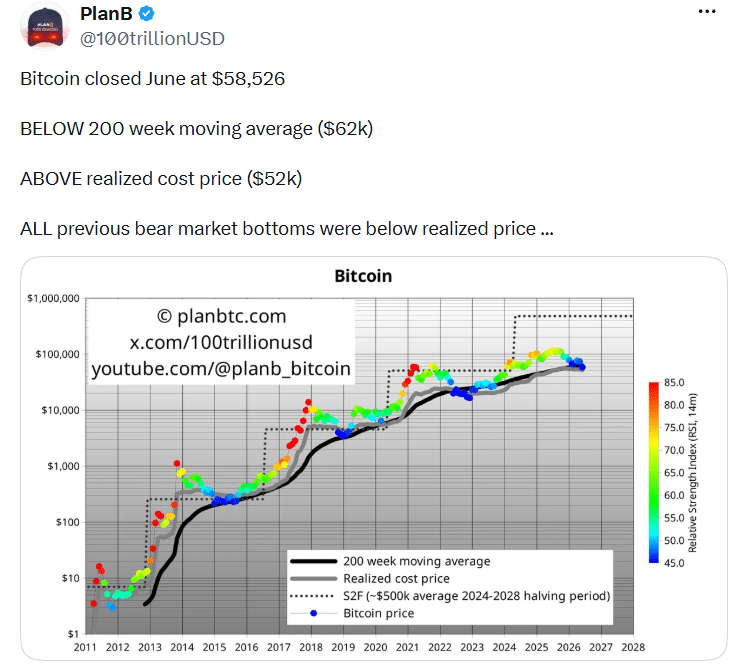
PlanB, however, believes the market may not have reached its final bottom. The analyst pointed out that Bitcoin closed June at $58,526, marking a 20.5% monthly decline, its weakest June performance since 2022. The monthly close remained below the 200-week moving average of $62,000 but above the realized price of $52,000. PlanB said previous bear market bottoms all formed below realized price and suggested Bitcoin could still fall toward $52,000 before completing the current cycle.
How are institutional flows shaping market sentiment?
Institutional activity continues to reinforce a cautious outlook despite Bitcoin’s rebound. Crypto sentiment indicators remain near 11 out of 100, placing the market in Extreme Fear territory. Bitcoin also remains roughly one-third below its level at the beginning of the year. The cautious positioning is reflected in investment products. U.S. spot Bitcoin exchange-traded funds recorded approximately $4.5 billion in net outflows during June, the largest monthly withdrawal since the ETFs were introduced.
Institutional data provider Talos reported that Bitcoin and Ether long liquidations totaled $8.35 billion during the second quarter of 2026. The firm said the deleveraging occurred alongside spot Bitcoin ETF outflows, reduced Bitcoin buying by Strategy and a contraction in stablecoin supply, all of which contributed to weaker market demand.
Talos noted that while lower leverage has reduced the risk of another chain reaction of forced liquidations heading into the third quarter, thinner order-book liquidity means the market may struggle to absorb large sell orders, leaving prices vulnerable to sharper swings. The Bitcoin price outlook therefore remains closely linked to whether institutional demand begins to recover in the weeks ahead.
Why has SharpLink restarted its Ether accumulation?
SharpLink has resumed expanding its Ether treasury after pausing direct purchases for eight months. On-chain data from Arkham shows the company acquired 5,000 ETH on June 25 before purchasing another 5,000 ETH on June 26, with the second transaction valued at approximately $8.5 million. The company confirmed the transactions, stating that it purchased a total of $16 million worth of Ether at an average price of $1,611 per ETH.
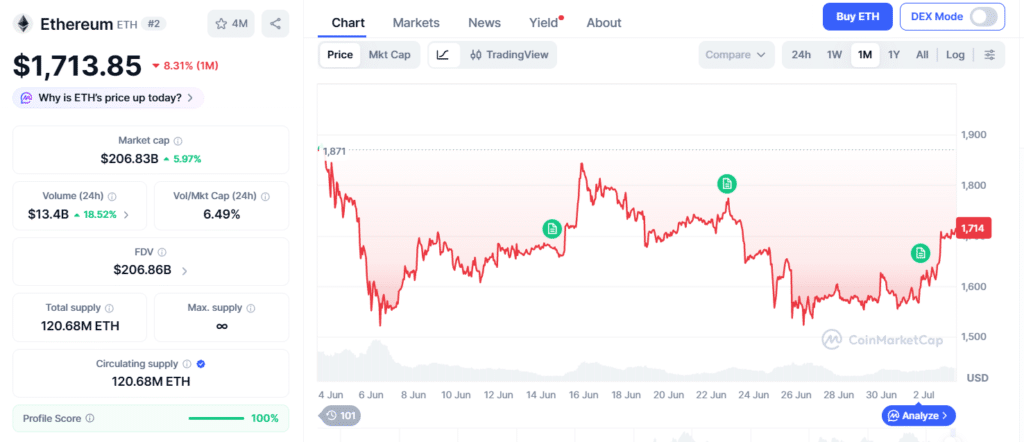
Following the latest acquisitions, SharpLink’s Ether treasury has increased to 866,725 ETH. The company said the purchases demonstrate its continued commitment to expanding its Ether holdings as a long-term reserve asset. The renewed buying suggests SharpLink has restarted its active accumulation strategy after relying primarily on existing holdings during the previous eight months, although it now trails Bitmine among the largest corporate Ether treasury holders.
Which factors could decide Bitcoin’s next move?
Several macroeconomic and market-specific developments are expected to influence Bitcoin in the near term. Treasury yields remain elevated, technology stocks continue attracting investment and uncertainty surrounding Federal Reserve policy persists. Those conditions may continue drawing capital toward traditional financial markets rather than non-yielding assets such as cryptocurrencies.

At the same time, lower leverage across the crypto market has reduced systemic risk after the second-quarter reset, although thinner liquidity means price volatility could remain elevated if selling pressure increases. The Bitcoin price outlook will therefore depend on whether improving technical signals can outweigh persistent institutional caution and macroeconomic headwinds.
Conclusion
Bitcoin price outlook remains balanced between a developing recovery and the possibility of renewed weakness. Supporters of the bullish case point to Bitcoin’s rebound from $57,737 reduced leverage following second-quarter liquidations and on-chain indicators that some analysts believe resemble previous market bottoms. Those factors have fueled expectations that Bitcoin could extend its recovery toward $65,000 if buying momentum continues.
The opposing view remains equally strong. Persistent Extreme Fear approximately $4.5 billion in June ETF outflows, Bitcoin’s monthly close below the 200-week moving average, and PlanB’s view that the market could still revisit $52,000 continue to weigh on sentiment. For now neither scenario has gained a decisive advantage. Bitcoin’s recovery has improved short-term confidence but traders remain divided over whether the move represents a bull trap or the beginning of a more durable recovery toward higher levels.
Glossary
Federal Reserve- The U.S. central bank that sets interest rate policy.
Treasury Yield- The interest earned on U.S. government bonds.
200-Week Moving Average- A long-term trend line used to track Bitcoin’s price direction.
Long Liquidation- The forced closure of buy positions after a price drop.
Market Capitalization- The total market value of all circulating Bitcoin.
Frequently Asked Questions About Bitcoin Price Outlook
Why did Bitcoin’s price increase?
Bitcoin’s price rose after investors reacted positively to recent Federal Reserve comments.
Why do some analysts expect Bitcoin to fall?
Some analysts think Bitcoin could fall because bearish market signals are still present.
What is making investors cautious?
High Treasury yields, ETF outflows, and weak market sentiment are making investors cautious.
What did PlanB predict for Bitcoin?
PlanB said Bitcoin could fall to around $52,000 before reaching a market bottom.
Why did SharpLink buy more Ether?
SharpLink bought more Ether to grow its long-term digital asset reserves.