



This article was first published on Deythere.
- BlackRock Continues to Dominate Ethereum ETF Demand
- Why the $1,800 Level Matters Beyond Technical Analysis
- Recovery is Encouraging, but Not Yet a Full Institutional Comeback
- What Analysts Expect Next for Ethereum Over the Coming Weeks
- Conclusion
- Glossary
- Frequently Asked Questions About Ethereum ETF
- Why are Ethereum ETF inflows important?
- Why is BlackRock’s ETHA leading the market?
- Has institutional demand fully returned?
- References
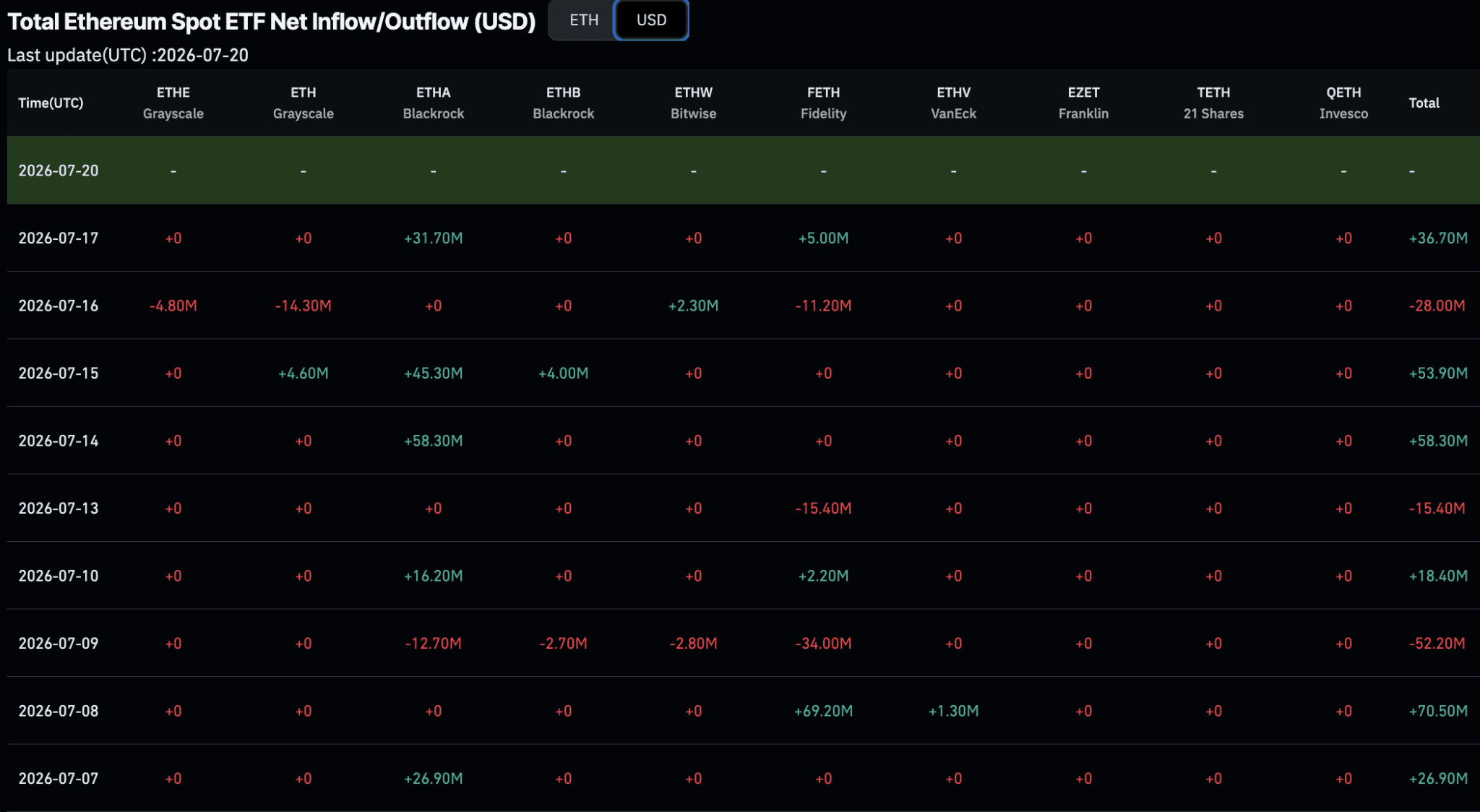
U.S. spot Ethereum ETFs attracted $105 million in net inflows during the just concluded week, their strongest weekly performance since April.
The gain follows the previous week’s $84 million inflow, ending an eight-week stretch of persistent redemptions, implying that investors may be cautiously rebuilding exposure to the second-largest cryptocurrency.
BlackRock’s iShares Ethereum Trust (ETHA) continues to account for the majority of positive flows across the spot Ethereum ETF market. While two consecutive weeks of inflows do not yet confirm a sustained trend reversal, it seems institutional investors have not abandoned Ethereum despite months of capital outflows.
BlackRock Continues to Dominate Ethereum ETF Demand
Institutional demand seems to have become more concentrated based on the latest ETF data.
BlackRock’s ETHA has consistently attracted most new capital entering the spot Ethereum ETF market, it being the benchmark product for traditional investors seeking ETH exposure. During the July 13-17 trading week, ETHA again contributed the bulk of industry inflows, helping lift total weekly net creations to approximately $105 million.
Since U.S. spot Ethereum ETFs launched in July 2024, cumulative net inflows have surpassed $11 billion, with BlackRock’s fund alone accounting for an even larger cumulative contribution due to persistent outflows from competing products.
Investors appear increasingly selective, favoring established asset managers with deep distribution networks over smaller competitors.
The concentration on this asset is both a strength and a vulnerability. Strong inflows into ETHA provide consistent buying pressure for Ethereum, but they also leave the ETF ecosystem heavily dependent on one product. Should ETHA’s momentum slow, industry-wide inflows could quickly fade.
Why the $1,800 Level Matters Beyond Technical Analysis
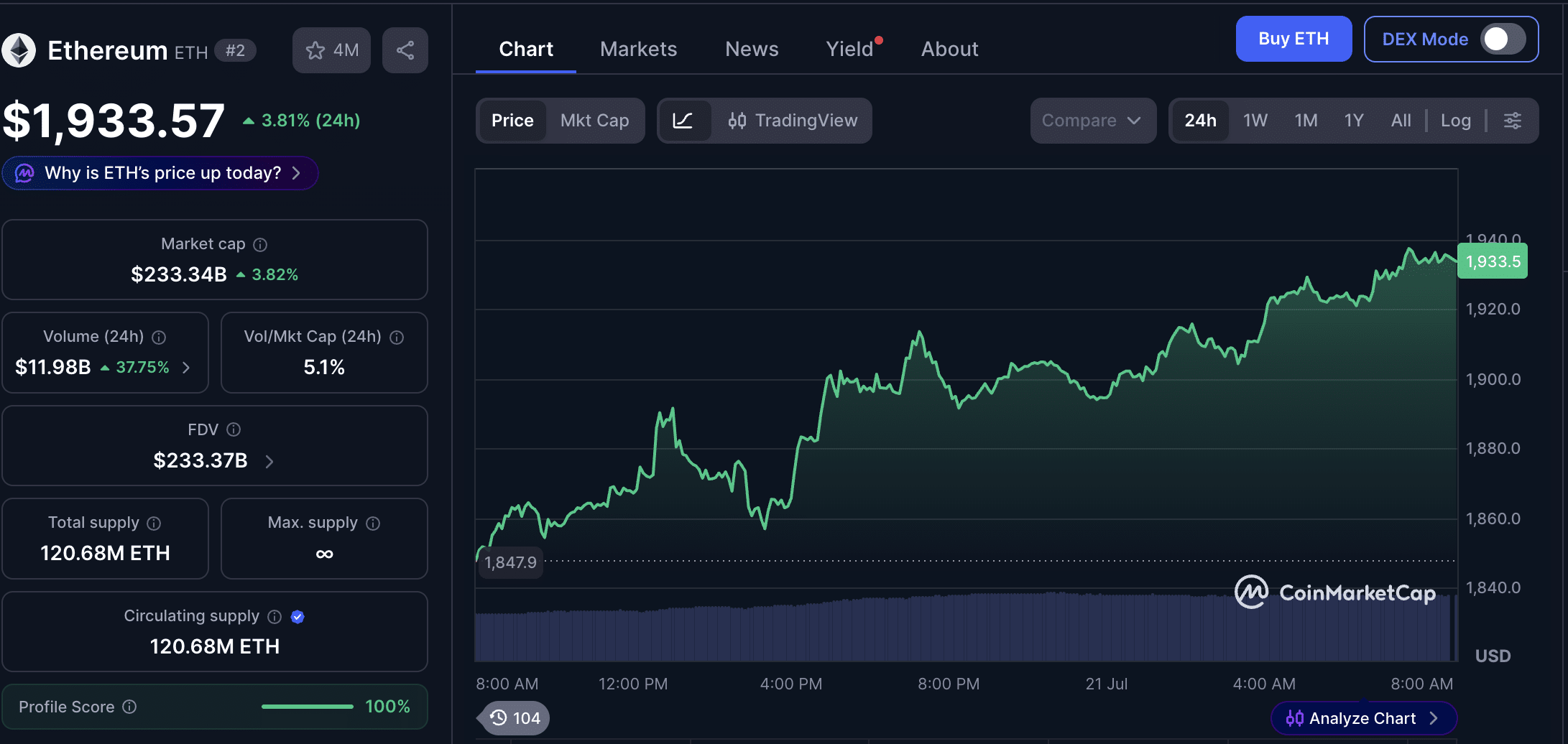
Ethereum traded around $1,845 during the reporting week, keeping the closely watched $1,800 support zone intact.
That level is no tagged important because ETF creations translate into real spot purchases. When new shares are issued, fund managers must acquire ETH, creating steady demand independent of short-term speculative trading.
This “mechanical bid” was mostly absent during the previous two months of ETF redemptions. Now, weekly inflows ranging from $80 million to $105 million are helping offset selling pressure and adding support near current prices.
Technically, maintaining the $1,800-$1,900 range keeps Ethereum within a constructive consolidation pattern. A move below that area would likely mean institutional buying has weakened or ETF flows have turned negative again. Conversely, continued positive creations could provide the foundation for another attempt at higher resistance levels.
Recent daily ETF data also tells that the recovery remains intact. On July 20, U.S. spot Ethereum ETFs recorded another $38 million in net inflows, with BlackRock’s ETHA contributing more than $34 million, extending the positive trend beyond the weekly reporting period.
Recovery is Encouraging, but Not Yet a Full Institutional Comeback
Although ETF flows have clearly improved, declaring a complete institutional rotation back into Ethereum would be premature.
The latest inflows is the strongest weekly performance in three months, but they remain below the exceptionally strong buying periods seen shortly after spot Ethereum ETFs launched and during previous market rallies.
The encouraging development is the consistency and not the size of recent inflows. After eight consecutive weeks of withdrawals, institutions have now added capital for two straight weeks despite lingering macroeconomic uncertainty. Analysts view it that allocators were likely waiting for more attractive valuations and improving market conditions not abandoning Ethereum.
Ethereum has also outperformed several large-cap digital assets over the past week because renewed ETF demand has coincided with improving network activity and growing optimism surrounding Ethereum’s ecosystem.
If weekly inflows continue exceeding $80 million while ETHA maintains its leadership position, confidence in a genuine accumulation phase will improve considerably.
What Analysts Expect Next for Ethereum Over the Coming Weeks
The improvement in ETF flows has prompted analysts to adopt a cautiously constructive stance on Ethereum, although most stop short of calling for an immediate breakout. Algorithmic forecasts compiled by CoinCodex suggest ETH could trade around $1,930-$1,955 over the coming week before consolidating, showing expectations that recent institutional buying continues to support prices in the short term.
Changelly’s latest outlook is similarly measured. Its July forecast places Ethereum’s average trading price near $1,875, with a projected range between $1,845 and $1,905, indicating analysts expect ETH to remain close to its current trading band unless a stronger catalyst emerges.
Longer-term forecasts remain considerably more optimistic. Firms including DigitalCoinPrice and Changelly, notes that many analysts expect Ethereum to regain the $2,400-$2,800 range during the second half of 2026 if ETF inflows continue, macroeconomic conditions remain supportive, and network activity strengthens.
That said, institutional researchers continue to stress that ETF demand is only one factor. Sustained ETF inflows, expanding stablecoin adoption and continued ecosystem growth are the main factors for a more durable recovery, while weaker network revenue or slowing capital flows could limit upside.
Investors should therefore monitor three closely related indicators: weekly ETF flow reports, ETHA’s daily creations, and Ethereum’s ability to remain above the $1,800 support zone.
Conclusion
Ethereum ETF inflows are showing signs of recovery since April, with two consecutive weeks of positive flows breaking an eight-week outflow streak.
BlackRock’s ETHA remains the main driver behind the turnaround, stressing both its dominance and the concentration of institutional demand within the ETF market.
While it is too early to declare a full-scale institutional comeback, sustained inflows and continued support above $1,800 would strengthen the case that long-term investors are gradually rebuilding Ethereum exposure not simply buying a short-term dip.
Glossary
Spot ETF: An exchange-traded fund that directly holds the cryptocurrency.
Net Inflows: The amount of new investor capital entering a fund after subtracting withdrawals.
ETHA: BlackRock’s iShares Ethereum Trust, the largest U.S. spot Ethereum ETF by cumulative inflows.
Redemption: The process of investors withdrawing money from an ETF, often requiring the fund to reduce its holdings.
Support Level: A price zone where buying demand has historically prevented further declines.
Frequently Asked Questions About Ethereum ETF
Why are Ethereum ETF inflows important?
Positive ETF inflows require fund managers to purchase Ethereum, creating additional spot-market demand that can support prices.
Why is BlackRock’s ETHA leading the market?
BlackRock benefits from strong institutional relationships, broad distribution, and investor confidence, making ETHA the preferred vehicle for many professional investors.
Has institutional demand fully returned?
Not yet. Two weeks of inflows represent a meaningful improvement, but a sustained trend will require several more weeks of consistent buying activity.