



This article was first published on Deythere.
- Why This Cardano Van Rossem Hard Fork Matters Beyond New Features
- Protocol Version 11 Focuses On Faster And More Efficient Smart Contracts
- The Upgrade Also Prepares Cardano For Its Next Scaling Phase
- ADA Market Reaction Shows Confidence, But Execution Still Matters
- Conclusion
- Glossary
- Frequently Asked Questions About Cardano Van Rossem Hard Fork
- References
Cardano has activated the Cardano Van Rossem Hard Fork, completing what many developers and governance participants consider the network’s biggest decentralization milestone since the Voltaire era began.
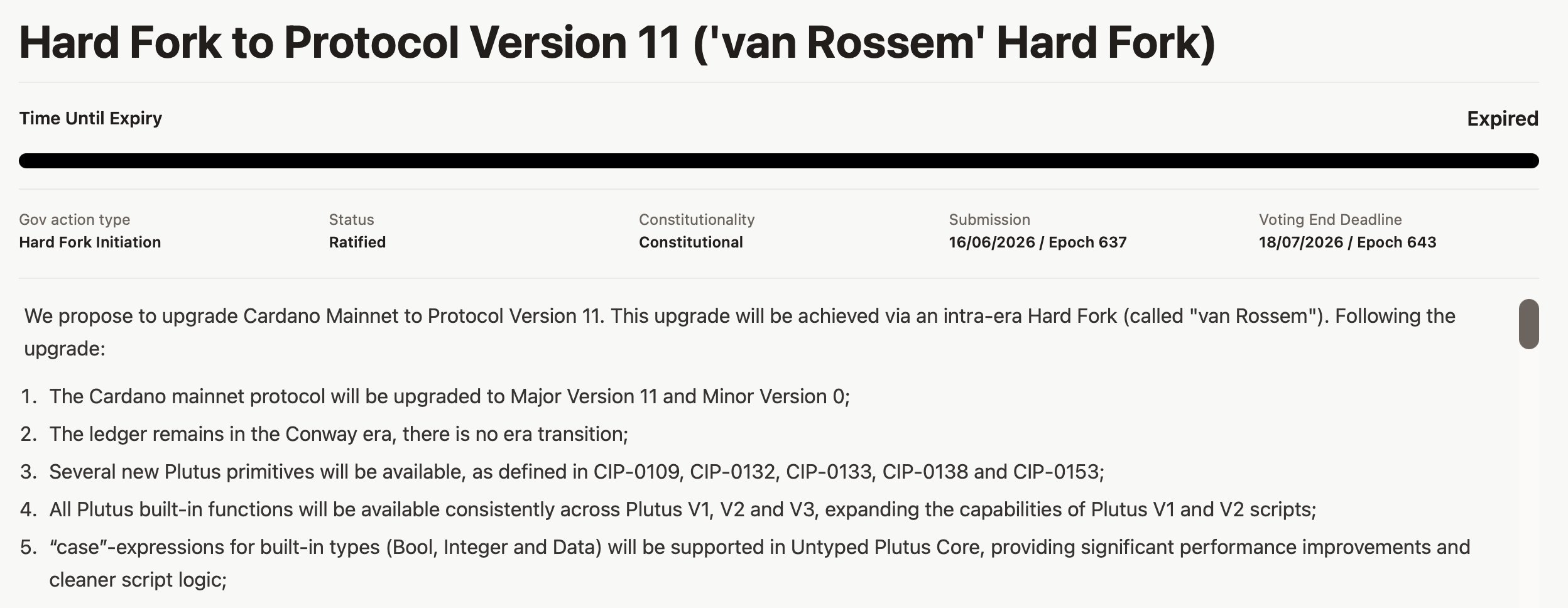
Unlike previous upgrades coordinated mainly by Cardano’s founding organizations, Protocol Version 11 reached mainnet after being proposed, debated, approved and lit into effect entirely through the blockchain’s on-chain governance process.
The upgrade was activated on July 18 at 21:44:51 UTC during Slot 192,844,800 while keeping the network within the Conway era through an intra-era hard fork not a full era transition.
The governance proposal comfortably exceeded every approval threshold before activation. Delegated Representatives (DReps) voted 77.63% in favor against a required 60%, Stake Pool Operators (SPOs) approved it with 52.7% support above the 51% threshold, while six Constitutional Committee members backed the proposal.
Network readiness went better than anticipated, with approximately 93% of block production already running the right node software before the upgrade went live.
Why This Cardano Van Rossem Hard Fork Matters Beyond New Features
For the first time, Cardano has shown that protocol changes can move from proposal to execution without relying on Input Output Global (IOG), the Cardano Foundation or Emurgo to direct the process.
Under the Voltaire governance framework, protocol upgrades now require approval from three independent groups which are: DReps, the Constitutional Committee and SPOs; before becoming effective.
That process creates a transparent decision-making system where every vote is recorded on-chain and can be independently verified.
For the ADA holders, this upgrade doesn’t require any action to be taken. Everything from wallet balances, staking positions and existing tokens will remain exactly the same. The immediate impact falls on developers and infrastructure providers building applications on Cardano.
Protocol Version 11 Focuses On Faster And More Efficient Smart Contracts
Protocol Version 11 introduces several improvements aimed at making Cardano’s smart-contract ecosystem more efficient. New Plutus primitives defined through multiple Cardano Improvement Proposals (CIPs) are now available across the network.
The upgrade also standardizes built-in functions across Plutus V1, V2 and V3 while introducing “case” expressions that simplify script execution and improve performance.
These changes are expected to reduce computation costs for certain on-chain operations and make decentralized applications easier to build and optimize.
Projects in decentralized finance, NFTs and enterprise blockchain services stand to benefit from lower execution costs and improved developer flexibility.
The cost-model update supporting these improvements had already been deployed separately in May, allowing developers to prepare before the hard fork reached mainnet.
The Upgrade Also Prepares Cardano For Its Next Scaling Phase
Intersect, the member-based organization coordinating Cardano’s governance process, has already started working toward the upcoming Dijkstra era, which is expected to introduce Ouroboros Leios, Cardano’s next major throughput upgrade.
Running this upgrade inside the existing Conway era minimizes disruption for exchanges, wallets, stake pool operators and decentralized applications while allowing the network to gradually prepare for larger architectural improvements later this year.
This also coincides with another structural change across the ecosystem. IOG has continued transferring responsibility for node development to independent engineering teams, reinforcing Cardano’s long-term objective of reducing reliance on any single organization.
ADA Market Reaction Shows Confidence, But Execution Still Matters
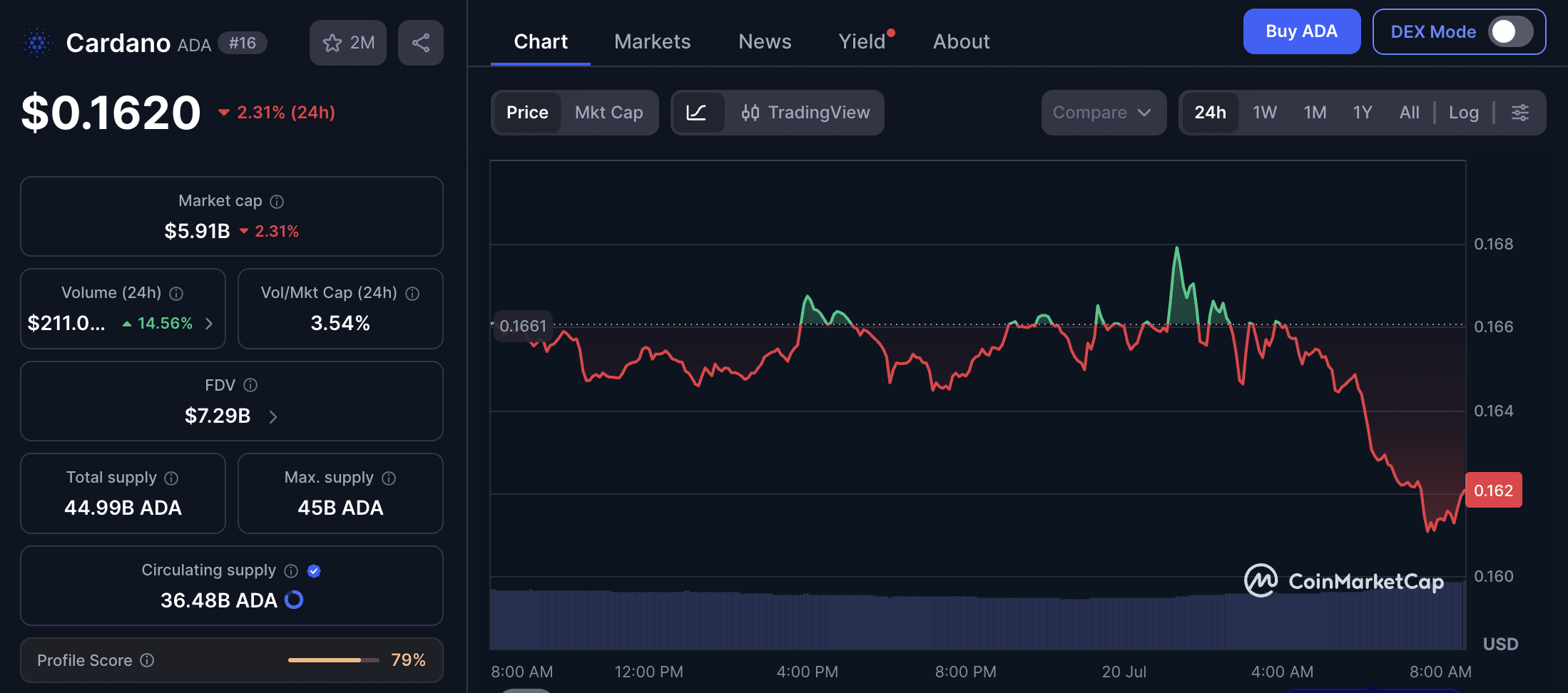
ADA traded higher around the activation period, extending gains after governance uncertainty disappeared.
Market data showed the token trading near $0.167 shortly after activation but at press time, the token trades at $0.162, while whale wallets holding between 100,000 and 100 million ADA controlled approximately 25.65 billion ADA, their highest concentration since February 2023.
Additionally, derivatives positioning remained relatively cautious, suggesting that some traders were still waiting to see whether developer adoption matches the governance milestone.
History shows that successful blockchain upgrades do not automatically translate into sustained price appreciation. The long-term impact will be a factor of whether developers actively use the new Plutus capabilities, whether decentralized applications migrate to the improved infrastructure and whether the roadmap toward the Dijkstra era stays on schedule.
The Cardano Van Rossem Hard Fork has therefore removed one major governance uncertainty. The next challenge is turning improved governance into measurable ecosystem growth.
Conclusion
The latest Cardano Van Rossem Hard Fork is important because it proves the network’s decentralized governance model can successfully deliver protocol upgrades without centralized coordination.
While Protocol Version 11 introduces meaningful technical improvements for developers, its larger achievement is establishing a repeatable governance process for future network evolution.
As projects begin deploying the new capabilities over the coming months, we’ll determine if it translates into stronger developer activity, institutional confidence and sustained ADA demand.
Glossary
DRep: Delegated Representative responsible for voting on governance proposals on behalf of ADA holders.
SPO: Stake Pool Operator responsible for validating transactions and securing the Cardano network.
Plutus: Cardano’s smart contract programming platform.
Protocol Version 11: The software upgrade introduced through the Van Rossem hard fork.
Ouroboros Leios: Cardano’s planned scalability upgrade designed to increase network throughput.
Frequently Asked Questions About Cardano Van Rossem Hard Fork
What is the Cardano Van Rossem Hard Fork?
It is Cardano’s Protocol Version 11 upgrade, approved and activated entirely through on-chain governance.
Does the Cardano Van Rossem Hard Fork require ADA holders to do anything?
No. Wallet balances, staking and existing assets remain unaffected.
What improvements does Protocol Version 11 introduce?
The upgrade expands Plutus functionality, improves smart contract efficiency and introduces new developer features.
Why is this Cardano Van Rossem Hard Fork considered historic?
It is the first Cardano protocol upgrade approved from start to finish through decentralized on-chain governance rather than founder-led coordination.