

What the On-Chain Data Reveals About Who Is Really Moving Bitcoin Right Now
Bitcoin has been through rougher patches in its history, but June 2026 is shaping up to be one of the more puzzling months for analysts and investors alike. The asset has shed roughly 15% of its value since June 1, and it has spent the better part of three weeks trading below the $70,000 mark without any convincing sign of recovery.
What makes this stretch particularly interesting is that whales, the large investors who typically signal market direction, have been actively buying throughout. More than $43 million in whale purchases landed in the past 24 hours alone, yet Bitcoin slipped below $63,000 anyway.
That disconnect between big-money buying and falling prices tells a story that goes well beyond surface-level headlines.
Whale Purchases Worth $43 Million Could Not Lift Bitcoin
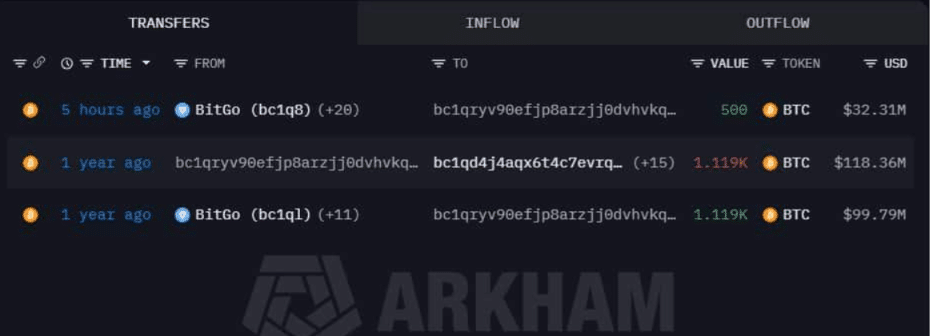
The two major purchases that caught the attention of on-chain trackers were significant by any standard. One large investor moved 500 Bitcoin, valued at approximately $32.31 million, out of custodian BitGo and into a private wallet. The act of withdrawing from a custodian and placing coins into cold storage is widely read as a long-term hold signal, since assets in private wallets are far less likely to hit the open market in the near term.
On top of that, a digital asset management firm added 166.24 Bitcoin worth around $10.74 million, growing its total holdings to 4,515 BTC with a combined value of $288.4 million. Taken together, these moves represented more than $43 million in fresh capital entering Bitcoin in a single day, the kind of activity that, under normal conditions, would at least slow a downtrend if not reverse it outright.
Instead, selling pressure absorbed the demand entirely, and Bitcoin kept sliding.
Bitcoin Price Action Since June 1 Paints a Difficult Picture
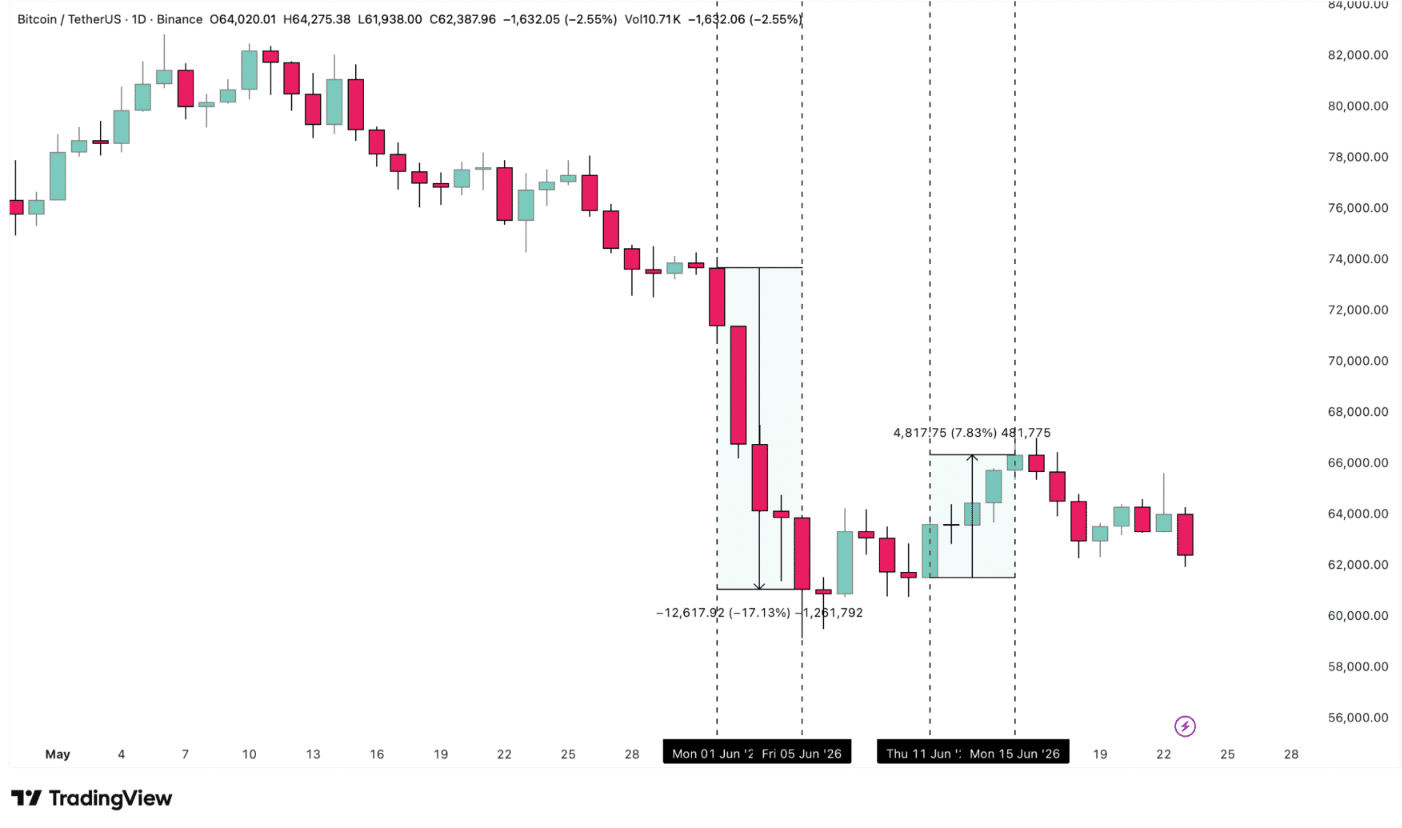
To understand why the June 2026 Bitcoin price drop has been so persistent, it helps to look at the full month in context rather than isolated 24-hour snapshots. Bitcoin opened the month at $73,674. Between June 1 and June 5, it fell 17.1%, closing at $61,056. That was a brutal five-day stretch, and the data from CoinGlass shows that whale activity was the dominant market force during that entire period.
The only stretch where buyers managed to regain meaningful ground came between June 11 and June 15, when Bitcoin climbed 7.8% from $61,510 to $66,328. That rally offered some hope, but it was short-lived. Since then, the asset has drifted lower again, and as of the time of writing, Bitcoin remains down 15.25% from its June 1 open.
Retail investors briefly took control of the market around June 8, but whales reclaimed dominance quickly and have held it since. The Bitcoin whale-retail delta, a metric tracked through CoinGlass that measures which cohort is driving net flows, has shown whale dominance for the vast majority of June.
Why Whale Dominance Does Not Always Mean a Bullish Bitcoin Outlook
This is the nuance that gets lost in most coverage of whale activity. The presence of whales in a market does not automatically mean prices will rise. Whales can be buyers or sellers, and in June, the data suggests that while some whales have been accumulating, others have been distributing. The net result has been negative price action despite headline-grabbing purchase figures.
Bitcoin spot exchange netflow data reinforces this reading. Between June 8 and the time of writing, the largest single-day sell netflow reached $59.55 million on June 11, while the largest buy netflow over that same window was $161.54 million. The fact that a buy netflow nearly three times the size of the sell netflow still could not generate sustained upward momentum speaks to just how much overhead resistance and broader selling pressure Bitcoin is currently facing.
Trading Volume Remains Dangerously Low
One of the quieter signals in all of this is volume, and it is worth paying attention. Trading activity has stayed notably suppressed for the better part of the past week. Low volume during a downtrend is sometimes interpreted as a sign that sellers are exhausted, but it can also mean that buyers simply lack conviction. Without meaningful participation from both retail and institutional traders, even large whale purchases struggle to move the needle in a sustained way.
Until volume picks up and net inflows into exchanges reflect genuine accumulation pressure rather than sporadic whale moves, Bitcoin is likely to remain range-bound between $61,000 and $66,000.
What Needs to Change for Bitcoin to Recover
The path forward for Bitcoin depends less on how many large purchases make headlines and more on whether the broader market sentiment begins to shift. For that to happen, analysts are watching for a sustained increase in buy-side netflows, a reduction in sell pressure from existing holders, and clearer signals from whale cohorts that accumulation is happening in a coordinated rather than fragmented way.
Bitcoin has recovered from setbacks like this before, and the fundamentals of the asset have not changed. However, the market right now is in a phase where patience and data-driven caution matter more than headline optimism.
Conclusion
June 2026 has been a difficult month for Bitcoin, and the $43 million in whale purchases that grabbed attention did little to alter the underlying trend. The Bitcoin price drop of 15% from its June 1 high reflects something deeper than a lack of institutional interest.
It reflects a market where whale activity is present but not yet aligned in a bullish direction, where trading volume is insufficient to sustain rallies, and where selling pressure continues to outweigh buying conviction. Until those conditions change, Bitcoin is likely to stay under pressure regardless of how large the individual buy orders appear on the surface.
Frequently Asked Questions
What is a whale in crypto?
A whale is an investor or entity that holds a very large amount of cryptocurrency, typically enough that their trades can influence market prices in a meaningful way.
Why did Bitcoin drop 15% in June 2026 despite whale buying?
Whale buying alone does not guarantee price increases. In June, selling pressure from other market participants outweighed the buying activity, and overall trading volume was too low to sustain any rally.
What is the whale-retail delta?
The whale-retail delta is a metric that tracks the difference in market participation between large investors and retail traders, helping analysts identify which group is driving price action at any given time.
Glossary of Key Terms
Bitcoin (BTC): The original and largest cryptocurrency by market capitalization, operating on a decentralized blockchain network.
Whale: An investor holding large amounts of a digital asset, capable of influencing market prices through their trading activity.
Netflow: The net difference between crypto assets flowing into and out of exchanges, used to gauge buying or selling pressure.
Whale-Retail Delta: An on-chain metric that compares market activity between large holders and retail participants to determine who is driving price movements.
Custodian: A financial institution or service that holds cryptocurrency on behalf of investors, such as BitGo.
Cold Storage / Private Wallet: An offline method of storing cryptocurrency, considered more secure and associated with long-term holding intentions.
Sources