

This article was first published on Deythere.
- Bitcoin Mining Cost Exceeds Market Price by More Than $15,000
- Miner Selling Reaches Record Levels
- The Network Is Adjusting to the Pressure
- Macro Headwinds Are Making Recovery Tougher
- Conclusion
- Glossary
- Frequently Asked Questions About Bitcoin Mining Costs
- What is the current Bitcoin mining cost?
- How many miners are operating at a loss?
- How much Bitcoin did public miners sell in Q1 2026?
- Why does mining difficulty fall?
- References
Bitcoin’s recent price dip is creating a problem that is beginning to eat away at the network’s foundations. While traders go on about Fed policy and what is going on in the overall economy, the miners are facing an even tougher reality. Bitcoin mining cost is now way higher than the price of that Bitcoin itself.
According to JPMorgan, it is costing miners around $78,000 to mine one Bitcoin, while the price of a Bitcoin has been hovering around $62,500 – $63,000. That means Bitcoin has now spent its fifth consecutive month below its estimated production cost which is putting real pressure on mining companies and forcing many of them to liquidate holdings just to stay in business.
Bitcoin Mining Cost Exceeds Market Price by More Than $15,000
The gap between Bitcoin mining costs and the market price for one is too big to ignore.
JPMorgan estimates that right now, it costs around $78,000 to produce a single Bitcoin while at last check, Bitcoin was trading around $62,700 after tumbling from Monday’s high of $67,000.
The price decline continued after the Federal Reserve maintained interest rates at 3.50%-3.75% while implying that inflation remains a concern and future rate hikes remain possible.
When Bitcoin stays below production costs for a prolonged period, the mining profitability gets worse for miners. The smaller operators and firms running less efficient equipment are the first to feel the pressure because electricity and equipment costs don’t change even if the price of Bitcoin does.
CoinShares data cited by JPMorgan shows that around 20% of miners are now running at a loss.
Unlike the last few cycles where miners could wait for the price to go up to cover their costs, this time around, many of them are having to take drastic action to stay afloat.

Miner Selling Reaches Record Levels
The financial pressure is already showing up in on-chain behavior.
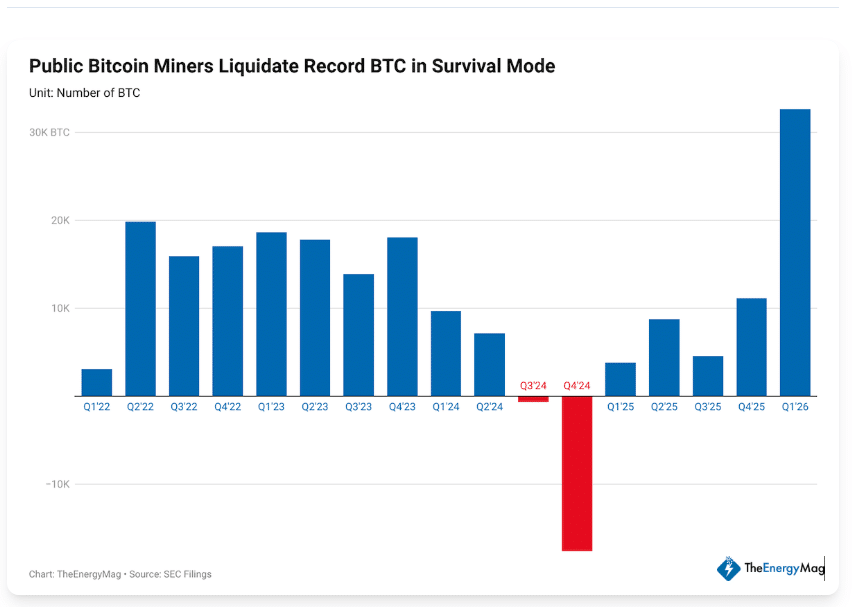
Publicly traded Bitcoin mining companies have sold more than 32,000 BTC during the first quarter of 2026; which is more than they sold in all of 2025. The figure also surpassed the previous quarterly record of approximately 20,000 BTC set during the Terra-Luna market collapse in 2022.
Some of the major sellers include MARA, CleanSpark, Riot Platforms, Cango, Core Scientific and Bitdeer. For many of these companies; these sales were necessary to cover operating expenses, repay debt; and maintain liquidity as mining economics worsened.
Hashprice has tanked to the low-$30 range per petahash per second per day, which is below the break even point for many operators. This explains why the amount of Bitcoin that miners are holding in their reserves has been steadily falling even as some big institutional investors are still accumulating Bitcoin.
The Network Is Adjusting to the Pressure
Bitcoin has a built-in system to deal with this kind of crisis.
When mining becomes unprofitable, the higher-cost operators often shut down their machines. As that happens, the hashrate of the network drops and eventually mining difficulty adjusts lower.
That process played out early in the month, when Bitcoin mining difficulty plummeted by roughly 10%, which was the second major downward adjustment of that size this year . The reduction lowered the computational burden required to mine new blocks and improved profitability for remaining participants.
Analysts point out that miners are now becoming a lot more sensitive to price fluctuations. Rather than just grinding it out through prolonged losses, a lot of them are now switching their equipment on and off depending on the state of profitability.
As long as the price of Bitcoin stays below the estimated Bitcoin mining cost, larger and more frequent difficulty adjustments could continue.
Macro Headwinds Are Making Recovery Tougher
Mining challenges are compounding with other market pressures.
The Federal Reserve’s hawkish stance has seen the US dollar get even stronger and weigh on risk assets around the world . The Japanese yen recently slumped to 161.45 per dollar; which takes it its weakest levels in nearly 40 years.
Meanwhile, Bitcoin has struggled to regain momentum despite positive geopolitical developments, including the U.S.-Iran peace agreement that helped push oil prices lower and supported equities.
For miners; this situation is serious because when liquidity gets weaker, the demand for assets like crypto often dips too.
JPMorgan however sees a glimmer of hope in that extreme pessimism has sometimes preceded recoveries in the past. Combined with some big investors accumulating Bitcoin and some exchange reserves dwindling, some analysts are now interpreting this situation as a contrarian signal, not the end of the road for miners.
Conclusion
Bitcoin mining cost has become one of the most obvious indicators of stress within the crypto ecosystem. With Bitcoin currently trading around $62,500 and production costs sitting at $78,000 per coin, it is plain to see that miners are having a really tough time making an operating profit.
The sale of more than 32,000 BTC during the first quarter shows the scale of the challenge.
While network difficulty adjustments are helping stabilize profitability; the sector remains under pressure until Bitcoin either recovers meaningfully or Bitcoin mining costs decline further.
Glossary
Bitcoin Mining Cost: How much is spent to produce one Bitcoin through mining operations.
Hashrate: The total amount of computing power that is keeping the Bitcoin network secure.
Mining Difficulty: A network setting that decides how hard it is to mine new Bitcoin blocks.
Hashprice: Revenue that miners earn per unit of mining power.
Miner Capitulation: A period when miners sell holdings or shut down operations due to poor profitability.
Frequently Asked Questions About Bitcoin Mining Costs
What is the current Bitcoin mining cost?
According to JPMorgan; the average Bitcoin mining cost is roughly $78,000 per coin.
How many miners are operating at a loss?
Around 20% of miners right now are running at a loss according to industry estimates.
How much Bitcoin did public miners sell in Q1 2026?
Public mining companies ended up selling more than 32,000 BTC in the first quarter; which is the highest quarterly amount ever recorded.
Why does mining difficulty fall?
Difficulty adjusts lower when miners leave the network; making it easier and more profitable for remaining operators to mine Bitcoin.