


This article was first published on Deythere.
- Global Efforts to Diversify From the Dollar and the Rise of Digital Currencies
- Stablecoins in Cross-Border Payments and Global Trade Settlement
- Payment Network Integration
- Where are We Now?
- What do Regulators and Experts Think?
- Conclusion
- Glossary
- Frequently Asked Questions About De-dollarization and Stablecoin Global Trade Settlement
- What is de-dollarization?
- How do stablecoins make global trade settlement a reality?
- Which stablecoins are dominating global trade settlement?
- What recent regulations are changing stablecoin global trade settlement?
- References
Over the past few years, countries have been looking to break free from their reliance on the US dollar and this has coincided with the rapid growth of stablecoins being used in global trade settlement.
Central banks from the likes of BRICS to ASEAN are taking a serious look at digital currencies and currency swaps to streamline trade settlements. Meanwhile, big payment networks and fintech firms are integrating dollar-pegged stablecoins into their infrastructure.
Global Efforts to Diversify From the Dollar and the Rise of Digital Currencies
The geopolitical space has become more tense and sanctions have become more common, as a result, it is not surprising that there is a global effort under way to break free from the dollar.
As an example, in January 2026, the Reserve Bank of India proposed linking the BRICS countries’ central bank digital currencies (CBDCs) to make global trade settlement and tourism easier.
If this goes ahead, it will allow Brazil , Russia , India , China and South Africa to trade directly in each other’s digital currencies without having to convert to dollars.
Reports make it clear that this is all about efficiency not about officially de-dollarizing but to some it looks like a change in the way global trade finance works. China on the other hand has been actively promoting the digital yuan abroad and even testing the use of the yuan offshore in trade .
A lot of emerging markets are already using local currency or digital yuan/rupee swaps for some of their trade. The experience of Russia and India however, shows the potential pitfalls. Large rupee balances built up in Moscow had to be invested locally when not used.
There are a few solutions being discussed to try to fix this, one of which is to have more frequent ( e.g. weekly ) settlements made via bilateral central bank swap lines, helping to mitigate imbalances.
While some central bankers warn that there are risks to de-dollarization, major banks caution that the dollar’s dominance is not going anywhere for decades.
The truth is that de-dollarization is happening gradually through changes in the way we do payments and use currency and not in an instant collapse of the dollar.
Stablecoins in Cross-Border Payments and Global Trade Settlement
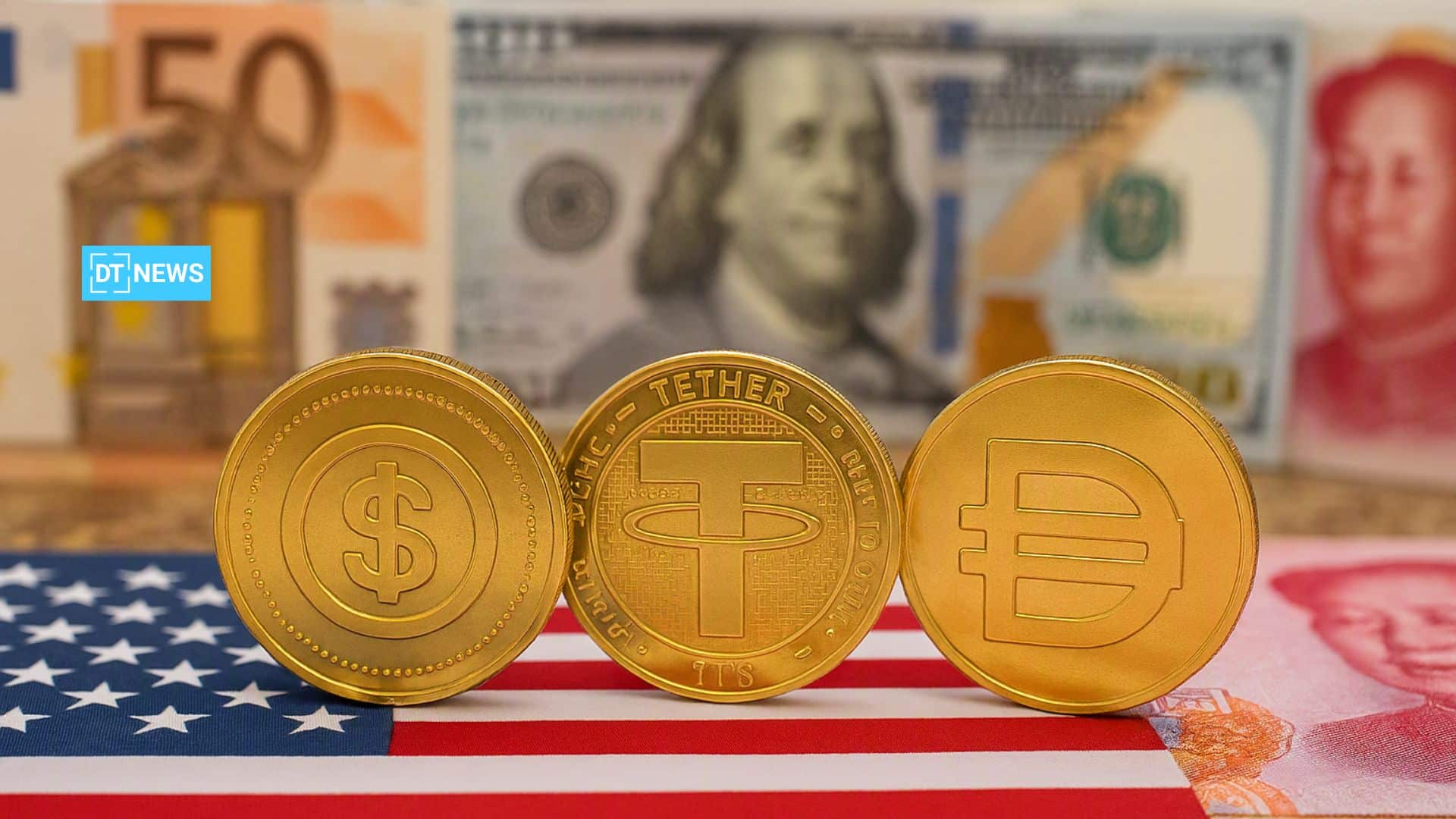
Stablecoins are digital tokens that are pegged 1:1 to fiat currencies ( mostly the US dollar ) that make it possible to send money rapidly over distances, 24 hours a day 7 days a week.
They allow near – instant settlement, charge low fees and are programmable . In 2025, stablecoin transaction volume exceeded $27 trillion a year. This is still below 1% of global money transfers but the growth rate has been absolutely fast over a period of four years.
The most popular stablecoins are USDT (Tether) and USDC (Circle) which together make up the lion’s share of the stablecoin market cap ( over $200B combined )
Stablecoins act as a bridge currency for global trade settlement, business and consumer transactions . Businesses convert local currency into a dollar pegged token, send it over to the recipient’s wallet (often in minutes ) and then convert to local currency at the receiving end .
This “stablecoin sandwich” cuts through the multi day correspondence banking chains.
Real world stablecoin payments totalled $350-$550 billion in 2025, with 60% coming from business to business trade flows . Companies that are already using stablecoins say they are seeing real savings. Around 41% claim that they have cut cross-border payment (B2B) costs by at least 10%.
Despite all the advances, traditional US dollar banking still dominates many corridors. To give an idea, a study found that 73% of Asian business payments still go through the US dollar . Stablecoins are most actively used where local banking is weak or FX volatility is high.
FXC Intelligence reports that nearly 66% of stablecoin supply is being held in emerging markets as a hedge against local currency risk. Places like Argentina and Nigeria are really using them to get round controls and FX volatility.
Payment Network Integration
Big financial networks like Visa, Mastercard, and PayPal have been really active building stablecoin rails since 2024-2026. Visa’s pilot has expanded to nine blockchain platforms in the last two years, enabling CBDCs and USD coins to solve global trade settlement quickly.
Mastercard acquired stablecoin rails fintech BVNK for $1.8 billion, and PayPal launched their own USD stablecoin. In Singapore, Facebook’s Meta is reportedly developing a region wide payment system that incorporates stablecoins.
Reports also note that China is integrating features of stablecoins (speed, offline transfer, programmability) into their own digital currency, the e-CNY. They even added an interest bearing feature.
Regulators have equally taken steps. The US “GENIUS Act” (July 2025) established comprehensive rules for payment stablecoins, clarifying backing requirements. EU MiCA and Singapore payment regulations now cover major global trade settlement flows.
Where are We Now?
In the middle of 2026, stablecoins in global trade settlement have long since moved beyond being a mere use case. A stablecoin analytics report shows that the number of press releases about stablecoins in payments went up by 186% in the first half of 2025 compared to the year before, and mentions of cross-border stablecoin payments jumped over 1000%.
More money transfer companies and remittance providers now use stablecoins like USDC or USDT because they are way cheaper than traditional banking methods, with fees as low as 1-2% compared to 6% for banks.
Major business use cases are emerging in Southeast Asia, Africa and Latin America, where FX volatility and banking gaps are greatest. Traditional cross-border fees often run $28–$52 per payment, whereas stablecoin transfers typically cost under $1.
Settlement time is also down to just minutes. Effectively, stablecoins are offering a “near-instant, 24/7, low-cost settlement option” that leaves old systems behind.
It is worth noting though that stablecoins still only make up a small fraction of global trade value. The Bank for International Settlements (BIS) points out that at the end of April 2026, the stablecoin market cap had been around $315 billion and the value of payment-related on-chain transactions was about $390 billion in 2025.
Even though the total volume of transactions on blockchains (including trading activity) was about $35 trillion, it is still small compared to traditional bank transfers. Stablecoins have held up well despite all the ups and downs in the crypto market. As a matter of fact is that a huge 98% of all stablecoins are denominated in US dollars which does nothing to dent the dollar’s dominant position.
Yet, stablecoins core uses (global trade settlement, managing company treasuries) are only just being tapped, meaning that they could have a lot more potential for adoption if the regulatory and infrastructure barriers come down.
What do Regulators and Experts Think?
The views of regulators and experts on the impact of stablecoins and de-dollarization are as mixed as can be. The US Federal Reserve for example thinks that stablecoins could make global trade settlement more efficient. A Fed study in March 2026 showed a model where companies and small businesses could use payment stablecoins to make direct payments, cutting out all the banks and other middlemen in the process.
However, it also points out that if banks were to back up the stablecoins they issue with reserves or government bonds, the Fed might need to adjust its reserve policy because of the way reserve flows can get volatile.
The Fed also cautions that stablecoins aren’t completely risk free, issues like finality, AML compliance and off-ramps remain challenging.
The BIS, in a similar vein, points out that the trust investors put in a stablecoin is still dependent on the strength of the fiat currency. One of their officials recently noted that money is a lot more than just technology, it is about creating a solid institutional achievement.
Research has also shown that while stablecoins have nice tech features like being able to program them and operate 24/7, their real-world use for traditional trade finance has so far been limited.
However, they also acknowledge that stablecoins could help pave the way for new approaches to global trade settlement and that central banks are already thinking about how to work with or regulate them.
Analysts at JPMorgan have pointed out that the adoption of well-regulated dollar pegged stablecoins could end up making the dollar even stronger by embedding its use into new payment systems.
In other words, stablecoins could end up channeling more trade and investment through dollar based tokens, and thus spread the dollar’s reach even as the world moves more to on-chain systems.
Even central bank leaders are chiming in with views of their own. The PBOC Governor in China Pan Gongsheng has been pushing for a multipolar financial system and has been promoting the digital yuan as a way to counter the dollar’s dominance.
At the same time, Beijing is aiming to incorporate stablecoin-like features (programmability, real-time settlement, offline transfer) into the e-CNY, making it more attractive to users accustomed to crypto rails.
Other regulators globally are moving cautiously. Many see stablecoins as promising for innovation but demand strict backing and oversight (as embodied in the US GENIUS Act and EU MiCA) to mitigate financial integrity risks.
Conclusion
Stablecoins global trade settlement and currency digitization efforts are coming together to change global trade settlement.
Countries pushing to de-dollarize are experimenting with linking their digital currencies and using local currencies for settlement, while stablecoins offer a private-sector solution for faster, cheaper global trade settlement.
Industry data show that stablecoin payment volumes have gone through the roof mainly because big businesses need them for trade and fintechs are pushing them as well.
Major economies now have comprehensive stablecoin rules in place (e.g. the US GENIUS Act and EU MiCA), which is starting to clear up some of the regulatory uncertainty.
Some experts are worried that stablecoins could entrench the dollar even as the digital payment rail gets more diverse, while others think that they could genuinely enable de-dollarization if they’re pegged to other currencies or used between people directly.
Overall, stablecoins are increasingly being seen as a tool for global trade settlement. Payment networks, banks, and firms in emerging markets are giving them a try for financing imports and exports, treasury transfers, and supply chain payments because they offer programmable rails and 24/7 settlement.
Glossary
Stablecoin: A cryptocurrency that sticks to a stable value by linking to a real-world currency (like the US dollar) or asset
De-dollarization: The process of reducing reliance on the US dollar for international trade or reserves, often by using other currencies or payment systems .
CBDC (Central Bank Digital Currency): A digital version of a country’s own currency .
Cross-Border Payment: A financial transaction where the person sending and receiving the money are in different countries .
On-Chain Settlement: The transfer of value directly onto a blockchain .
Correspondent Banking: A system where banks in different countries hold accounts with each other to make international payments.
Frequently Asked Questions About De-dollarization and Stablecoin Global Trade Settlement
What is de-dollarization?
De-dollarization is when countries turns away from using the U.S. dollar in international trade, finance, or their reserves. It can be as simple as settling trade in local currencies, or as complex as creating a regional currency bloc like the euro or yuan.
How do stablecoins make global trade settlement a reality?
Stablecoins can move across borders instantly and cost-effectively. When a seller gets a stablecoin in their digital wallet , they can easily swap it for local currency when it arrives at its destination, cutting settlement time down from days to minutes and eliminating foreign exchange fees.
And because stablecoins exist on the blockchain, they can settle trades 24/7 and also be programmed into automated payment smart contracts.
Which stablecoins are dominating global trade settlement?
The top stablecoins by market cap are USDT (Tether), USDC (Circle).
What recent regulations are changing stablecoin global trade settlement?
In the US, the Genius Act (signed into law in 2025) gave the Federal government a framework for regulating payment stablecoins. This means that the likes of USDT and USDC need to be backed by top-shelf assets (like US Treasuries or bank deposits) and that algorithmic stablecoins are out of the picture.
Similar rules were put in place by the EU under the MiCA regime where stablecoin issuers need to hold reserves and have a tight governance system in place. Singapore and Hong Kong have also given their payment laws an update to cover stablecoin transfers.
References
Disclaimer: This article provides factual information and analysis of trends as of June 2026. It is not financial advice or a prediction of what’s to come. Readers should always consult their own professional advisors before making any financial decisions.