

The MARA Bitcoin sale is shaking confidence across the crypto market because it challenges one of Bitcoin’s strongest institutional narratives. For years, companies promoted the idea that corporate Bitcoin reserves represented long-term conviction. Now, one of America’s largest Bitcoin mining firms is selling billions in BTC while shifting toward artificial intelligence infrastructure instead.
According to the source, Marathon Digital Holdings, now operating as MARA Holdings, reportedly sold nearly $1.5 billion worth of Bitcoin after offloading around 20,880 BTC at an average price near $70,137 per coin. The company also announced it would stop purchasing additional Bitcoin mining hardware, signaling a major operational transition already underway.
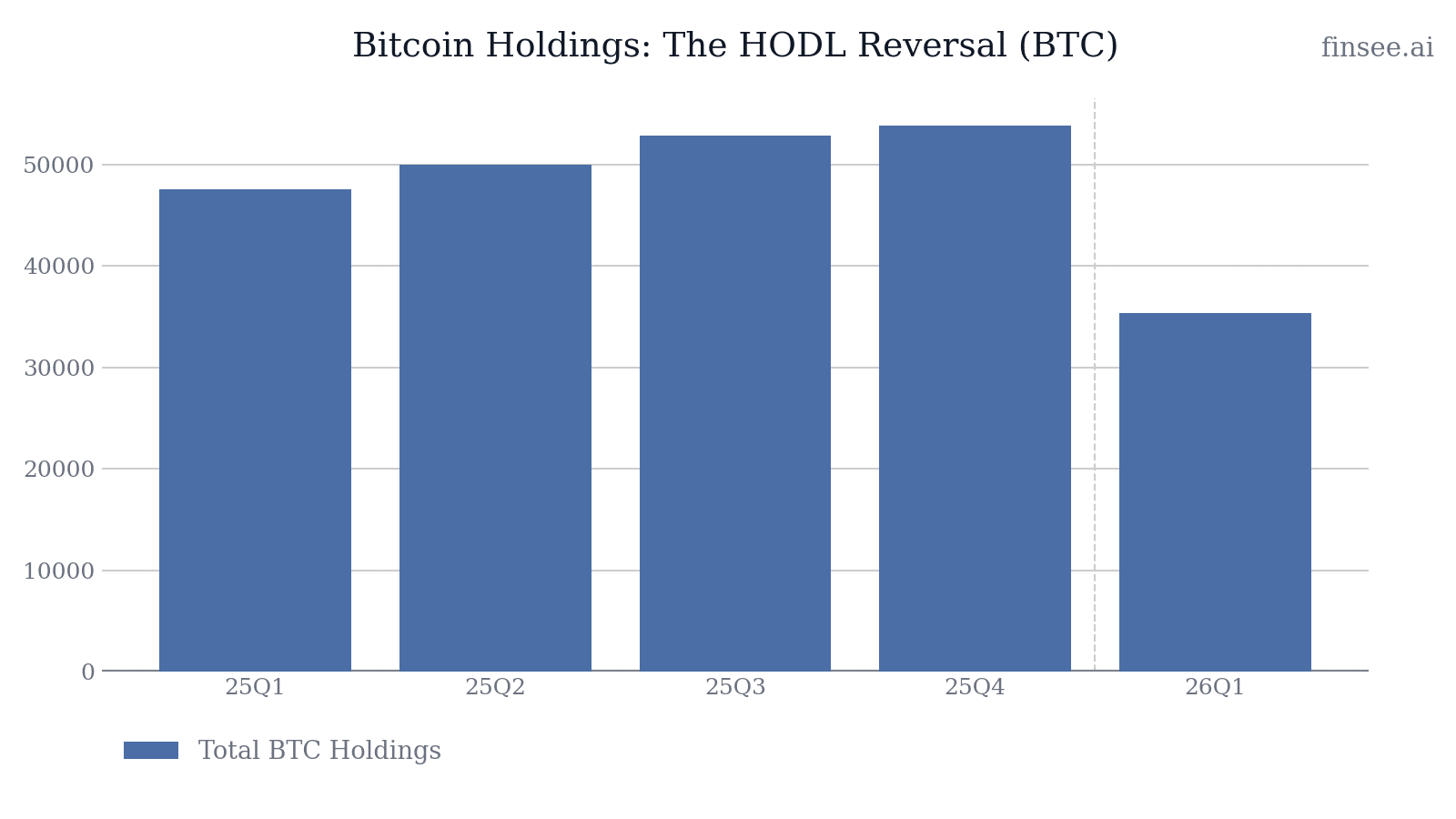
The sale reduced MARA’s Bitcoin holdings from 38,689 BTC to roughly 35,303 BTC. Even after the liquidation, those reserves remain worth nearly $2.84 billion, making MARA the fourth-largest public Bitcoin holder globally. Still, the company no longer reflects the treasury-first posture it promoted aggressively just one year ago.
The MARA Bitcoin Sale Revived Fears Around Treasury Models
The scale of the MARA Bitcoin sale surprised many analysts because it represented nearly 54% of the company’s former Bitcoin stack by coin count. Reports show MARA sold around 15,133 BTC worth roughly $1.1 billion between March 4 and March 25 through carefully timed tranches instead of a sudden market dump.
That detail matters because the company did not abandon Bitcoin in panic. Instead, management used Bitcoin as liquidity to stabilize a balance sheet stretched by aggressive debt expansion and weakening post-halving margins.
The proceeds helped MARA repurchase convertible notes at a discount, reducing total debt from around $3.3 billion to $2.3 billion while generating a $71 million accounting gain. Yet the broader market interpreted the move as a bearish signal for corporate Bitcoin treasury models.
That concern did not emerge from nowhere. MARA previously embraced a debt-funded Bitcoin accumulation strategy similar to the one popularized by Michael Saylor and Strategy. Like Saylor’s model, MARA relied heavily on convertible debt to expand Bitcoin reserves during bullish market conditions.
Critics now argue the MARA Bitcoin sale exposed how fragile that treasury model becomes when mining profitability weakens and debt obligations rise.
Bitcoin Mining Economics Are Becoming Harder to Ignore
The latest Bitcoin mining environment looks dramatically different from previous cycles. The Bitcoin halving reduced mining rewards while energy costs, operational expenses, and financing pressure continued climbing across the sector.
MARA’s latest earnings reflected those challenges clearly. Revenue reportedly fell 18% year over year to $174.6 million while net losses reached nearly $1.26 billion. Even so, the company still produced 2,247 BTC during Q1 and expanded energized hashrate by 33% year over year to 72.2 EH/s.
That distinction matters because the MARA Bitcoin sale did not signal a complete retreat from Bitcoin mining. The company remains deeply involved in mining operations while adapting to a more difficult economic environment.
At the time of reporting, MARA stock rose slightly by 0.24%, while Bitcoin declined 1.39%. That mixed market response reflected uncertainty around whether the company acted out of smart financial discipline or fading long-term conviction.
Why AI Infrastructure Suddenly Looks More Attractive
The MARA Bitcoin sale also reflects a larger transformation happening across the crypto industry. MARA recently agreed to acquire Long Ridge Energy’s 505-megawatt natural gas facility in Ohio for nearly $1.5 billion.
The site is expected to generate roughly $144 million in annual EBITDA while supporting future AI infrastructure and data-center expansion, according to recent industry reports. Many analysts now believe AI infrastructure offers steadier margins than traditional Bitcoin mining operations.
Scott Melker recently noted that “Bitcoin miners are no longer Bitcoin miners, they are AI companies that will also mine Bitcoin,” reflecting the industry’s rapid shift toward AI infrastructure.
Even Bitcoin Society recently paused additional treasury accumulation, showing how several companies are quietly reassessing Bitcoin reserve strategies at the same time.
Was the MARA Bitcoin Sale a Collapse of Conviction or Smart Risk Management?
The biggest debate surrounding the MARA Bitcoin sale is philosophical as much as financial. Critics believe genuine conviction would have required MARA to preserve its Bitcoin reserves despite difficult conditions.
Supporters argue the opposite. Selling Bitcoin to reduce debt during shrinking margins may simply reflect disciplined operational management rather than abandoning belief in Bitcoin itself.
That distinction remains critical because MARA still controls one of the largest corporate Bitcoin reserves globally while continuing aggressive Bitcoin mining expansion. The company did not fully unwind its thesis. It adjusted strategy to survive changing market realities.

Conclusion
The MARA Bitcoin sale may become one of the most important case studies in modern crypto finance because it exposed the growing tension between ideology and operational survival. Corporate Bitcoin treasury models looked unstoppable during bull markets, but the economics of modern Bitcoin mining are forcing companies to prioritize liquidity, debt management, and long-term sustainability.
For investors, the message is becoming increasingly clear: conviction alone may no longer protect treasury-heavy crypto businesses from market pressure.
Glossary of Key Terms
Bitcoin Mining: The process of validating Bitcoin transactions using specialized computing hardware.
Convertible Notes: Corporate debt instruments that may later convert into company shares.
Hashrate: The total computing power supporting Bitcoin mining operations.
Bitcoin Treasury Strategy: A corporate strategy focused on holding Bitcoin as a reserve asset.
AI Infrastructure: Computing systems and data centers designed for artificial intelligence workloads.
FAQs About MARA Bitcoin Sale
Why did MARA sell Bitcoin?
MARA sold Bitcoin mainly to reduce debt and improve balance-sheet flexibility.
How much Bitcoin does MARA still hold?
The company reportedly still holds around 35,303 BTC worth nearly $2.84 billion.
Is MARA still involved in Bitcoin mining?
Yes, MARA continues expanding mining operations despite its AI infrastructure pivot.
Why are Bitcoin miners shifting toward AI?
AI infrastructure currently offers steadier margins and more predictable long-term revenue opportunities.