



Ethereum funding crisis concerns have intensified after former Ethereum Foundation contributor Trenton Van Epps warned that the ecosystem could face a slow-burning funding crisis within months, triggering a wider debate over how Ethereum should finance development without compromising decentralization. The discussion has placed a controversial validator reward proposal under the spotlight while a separate nonprofit initiative, Ethlabs, has emerged as an alternative funding route.
- What is behind the Ethereum funding crisis debate?
- What is the Validator Redirected Revenue proposal?
- Why are critics calling the idea a staking tax?
- How much funding could validator rewards provide?
- Could Ethlabs change Ethereum’s funding approach?
- Conclusion
- Glossary
- Frequently Asked Questions About Ethereum Funding Crisis
The debate is not only about raising money but also about who should control ecosystem funding decisions in a decentralized network. As Ethereum enters a new phase of development, community members are divided between those supporting new funding mechanisms and those warning against changes that could reshape validator incentives.
What is behind the Ethereum funding crisis debate?
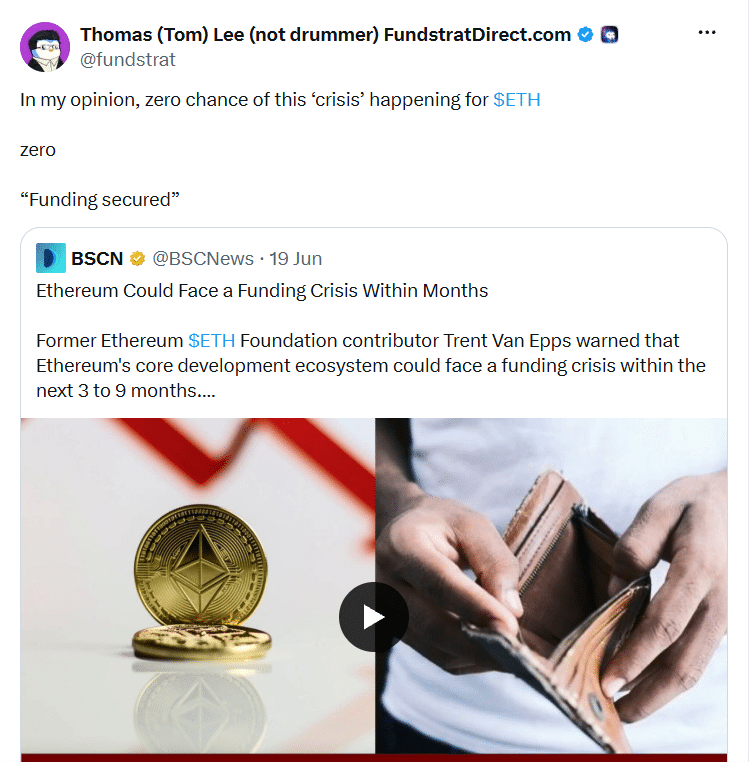
Ethereum funding crisis refers to concerns about whether the network has a reliable long-term funding model for research, infrastructure and ecosystem development. The discussion began after Trenton Van Epps, a former Ethereum Foundation contributor, warned that Ethereum’s core development ecosystem could face financial pressure within three to nine months.

He pointed to the decline of older support programs and reduced Foundation spending as key factors behind his concerns. Van Epps estimated that maintaining more than 10 client, research and coordination teams costs around $30 million annually. He argued that existing mechanisms, including the Client Incentive Program, may not be enough to support Ethereum’s growing development needs.
However, the warning has faced strong opposition from some Ethereum participants. Some Ethereum participants pushed back on the warning, saying the Foundation’s existing reserves could support operations for a long period and that the situation does not represent an immediate funding shortage. BitMine chairman Tom Lee also rejected the concern, saying there was a “zero chance” of Ethereum running out of funding for protocol development.
The Ethereum Foundation’s own treasury policy has also shaped the discussion. In June 2025, the Foundation outlined a plan to maintain a 2.5-year operating expense buffer in cash and stablecoins. It also planned to limit annual spending to 15% of treasury assets while gradually reducing that level toward a 5% baseline over five years.
The Foundation later reduced spending by around 40% as part of this transition. The changes added pressure to the debate because some participants viewed the reduced budget as a sign that new funding structures may be needed.
What is the Validator Redirected Revenue proposal?
Validator Redirected Revenue is a research proposal introduced by Kleros co-founder Clément Lesaege that explores whether validators could redirect a portion of their staking rewards toward Ethereum ecosystem funding. Lesaege presented the idea as a possible solution to Ethereum’s public-goods and free-rider problem.
His argument is that many participants benefit from shared infrastructure improvements, but no single group has a strong incentive to fund those efforts alone. The proposal suggests that validators could signal a redirect percentage between 0% and 10% of staking rewards. Validators would also indicate preferred recipient addresses or funding splits.
Execution clients would then aggregate validator preferences to determine how redirected funds are distributed. The proposal describes a collective decision process based on preference aggregation methods similar to Condorcet-style voting. This is a research-stage proposal on EthResearch, not an EIP or protocol change. It is not active, approved or part of Ethereum consensus today.
Any implementation would require client updates, validator coordination and a protocol change or hard fork, creating a significant technical and governance barrier. The proposal suggests that if a majority of validators support a non-zero redirect rate, the mechanism could become mandatory across the network. The current status quo remains a 0% redirect rate.
Why are critics calling the idea a staking tax?
The Ethereum funding crisis debate became more controversial after opponents described the proposal as a possible “staking tax” or “validator tax.” Critics argue that the mechanism could create a precedent for protocol-level redistribution and give large validators or staking operators greater influence over ecosystem funding decisions.
Some participants fear it could blur the line between network security and governance by turning validators into decision-makers over financial allocation. Opponents also warned about cartel formation risks and a possible mismatch between validator operators and ETH holders who delegate their assets.
A staking provider may support a funding preference that individual delegators do not necessarily agree with. The political reaction has been stronger than the economic impact suggested by the numbers. While supporters argue the redirect amount would be limited, critics believe the principle of changing validator rewards through protocol rules is the bigger concern.
Max Shannon, senior research associate at Bitwise, noted that Ethereum staking participation has remained relatively stable despite lower rewards. He said staking APR declined from around 4.6% in June 2023 to approximately 2.7% currently, while staked supply and the staking ratio roughly doubled.
However, Shannon warned that further reward compression could make slashing risk and exit-queue liquidity concerns more important. He also said lower consensus-layer returns could encourage validators to depend more heavily on maximal extractable value (MEV), which may create additional concerns around censorship resistance.
How much funding could validator rewards provide?
The financial gap at the center of the debate is relatively small compared with Ethereum’s overall staking economy. Shannon estimated that if Ethereum’s annual funding shortfall is around $30 million and yearly staking rewards are approximately $1.9 billion, the gap could be covered by about 1.6% of staking rewards.
Lesaege estimated that a 5% to 10% redirect could generate around 50,000 to 70,000 ETH annually for ecosystem development. Based on current ETH prices mentioned in the proposal discussion, that equals roughly $82.5 million to $115.5 million. However, the main disagreement is not about whether the amount is affordable.
The conflict centers on whether Ethereum should introduce a protocol-level mechanism that changes how staking income is distributed. Supporters see the proposal as a possible coordination tool for funding public goods. Critics believe it could create long-term governance risks by concentrating influence among major validators.
Could Ethlabs change Ethereum’s funding approach?
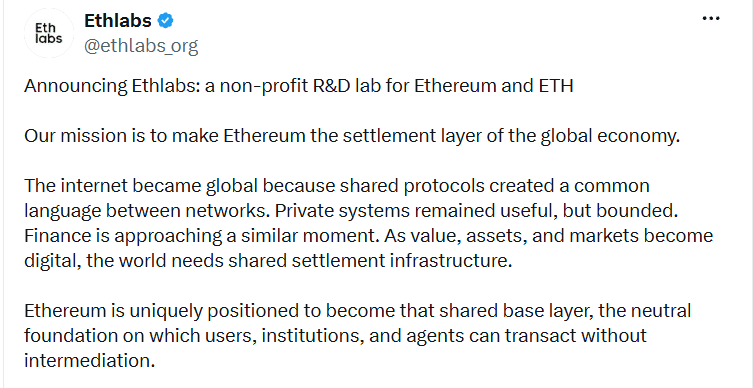
Ethlabs has emerged as another possible response to the Ethereum funding crisis debate by creating a nonprofit research and development organization focused on Ethereum and ETH. The organization was announced by five former Ethereum Foundation researchers and received backing from ecosystem supporters including BitMine, Sharplink and ConsenSys founder Joseph Lubin.

Unlike Validator Redirected Revenue, Ethlabs does not require changes to Ethereum’s protocol rules or validator economics. Its approach is based on direct institutional support for research, infrastructure and ecosystem development. Ethlabs said it aims to support Ethereum as a settlement layer for the global economy while working with developers, infrastructure teams, applications, institutions and ETH holders.
The organization does not replace the Ethereum Foundation. Instead, it represents a possible multi-organization funding model where different groups contribute to different areas of Ethereum development. Lubin said the Ethereum Foundation still has significant talent focused on core cypherpunk components of the protocol. He added that other research teams could explore additional areas of Ethereum development.
Ethlabs offers a non-protocol funding path, but it remains unclear whether institutional backing alone can sustain Ethereum’s long-term research needs. Concentrated funding sources may also raise questions about influence over research priorities.
Conclusion
Ethereum funding crisis discussions show that the network’s challenge is not simply finding money. It is about creating a funding structure that supports development while protecting Ethereum’s decentralized principles. The Validator Redirected Revenue proposal remains an early research discussion and has not changed staking rewards.
The proposal has sparked debate across the Ethereum community as participants weigh concerns around validator roles, governance influence and the need to maintain protocol neutrality. Ethlabs represents a different approach by allowing organizations and large ETH supporters to fund development directly.
The future of this funding model is still uncertain. Ethereum developers, validators, investors and ecosystem groups will continue debating how to finance network development while keeping decision-making power distributed.
Glossary
Ethereum Funding Crisis: Questions over funding Ethereum’s future growth.
EthLabs: A nonprofit supporting Ethereum research.
Staking Rewards: Income earned by Ethereum validators.
ETH Staking: Locking ETH to earn network rewards.
Protocol Funding: Funding used to support Ethereum development.
Governance Debate: Discussion over Ethereum’s funding and decision-making.
Frequently Asked Questions About Ethereum Funding Crisis
Why is Ethereum facing funding concerns?
Some contributors worry that future development costs could exceed current funding support.
Why do some people call the proposal a staking tax?
Critics believe it would redirect part of validator rewards to fund ecosystem projects.
How much funding could the proposal generate?
Supporters estimate it could generate up to tens of millions of dollars per year.
Could EthLabs change Ethereum’s funding model?
EthLabs could provide a new way to fund Ethereum development through private support.
Has the staking rewards proposal been approved?
No. The proposal remains under discussion and is not part of Ethereum today.