

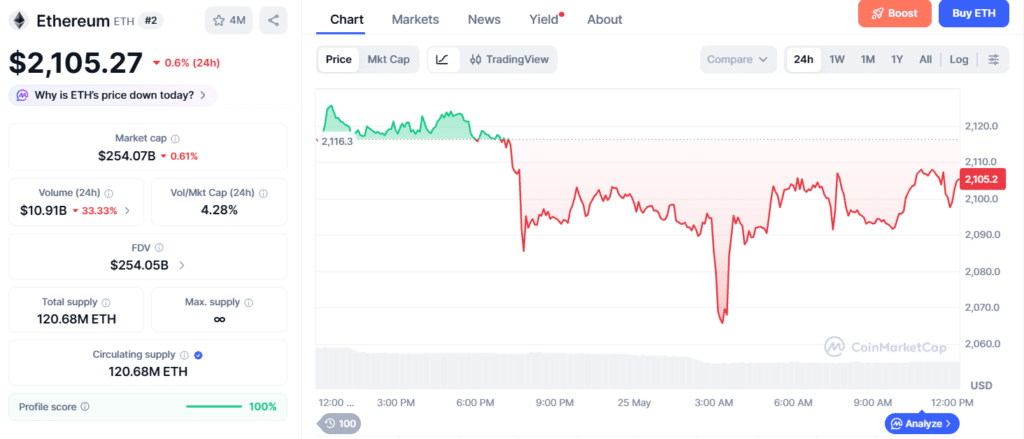
Ethereum bearish outlook has become a major discussion point across crypto markets as weakening spot demand, sustained ETF outflows, and leadership changes inside the Ethereum Foundation continue shaping sentiment around ETH. Ethereum is currently trading around $2,104.44, down 0.62% over the past 24 hours, as investors closely monitor whether the asset can maintain support above the $2,000 level.
- Why Has the Ethereum Bearish Outlook Become a Key Market Debate?
- What Do ETF Flows and Spot Market Trends Show?
- How Are Derivatives Traders Positioning Around ETH?
- Why Are Ethereum Foundation Departures Receiving Attention?
- Could Governance Reforms Reshape Ethereum’s Direction?
- What Still Supports Ethereum’s Long-Term Position?
- Conclusion
- Glossary
- Frequently Asked Questions About Ethereum Bearish Outlook
Santiment data showed ETH-related conversations increased steadily throughout May, but the tone shifted sharply toward frustration, disappointment, and concern over deeper downside risks as traders reacted to softer price action and fading institutional participation. Market observers say the current weakness has evolved into a broader debate over Ethereum’s long-term structure and investment narrative.
While some investors remain cautious about slowing spot demand and internal organizational churn, others argue Ethereum still holds durable advantages through its developer ecosystem, stablecoin dominance, and institutional infrastructure. CryptoQuant data showed the ETH/BTC ratio falling to nearly 0.02758, its lowest point in 10 months, reflecting Ethereum’s weaker relative performance against Bitcoin during recent market conditions. At the same time, long-term supporters of the network maintain that Ethereum’s neutrality-first design and focus on base-layer infrastructure may continue supporting adoption even during periods of market stress.
Why Has the Ethereum Bearish Outlook Become a Key Market Debate?
Ethereum bearish outlook intensified after several indicators across spot trading, derivatives markets, and institutional positioning weakened simultaneously. Santiment analysts observed that while ETH-related discussions increased through May, the broader tone of market commentary turned increasingly negative. Traders expressed frustration over weak spot performance, disappointment around fading momentum, and concern that ETH could face deeper downside pressure if institutional demand continues slowing.

The discussion also intensified as competing layer-1 networks including Solana, Hyperliquid, and Zcash recorded stronger market performance during the same period. At the center of the debate is the Ethereum Foundation’s neutrality-first strategy. The Foundation’s “Mandate” document emphasized censorship resistance, privacy, open-source development, and base-layer security instead of prioritizing token price gains or aggressive commercial expansion.
Supporters view that structure as one of Ethereum’s long-term strengths because it prioritizes decentralization and network resilience. Critics argue the ecosystem currently lacks a commercially focused institution capable of defending ETH’s market position during periods of competitive pressure.
What Do ETF Flows and Spot Market Trends Show?
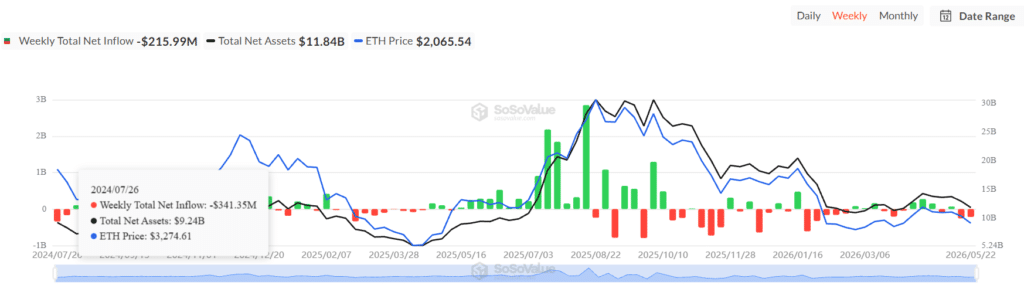
Institutional participation across Ethereum markets has weakened noticeably during the last two quarters. CryptoQuant data showed total fund holdings declining from more than 7 million ETH in October 2025 to around 5.5 million ETH during the ongoing drawdown. Ethereum ETF assets under management also fell to nearly $12.14 billion, representing a 23% decline from January levels.
Data from SoSoValue showed May recorded two consecutive weeks of ETF net outflows totaling roughly $470 million, marking one of the largest periods of concentrated capital withdrawals this year. ETH’s market outlook has also been pressured by weakening US spot demand. The Coinbase Premium Index remained negative throughout May, signaling limited buying activity from American institutional investors.
Liquidity conditions weakened alongside declining fund reserves. CryptoQuant reported that daily fund trading volume dropped below its trailing one-year moving average and recently traded within a range of $17 million to $42 million. Analysts noted that weaker spot accumulation and thinning liquidity have left ETH more vulnerable to volatility during periods of negative news flow.
Still, several long-term Ethereum supporters argue the current slowdown reflects a cyclical market phase rather than a structural breakdown. They point to Ethereum’s continued dominance across stablecoins, tokenized assets, and decentralized finance as evidence the network retains strong long-term infrastructure advantages.
How Are Derivatives Traders Positioning Around ETH?
Ethereum’s derivatives market has developed what analysts describe as a split-market identity, one of the defining themes behind the current market structure. Spot investors have steadily reduced exposure while derivatives traders remain divided between aggressive downside hedging and leveraged long exposure. Data from Block Scholes showed ETH’s seven-day 25-delta risk reversal skew traded near negative 7%, indicating traders were paying elevated premiums for downside protection through put options.
Deribit data revealed put open interest around the $2,100 and $2,000 strike prices exceeded $380 million, placing those support levels at the center of institutional hedging activity. Market participants noted that ETH’s near-term stability now depends heavily on whether the asset can hold above the closely watched $2,000 region. Analysts warned that a breakdown below those levels could trigger liquidation pressure across leveraged positions.
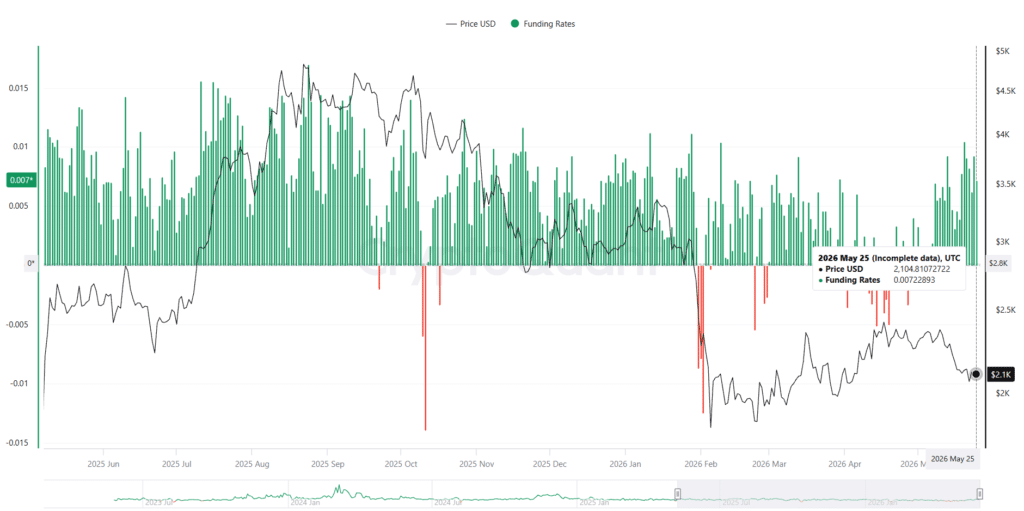
At the same time, perpetual futures traders have not fully abandoned bullish sentiment. CryptoQuant data showed Ethereum’s derivatives funding rate remained positive and reached 0.0082 on May 21, 2026. That divergence between downside hedging and leveraged long exposure has created the possibility of sharp moves in either direction. Analysts noted that if spot demand unexpectedly returns, heavily hedged positioning could amplify a rebound through a sharp short squeeze.
Why Are Ethereum Foundation Departures Receiving Attention?
Leadership changes inside the Ethereum Foundation have become another major focus for market participants during the recent market downturn. Research veterans Carl Beek and Julian Ma recently departed the Foundation. Beek spent seven years contributing to Beacon Chain design, while Ma worked on Ethereum’s Forwarding Oversight Committee for Incentivized Labs framework.
Their exits increased the number of senior departures or step-backs since February to at least nine, including five during May alone. The list includes former co-Executive Director Tomasz Stańczak, board co-steward Josh Stark, Protocol Guild contributor Trent Van Epps, and protocol leads Barnabé Monnot and Tim Beiko. Senior researcher Alex Stokes also began a three-month sabbatical during the same period.
Some ecosystem observers interpreted the departures as evidence of internal disagreement around Ethereum’s governance direction. Tommy Shaughnessy, co-founder of Delphi Ventures, argued the exits reduced the number of reform-oriented voices inside the Foundation. However, others view the changes as part of a broader transition rather than evidence of structural instability.
Ryan Berckmans described the turnover as a generational handoff inside the ecosystem. He argued Ethereum has previously navigated leadership transitions and regulatory pressure while continuing to deliver upgrades including the Merge and blob transactions. Berckmans also pointed to Ethereum’s expanding role in stablecoins, tokenized assets, and institutional blockchain infrastructure as evidence the network still maintains durable adoption drivers despite current market weakness.
Could Governance Reforms Reshape Ethereum’s Direction?
Calls for structural reform have intensified as parts of the market push for stronger commercial coordination around ETH. Former Ethereum Foundation researcher Dankrad Feist proposed creating an independent organization backed by at least $1 billion in capital to support Ethereum’s market relevance and broader financial adoption.
Feist argued the current Foundation controls less than 0.1% of circulating ETH supply and does not directly receive staking yields or transaction fees. In his view, the ecosystem lacks an institution specifically incentivized to strengthen ETH’s position within capital markets. Bankless co-founder Ryan Sean Adams supported the broader idea of adding organizations focused on commercial execution while allowing the Foundation to remain focused on decentralization and public goods.
The discussion has effectively introduced the concept of a dual-institution structure where one organization protects Ethereum’s neutrality and another focuses on market competitiveness and institutional engagement. Supporters of Ethereum’s existing structure argue the neutrality-first approach may appear slower during competitive market cycles, but they believe it remains essential for maintaining long-term trust and operational resilience.
What Still Supports Ethereum’s Long-Term Position?
Even amid weakening market sentiment, several institutional and ecosystem participants continue defending Ethereum’s broader investment case. Thomas Lee, chairman of BitMine, described the current market weakness as a cyclical capitulation phase rather than evidence of long-term structural decline. BitMine currently holds 5.2 million ETH and more than $10 billion in actively staked tokens.

Lee argued Ethereum maintains advantages through its security record, deep liquidity, and institutional familiarity across blockchain markets. Ethereum bearish outlook has also been challenged by the network’s continued leadership in decentralized finance, stablecoin settlement, and tokenized asset issuance.
Galaxy Digital analysts stated Ethereum’s recovery path may depend on executing upgrades such as Glamsterdam and Hegotá while improving operational clarity around ecosystem leadership and commercial priorities. The firm also highlighted Ethereum’s positioning in privacy-focused financial infrastructure, tokenized real-world assets, and AI-linked blockchain systems as areas that could support future adoption.
Conclusion
Ethereum bearish outlook continues to reflect weakening spot demand, persistent ETF outflows, and uncertainty surrounding governance transitions inside the ecosystem. At the same time, the market remains divided between institutional traders hedging against downside risk and speculative traders maintaining leveraged long exposure. That split-market identity has become one of the clearest themes surrounding ETH’s recent performance.
While concerns around liquidity conditions, organizational turnover, and competitive pressure remain active, Ethereum still retains strong positioning across developer activity, stablecoin infrastructure, tokenized assets, and institutional blockchain adoption. For now, the broader market debate centers on whether Ethereum’s neutrality-first structure and long-term infrastructure advantages can outweigh the near-term pressures affecting sentiment and capital flows.
Glossary
Neutrality-First Model: Ethereum’s decentralization-focused approach.
ETF Outflows: Investors pulling money from Ethereum ETFs.
Funding Rate: A signal of bullish or bearish futures sentiment.
Spot Demand: Direct market buying interest for ETH.
ETH/BTC Ratio: Ethereum’s market strength compared with Bitcoin.
Frequently Asked Questions About Ethereum Bearish Outlook
Why is Ethereum bearish outlook growing?
Ethereum bearish outlook is growing due to ETF outflows and weakening spot demand for ETH.
Why are traders watching the $2,000 ETH level?
Traders view $2,000 as a key support level for Ethereum’s market trend.
Could Ethereum recover from the current selloff?
Ethereum could recover if buying demand and investor confidence improve again.
What still supports Ethereum’s long-term growth?
Ethereum still benefits from strong adoption in DeFi, stablecoins, and blockchain infrastructure.
What are analysts expecting next for Ethereum?
Analysts expect continued volatility as markets track ETF flows and ETH demand.