

Ethereum price prediction trends are turning increasingly cautious as silent selling pressure spreads across the market. Ethereum’s silence is now becoming louder than Bitcoin’s rallies, and traders are starting to question whether institutional confidence is quietly fading beneath the surface.
According to the source, rising Ethereum spot selling pressure has sparked fears that large investors may already be reducing exposure while retail traders continue betting on a breakout. Ethereum’s price has remained unusually weak for weeks, creating frustration among traders who expected stronger momentum after recent crypto market rallies.
Weeks of Weak Ethereum Price Action Shake Market Confidence
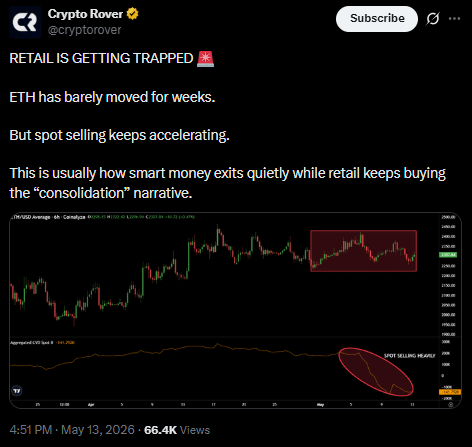
Ethereum has struggled to regain strength despite broader crypto volatility. Over recent weeks, ETH repeatedly failed to sustain breakout attempts, leaving traders trapped inside a prolonged consolidation range.
Verified data showed Ethereum trading near $3,250 at publication time. That stagnant movement has become one of the market’s biggest concerns because prolonged weak Ethereum price action often signals fading buyer confidence.
The latest Ethereum price prediction outlook reflects growing uncertainty as Ethereum momentum continues slowing. What initially appeared to be healthy Ethereum consolidation is now beginning to resemble market exhaustion.
Many traders expected Ethereum to follow Bitcoin’s recovery path. Instead, ETH continued drifting sideways while buying pressure weakened steadily. That shift has started changing market psychology fast.
Ethereum Spot Selling Fuels Quiet Distribution Fears
The growing rise in Ethereum spot selling has become difficult for traders to ignore. Spot markets reflect actual ownership transfers, making them more important than leveraged futures activity when analyzing investor behavior.
Professional investors often reduce exposure gradually during calm market periods. This strategy allows institutions to exit positions quietly without triggering immediate panic selling. Historically, similar low-volatility distribution patterns have appeared before larger crypto corrections.
According to recent on-chain market research, institutional selling pressure during quiet trading periods often signals weakening confidence among experienced market participants.
One analyst recently described the current market structure bluntly, saying, “The market is showing signs of silent distribution.” That growing fear is now shaping the broader Ethereum price prediction narrative.
Meanwhile, retail investors still view Ethereum’s sideways structure as temporary consolidation before another rally begins.
Ethereum Price Prediction Turns Defensive as ETF Demand Weakens
The latest Ethereum price prediction models are becoming more defensive as traders closely monitor ETF inflows, exchange activity, and whale behavior.
ETF demand remains especially important because it reflects institutional participation. Weak ETF inflows often suggest large investors are becoming more cautious toward Ethereum exposure. Rising exchange inflows can also indicate growing intent to sell.
Analysts monitoring on-chain market data recently noted increasing whale activity alongside weakening Ethereum momentum. That combination has historically increased volatility risks across crypto markets.
At the same time, growing Ethereum spot selling pressure continues adding uncertainty to an already fragile market structure. Some traders now worry that institutional selling pressure may continue quietly unless Ethereum regains strong momentum soon.
Retail Optimism and Smart Money Fear Are Moving Apart
The biggest concern surrounding the current Ethereum price prediction outlook is the widening disconnect between retail traders and institutional investors.
Retail investors often interpret stable price action as strength, especially after bullish rallies. Many still believe Ethereum is simply preparing for another breakout phase.
Institutions, however, usually operate differently. Smart money tends to reduce exposure gradually rather than exiting aggressively all at once. Quiet distribution during low-volatility conditions allows large investors to preserve liquidity while avoiding major disruptions.
That difference in positioning now sits at the center of the market debate. Rising Ethereum spot selling continues fueling fears that experienced investors may already be positioning defensively while retail optimism remains elevated.
Ethereum still dominates decentralized finance, staking ecosystems, NFTs, and blockchain infrastructure. Because of that influence, prolonged weakness in ETH could eventually pressure the wider altcoin market as well.

Conclusion
The latest Ethereum price prediction debate reflects far more than short-term price weakness. Weeks of stagnant Ethereum price action, fading momentum, and accelerating Ethereum spot selling have created growing fears that institutional confidence may be slipping quietly behind the scenes.
Retail traders continue hoping for a breakout, yet smart money fears are becoming increasingly difficult to dismiss. Crypto history has repeatedly shown that low-volatility distribution phases often appear calm before volatility returns sharply. Whether Ethereum rebounds or faces deeper pressure ahead, the market is clearly entering a more cautious and emotionally divided phase.
This article is for informational purposes only and does not constitute financial advice. Readers should conduct their own research before making investment decisions.
Glossary of Key Terms
Ethereum Spot Selling: Direct ETH selling involving real ownership transfers in spot markets.
Ethereum Consolidation: A sideways trading phase before a stronger market move develops.
Whale Activity: Large transactions from major crypto holders capable of influencing prices.
ETF Inflows: Capital entering crypto investment funds linked to institutional demand.
Smart Money: Institutional or experienced investors using advanced market strategies.
FAQs About Ethereum Price Prediction
Why is Ethereum price action considered weak?
Ethereum has failed several breakout attempts and remained stuck in sideways trading for weeks.
Why does Ethereum spot selling matter?
It reflects real investor behavior and may signal weakening institutional confidence.
How do ETF inflows affect Ethereum?
Strong ETF inflows usually indicate rising institutional demand and market confidence.
What is low-volatility distribution?
It refers to institutions quietly reducing positions during calm market conditions.