



This article was first published on Deythere.
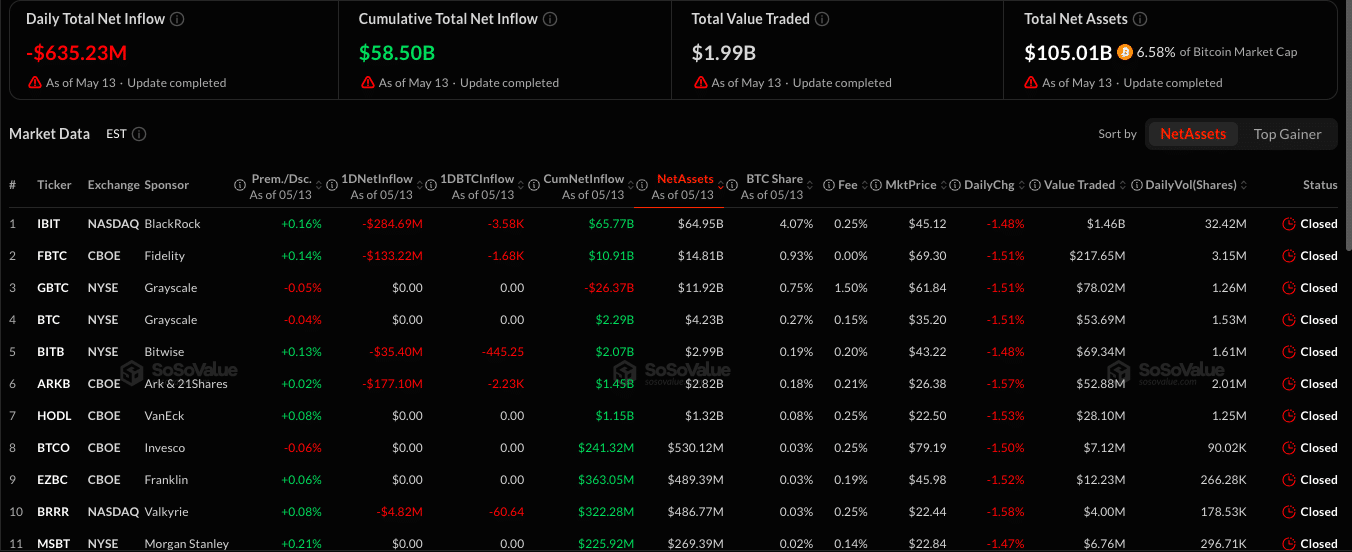
Bitcoin ETF outflows returned in full force on May 13, after weeks of mostly stable institutional flows, with U.S. spot Bitcoin ETFs seeing around $635 million worth of net redemptions.
The abrupt reversal took place as Bitcoin continued sitting in the $79,000-$80,000 range without a clear catalyst for a rally. Market data showed that many of the largest ETF products saw investors moving money out, with nearly $285 million worth accounted for from BlackRock’s iShares Bitcoin Trust (IBIT).
This is recorded as one of largest single -day Bitcoin ETF outflow sessions in the last few weeks, though still well below the extreme redemption periods seen earlier in 2026.
BlackRock’s IBIT Faces Rare Pressure
Since its launch, BlackRock’s IBIT has been the spot Bitcoin ETF to dominate inflows, this has made last week’s outflow more notable.
The fund received billions of institutional money back in April and early May as Bitcoin was recovering from previous lows. Some analysts now believe the latest selling means profit-taking after that rebound and not necessarily a collapse in institutional demand.
During macro uncertainty, Bitcoin ETF outflows tend to increase, especially when BTC price turns sideways. Bitcoin has seen multiple rejections at key resistance levels causing some institutional traders to make temporary adjustments to reduce their exposure.
However, despite all these, BlackRock remains on top of the ETF market by AUM and cumulative fund inflows.
Bitcoin Holds Near $80,000 Despite Outflows
One important detail though is the muted reaction from Bitcoin itself.
Even after the ETF data broke, BTC was still hovering around, close to the $79,500-$80,000 area. This means spot demand continues to absorb more of the selling pressure in the market.
Earlier this year, similar flows out of such ETFs resulted in sharper corrections. Price stability in the short-term shows that some long-term buyers are still here, at least in spite of weaker sentiment.
That has now led analysts to watch two key levels:
Support around $78,000; Resistance between $82,000 and $84,000
If Bitcoin’s performance breaks above resistance, this will restart bullish momentum, while continued BTC outflows from ETFs will create pressure that could push Bitcoin back down towards lower supported areas.
Ethereum ETFs Also Record Redemptions
Spot Ethereum ETFs also saw net outflows with BlackRock’s Ethereum ETF seeing its own share of the selling. This drop across Bitcoin and Ethereum products implies that institutional investors are reacting more to macro conditions; than asset-specific weakness.
Treasury yields continue to weigh on risk appetite across crypto and equities; with fears that rising inflation will see a less accommodative future for monetary policy from the Federal Reserve.
Additionally; regulatory developments remain a longer term positive catalyst. Market participants are keeping an eye on the US crypto legislation progress and the CLARITY Act discussions in Washington.
Why Bitcoin ETF Outflows Matter
Since launching in the US, spot ETF flows have become one of the most important indicators of institutional interest in the crypto market.
Usually strong inflows support Bitcoin rallies, as ETF issuers need to buy BTC to cover newly issued shares. Outflows can create the opposite effect by increasing selling pressure or weakening market sentiment.
While $635 million is a massive outflow, previous peaks above $800million and in some cases, over $1 billion from corrections in 2025 as well as early 2026 produced larger redemption sessions.
This implies that the current conditions look more like institutional repositioning than panic exits.
Conclusion
Bitcoin ETF outflows spiked high recently as BlackRock’s IBIT saw institutional investors scale back exposure while Bitcoin consolidated near $80,000
However; the overall market structure is quite intact. Bitcoin held key support despite heavy redemptions; cumulative ETF inflows stayed strong overall and institutional participation continued to grow.
The next few trading sessions will likely determine whether the latest outflows were temporary profit-taking or the beginning of a larger institutional cooldown.
Glossary
Bitcoin ETF: A regulated investment fund that tracks the price of Bitcoin.
IBIT: BlackRock’s Cryptocurrency ETF, the iShares Bitcoin Trust ETF
ETF Outflows: Amount of capital investors take out from exchange-traded funds.
Spot Bitcoin ETF: An exchange-traded fund (ETF) that is backed directly by Bitcoin holdings rather than futures contracts.
Frequently Asked Questions About Bitcoin ETF Outflows
What are Bitcoin ETF outflows?
Bitcoin ETF outflows take place when investors pull money from spot Bitcoin exchange-traded funds (ETFs) by redeeming shares; forcing the ETF to sell Bitcoin in order to pay off the withdrawing investors.
Which ETF saw the biggest outflow?
IBIT from BlackRock had the largest reported outflow at nearly $285 million leaving.
Did Bitcoin crash after the ETF outflows?
Not at all; Bitcoin continues to trade around the $79,000-$80,000 range despite these large outflows.
Are institutional investors leaving Bitcoin?
With current data, it appears institutions are merely repositioning rather than exiting the market.