

Altcoin season remains one of the most closely watched themes in the cryptocurrency market, yet recent market data suggests the long-anticipated shift away from Bitcoin has not fully arrived. While several indicators point to growing interest in alternative digital assets, broader participation across the sector remains limited.
- What Is Driving The Altcoin Season Debate?
- What Does The Divergence Between Key Indicators Reveal?
- Why Is Ethereum Playing Such A Critical Role?
- What Are On-Chain Metrics Saying About Market Participation?
- Could Recent Altcoin Winners Signal A Broader Shift?
- Conclusion
- Glossary
- Frequently Asked Questions About Altcoin Season
Market observers are increasingly focused on whether current conditions represent the early stages of a wider rotation or simply a selective move into a handful of outperforming assets. Recent trading activity has strengthened the case for an altcoin rally.
However, key indicators linked to market breadth and capital distribution continue to show that investors are not yet committing funds across the wider altcoin ecosystem. That divergence has become one of the most important developments traders are monitoring as June begins.
What Is Driving The Altcoin Season Debate?
The data suggests that capital rotation is occurring, but only in selected areas of the market. Bitcoin has continued to outperform most major digital assets during the second quarter. $BTC is up more than 6% in Q2 so far, while many large-cap cryptocurrencies remain in negative territory for the quarter.

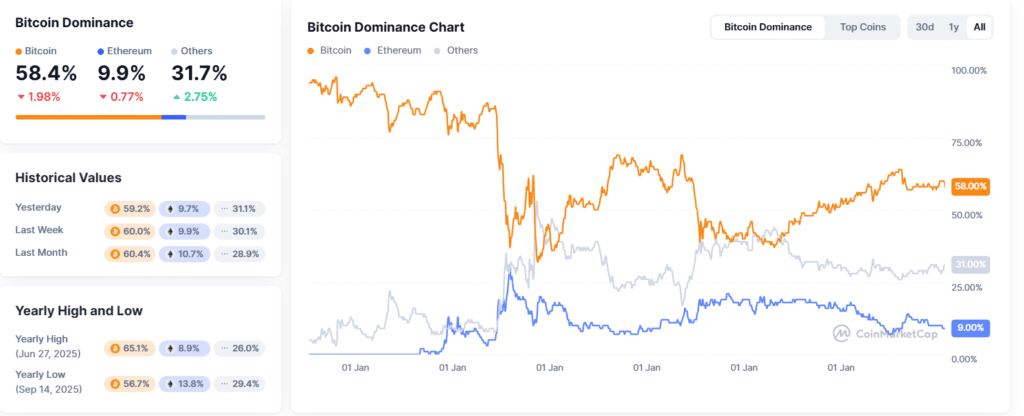
Recent market composition data also points to subtle shifts beneath the surface. Bitcoin currently represents 58.4% of the total cryptocurrency market, with its dominance down 1.98%. Ethereum accounts for 9.9% of the market, while its dominance has declined by 0.77%.
Meanwhile, other cryptocurrencies now hold a combined 31.7% market share, reflecting a 2.75% increase. The changes suggest that market participation is gradually expanding beyond Bitcoin and Ethereum. That trend is also reflected in the OTHERS/BTC ratio, which tracks altcoin performance relative to Bitcoin.
The ratio has gained more than 6% during Q2 and recorded a strong 14.5% rise in May, suggesting that selective inflows into alternative cryptocurrencies are continuing. Despite those gains, the broader market has not entered a confirmed altcoin season phase. Participation remains concentrated rather than widespread
What Does The Divergence Between Key Indicators Reveal?
The answer appears to be that capital is rotating selectively instead of broadly. Data from BlockchainCenter shows the Altcoin Season Index ended May down more than 10%, highlighting the gap between improving performance in certain altcoins and weaker participation across the wider market.
The index currently stands at 41 out of 100, keeping the market within Bitcoin Season territory rather than signaling a broad-based rotation into altcoins. The current reading also remains well below the index’s yearly high of 78, recorded on September 20, 2025, when market conditions reflected a significantly stronger altcoin environment.
By comparison, the yearly low of 14 was recorded on December 19, 2025, underscoring how strongly Bitcoin has dominated market leadership during the past year. The disconnect suggests that only a limited number of assets are attracting investor interest.
While some traders view rising altcoin performance against Bitcoin as an encouraging sign, the broader index indicates that most cryptocurrencies have yet to participate meaningfully in the move. As a result, the recent improvement in altcoin-related indicators appears to reflect targeted positioning in select assets rather than the beginning of a full altcoin season.
Why Is Ethereum Playing Such A Critical Role?
Ethereum remains a major piece of the puzzle. Many traders view June as a potential turning point for the market. Expectations of improving regulatory clarity have fueled hopes that investors may become more willing to move further along the risk curve. However, Ethereum continues to lag behind expectations.
ETH is still trading nearly 60% below its previous cycle high, making its performance a key factor in determining whether a broader altcoin season can develop. One market analyst recently noted that Hyperliquid (HYPE) has continued to trend higher, but that strength has not translated into broader participation across the altcoin market.
Instead, capital remains concentrated in a small group of outperformers. Until Ethereum and its DeFi ecosystem begin attracting stronger inflows, analysts believe the broader market may struggle to build sustained momentum.
What Are On-Chain Metrics Saying About Market Participation?
Current blockchain data points to continued caution among investors. Data from DeFiLlama shows Ethereum’s total value locked has declined back toward the $40 billion level. That area was last seen during the first quarter of 2024.
At the same time, stablecoin supply on the Ethereum network remains roughly $6 billion below its previous peak of $166 billion. These metrics provide measurable evidence rather than speculation.
Analysts often view rising TVL and stablecoin growth as indicators of increasing investor confidence and network activity. Their absence helps explain why enthusiasm surrounding altcoin season remains restrained despite isolated pockets of strength.
Could Recent Altcoin Winners Signal A Broader Shift?
Some traders believe recent gains among smaller cryptocurrencies could be early evidence of changing market behavior. Several alternative tokens have significantly outperformed Bitcoin and Ethereum in recent days, helping revive discussions around capital rotation.

Market participants have pointed to this performance as evidence that investors may be beginning to explore opportunities beyond the largest cryptocurrencies. Crypto trader Don Wedge argued that the market could be emerging from a prolonged accumulation phase after years of underperformance.
However, he also cautioned that a move above the 0.146 level on his tracked chart would be needed before confirming a broader rotation. Until then, he described the current setup as an early indication rather than confirmation of a full altcoin season.
Not all market observers agree with the bullish interpretation. Some analysts argue that strength in individual sectors does not necessarily indicate a market-wide expansion, particularly when capital remains concentrated in only a few assets.
Conclusion
Altcoin season remains an incomplete story rather than a confirmed market reality. While the OTHERS/BTC ratio has strengthened and certain cryptocurrencies are attracting capital, broader participation across the sector remains limited.
Several key indicators continue to tell the same story. The Altcoin Season Index remains in Bitcoin Season territory at 41, Bitcoin accounts for 58.4% of the crypto market, and Ethereum has yet to attract the stronger inflows that many traders have been looking for.
For now, the evidence suggests investors are selectively allocating capital rather than embracing the entire altcoin market. Until Ethereum’s ecosystem records stronger inflows and participation expands beyond a handful of outperformers, altcoin season may continue to remain out of reach.
Glossary
Altcoin Season: When altcoins outperform Bitcoin.
Bitcoin Dominance: Bitcoin’s percentage of the crypto market.
Altcoin Season Index: A gauge of altcoin strength versus Bitcoin.
OTHERS/BTC Ratio: A measure of altcoin performance against Bitcoin.
Capital Rotation: Money moving between different assets.
Frequently Asked Questions About Altcoin Season
Has altcoin season started yet?
No, current market data does not indicate that a full altcoin season has started.
What does the Altcoin Season Index currently show?
The Altcoin Season Index is at 41, which still places the market in Bitcoin Season territory.
Why are some traders optimistic about altcoins?
Some traders believe rising altcoin activity could signal early capital rotation beyond Bitcoin.
How much has the OTHERS/BTC ratio gained recently?
The OTHERS/BTC ratio has increased more than 6% in Q2 and rose 14.5% in May.
How far is Ethereum below its previous cycle high?
Ethereum remains nearly 60% below its previous cycle peak.