


This article was first published on Deythere.
- A Failed ICO That Never Lived Up To Its Promises
- An Old Overflow Bug Became The Secret To Getting The Funds Out
- Getting The Funds Out Was A Team Effort
- Why The HongCoin Recovery Matters
- Conclusion
- Glossary
- Frequently Asked Questions About Hong on Recovery
- What is the HongCoin recovery?
- How much ETH was recovered?
- Why were the funds locked up for years?
- Can the same method be used to recover other lost crypto funds?
- References
Nearly a decade after a failed Ethereum fundraising campaign left investors stranded, a security researcher has finally come to the rescue and reopened access to over 1,003 ETH that was locked inside the HongCoin smart contract.
The HongCoin recovery process was carried out by researcher 0xFlorent in cooperation with holders who had originally set up HongCoin’s multisignature wallet. Together, they restored eligibility for 48 investors to claim funds that had been inaccessible since 2016.
Given that Ethereum’s price as of June 1 was roughly $1,983, the recovered 1,003.62 ETH was worth $1.99 million.
A Failed ICO That Never Lived Up To Its Promises
HongCoin launched its token sale on Aug. 29, 2016, and concluded on Oct. 28, 2016. The project, which promised to be a decentralized venture fund style initiative, failed to hit its fundraising targets. Investors were supposed to get their cash back out through the smart contract but this never happened for many participants.
The flaw in the refund process gradually prevented larger token holders from withdrawing their ETH.
As each refund was processed, the contract’s accounting variable or “tokensCreated” as it was called, kept declining. Eventually, some investors had token balances that were bigger than the remaining counter, and so the contract started rejecting their refund requests even though they were perfectly valid.
This created a situation where investors were entitled to refunds but just couldn’t get access to them because of the contract’s own internal checks.
An Old Overflow Bug Became The Secret To Getting The Funds Out
The breakthrough came from another piece of old code.
Apparently, 0xFlorent found that a multisig-restricted admin function contained an integer-overflow vulnerability that had been built into early versions of Solidity. Before version 0.8 of Solidity, if an arithmetic operation overwrote the end of the number it would just wrap around instead of automatically reverting.
By carefully using that admin function, the researcher was able to reset the token balances for the investors that had been locked out to levels that the contract’s internal checks would allow, and then they were able to claim their refunds.
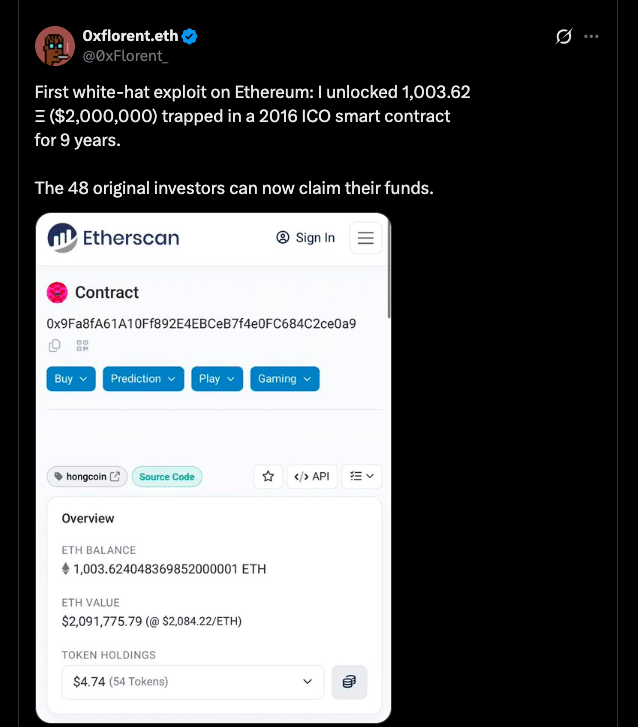
In a post on X, 0xFlorent wrote :
“First white-hat exploit on Ethereum: I unlocked 1,003.62 ETH ($2,000,000) trapped in a 2016 ICO smart contract for 9 years. The 48 original investors can now claim their funds.”
This recovery required the cooperation of HongCoin’s original multisig holders as the vulnerable function could only be executed through the project’s multisignature wallet.
Getting The Funds Out Was A Team Effort
For this HongCoin recovery to work, It reportedly took 41 different signed transactions to process the refunds for the investors that were blocked, while a handful of seven smaller investors were able to get their refunds out without needing any assistance.
The original multisig holders had to sign off on each transaction to make sure it was legitimate, creating a clear authorization trail for every action taken.
A transaction on May 29 managed to trigger the refund function and generated a transfer of 96 ETH to one investor’s address. Reports say that at least two investors have already reclaimed a combined 96.5 ETH.
That makes a difference because the recovery reopened eligibility to claim those funds although it didn’t automatically hand out all the remaining ETH.
Why The HongCoin Recovery Matters
The HongCoin recovery has opened up one of the lesser-discussed aspects of Ethereum. Smart contracts can somehow hold onto both the mistakes that were made and the possible fixes for years.
Many trapped crypto funds never get returned because the contracts are missing active administrators, proper documentation or identifiable beneficiary information.
HongCoin however had an unusual combination of factors; a fixable bug, a working multisig, identifiable claimants, and a researcher who had been investigating responsibly. That makes the case difficult to replicate elsewhere.
Still, the event has created new discussion about dormant Ethereum contracts and forgotten assets. According to a report from 2025 that was cited by Coinbase’s Conor Grogan, over 913,111 ETH may have been lost for good due to contract failures, burn addresses, and user errors.
The HongCoin recovery shows that while it might not be easy, some of the funds that people thought were out of reach might actually be recoverable under the right circumstances.
Conclusion
Ethereum’s history has bigger recovery controversies going back to the 2016 DAO hard fork and the 2017 Parity multisig wallet incident which froze 513,774.16 ETH across 587 wallets. Compared to those events, HongCoin is relatively small.
Even so, it resonates because it shows how decisions made during Ethereum’s earliest development era can continue to affect users years later.
For the 48 investors who just got their ETH back, the HongCoin recovery finally closes a chapter that started nearly 10 years ago.
For the entire crypto industry, it serves as another reminder that blockchain immutability preserves everything from successful code, broken code, and occasionally the forgotten escape route that makes recovery possible.
Glossary
HongCoin: A decentralized venture fund style Ethereum project that launched in 2016 but unfortunately it never got off the ground as its ICO fell short.
Initial Coin Offering (ICO): A fundraising method used by blockchain projects to raise money by selling tokens to investors in return for some ETH or other cryptocurrencies.
Smart Contract: A self-executing program that gets deployed on a blockchain; If certain conditions are met, it takes action automatically.
Whitehat Researcher: A security expert who spots vulnerabilities and instead of just using them for their own gain, works to sort out the problem or responsibly lets the project teams know about it.
Multisignature Wallet (Multisig): A type of wallet that needs more than just one person to sign off on transactions before they can happen.
Overflow Bug: A coding issue that occurs when a mathematical operation exceeds a variable’s storage limit, causing the value to wrap around unexpectedly in older software environments.
Frequently Asked Questions About Hong on Recovery
What is the HongCoin recovery?
The HongCoin recovery refers to the successful unlocking of 1,003.62 ETH that had been trapped inside the failed HongCoin ICO smart contract since 2016. A whitehat researcher known as 0xFlorent worked with the project’s original multisig signers to restore access to the funds.
How much ETH was recovered?
1,003.62 ETH was recovered. At Ethereum’s price of roughly $1,983 on June 1, it is worth around $1.99 million.
Why were the funds locked up for years?
The funds were locked because there was a flaw in HongCoin’s refund mechanism. As investors went to claim refunds, this variable decreased, and eventually some of the bigger token holders failed the contract’s refund eligibility check even though they were legitimate claimants.
Can the same method be used to recover other lost crypto funds?
It is unlikely. The HongCoin recovery was one of a kind because it needed a very specific set of factors, including an operational administrative control path, identifiable claimants, recoverable contract logic and the cooperation of the original multisig signers. Many abandoned contracts don’t have all that in place.