

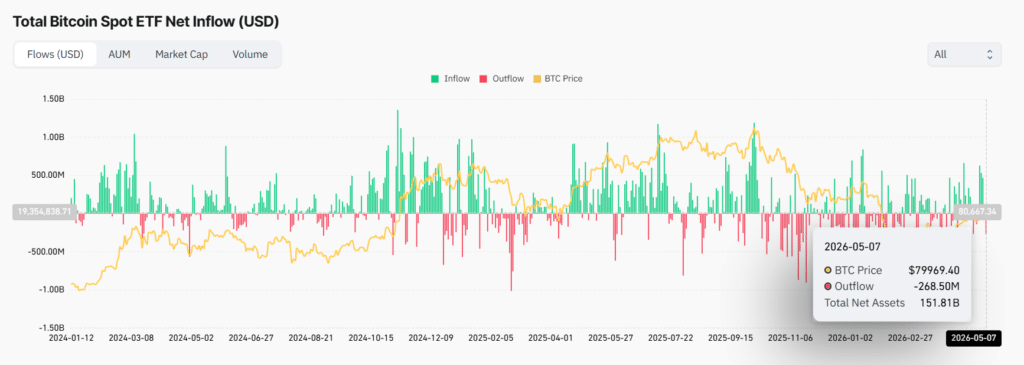
Bitcoin ETF outflows returned to focus after U.S. spot Bitcoin ETFs recorded $268.5 million in net withdrawals on May 7, signaling a sharp shift in short-term institutional sentiment toward the crypto market. The latest movement ended a five-day inflow streak and added fresh pressure on Bitcoin as traders closely monitored whether fund managers were reducing exposure or temporarily repositioning capital amid volatile market conditions.
- What Do Bitcoin ETF Outflows Reveal About Market Direction?
- Which Funds Recorded the Largest Withdrawals?
- How Are Spot Bitcoin ETFs Performing Overall?
- Why Are Traders Watching ETF Flows So Closely?
- Could Selling Pressure Continue in the Near Term?
- What Could Happen to Bitcoin if ETF Flows Remain Weak?
- Conclusion
- Glossary
- Frequently Asked Questions About Bitcoin ETF Outflows
- Which Bitcoin ETF saw the biggest withdrawal?
- How much money left Bitcoin ETFs recently?
- How much BTC left spot Bitcoin ETFs during the session?
- What is the current total asset value of spot Bitcoin ETFs?
- Did any Bitcoin ETFs still record inflows?
- What price was Bitcoin trading at during the ETF outflows?
- Sources
Bitcoin is currently trading around $79,423.81. The sudden reversal in ETF activity has become an important signal for digital asset investors because spot Bitcoin ETFs are widely viewed as a direct indicator of institutional confidence. While Bitcoin continued trading in the upper-$70,000 range, the scale of the withdrawals raised concerns about weakening momentum in the near term.
What Do Bitcoin ETF Outflows Reveal About Market Direction?
Bitcoin ETF outflows often reflect how institutional investors are positioning themselves in the market. When large amounts of capital leave spot Bitcoin ETFs, traders usually interpret it as a sign of caution or reduced appetite for risk. The data showed total net outflows of approximately $268.46 million across U.S. spot Bitcoin ETFs.

The withdrawals came after several days of positive inflows, indicating that investor sentiment may be turning more defensive in the short term. Market participants continue to monitor ETF activity closely because these products provide regulated exposure to Bitcoin and are frequently used by institutional investors to manage portfolio positioning.
Which Funds Recorded the Largest Withdrawals?
Several major spot Bitcoin ETFs recorded notable withdrawals during the session. Fidelity’s FBTC posted the largest outflow at $128.99 million, while BlackRock’s IBIT saw $98.02 million leave the fund. Grayscale’s GBTC registered $26.78 million in outflows. Ark’s ARKB lost $12.62 million while Invesco’s BTCO recorded withdrawals of $9.97 million.
VanEck’s HODL also reported $5.10 million in net outflows. Despite the broader negative trend, a few products still attracted capital. Morgan Stanley’s MSBT posted inflows of $7.35 million and Grayscale’s Mini Bitcoin ETF added $5.67 million. Bitwise’s BITB, Franklin’s EZBC, Valkyrie’s BRRR, and WisdomTree’s BTCW recorded no net flows during the trading session.
How Are Spot Bitcoin ETFs Performing Overall?
Despite the latest wave of Bitcoin ETF outflows, the broader U.S. spot Bitcoin ETF market continues to reflect strong institutional participation over the long term. Total net inflows across spot Bitcoin ETFs have reached $59.91 billion since launch, representing nearly 757.42K BTC accumulated by ETF products.
Daily flows, however, shifted into negative territory after $268.50 million exited spot Bitcoin ETFs in a single trading session. The withdrawals were equivalent to almost 3.30K BTC leaving ETF holdings, adding short-term pressure on market sentiment.
Trading activity across the ETF sector remained active, with daily volume reaching $3.39 billion. Total net assets held by U.S. spot Bitcoin ETFs currently stand at $108.76 billion, underlining the sector’s growing role in the digital asset investment landscape.
Why Are Traders Watching ETF Flows So Closely?
Bitcoin ETF outflows have become one of the most closely watched indicators in the crypto market because they provide insight into institutional demand trends. Strong inflows into spot Bitcoin ETFs are generally associated with rising confidence and improving market sentiment. In contrast, sustained withdrawals can increase bearish pressure and weaken short-term momentum.
Analysts tracking ETF activity noted that the latest decline may not necessarily indicate a long-term structural change. Some market observers view the movement as part of the ongoing rotation between inflow and outflow periods that has characterized ETF trading in recent months. Still, Bitcoin ETF outflows at this scale can influence sentiment quickly because they often shape expectations around future buying pressure.
Could Selling Pressure Continue in the Near Term?
Short-term market sentiment has turned cautious following the latest ETF withdrawals. Market data highlighted bearish positioning, with Bitcoin futures long-short ratios and negative funding rates reflecting weaker confidence among traders. Analysts monitoring recent activity said continued ETF outflows could increase short-term supply pressure and limit Bitcoin’s upward momentum if institutional demand remains soft.
At the same time, some market participants believe the current weakness could remain temporary. Bitcoin ETF outflows have alternated with inflows several times in recent months, preventing analysts from confirming whether the latest move represents a broader reversal trend.
What Could Happen to Bitcoin if ETF Flows Remain Weak?
Bitcoin ETF outflows may continue to influence short-term market sentiment if institutional demand remains under pressure. Analysts tracking recent fund activity said the latest withdrawals appear linked to short-term positioning rather than a structural shift away from Bitcoin exposure. Even with the latest withdrawals, spot Bitcoin ETFs remain one of the main channels used by institutional investors to gain exposure to Bitcoin.

Some funds also recorded modest inflows during the same trading session, showing that investor positioning remains mixed. Traders now watch closely to see if ETF inflows pick back up in coming sessions. A demand recovery could steady sentiment while ongoing outflows might cap near-term upside.
Conclusion
Bitcoin ETF outflows have raised concerns about weakening institutional demand, but market sentiment could still improve if capital returns to spot Bitcoin funds in the coming days. ETF flows continue to act as a real-time measure of investor confidence in Bitcoin.
While the latest data reflected caution, it also reinforced how quickly sentiment can shift in the digital asset market. For now, traders are likely to remain focused on daily ETF flow reports as they evaluate whether the recent $268.5 million withdrawal was a temporary pause in demand or the beginning of a broader cooling period for Bitcoin exposure.
Glossary
Spot Bitcoin ETF: A fund that follows Bitcoin’s real price.
Net Outflows: More money leaving a fund than entering.
ETF Inflows: New investor money entering ETF funds.
Portfolio Repositioning: Investors reshuffling assets during market changes.
Regulated Exposure: Safe market access through approved financial products.
Frequently Asked Questions About Bitcoin ETF Outflows
Which Bitcoin ETF saw the biggest withdrawal?
Fidelity’s FBTC recorded the largest outflow during the session.
How much money left Bitcoin ETFs recently?
About $268.5 million in Bitcoin ETF outflows were recorded across U.S. spot Bitcoin ETFs on May 7.
How much BTC left spot Bitcoin ETFs during the session?
Around 3.30K BTC exited U.S. spot Bitcoin ETFs in one trading day.
What is the current total asset value of spot Bitcoin ETFs?
U.S. spot Bitcoin ETFs currently manage around $108.76 billion in assets.
Did any Bitcoin ETFs still record inflows?
Yes, Morgan Stanley’s MSBT and Grayscale’s Mini Bitcoin ETF posted small inflows.
What price was Bitcoin trading at during the ETF outflows?
Bitcoin traded around $79,423 during the latest Bitcoin ETF outflow session.