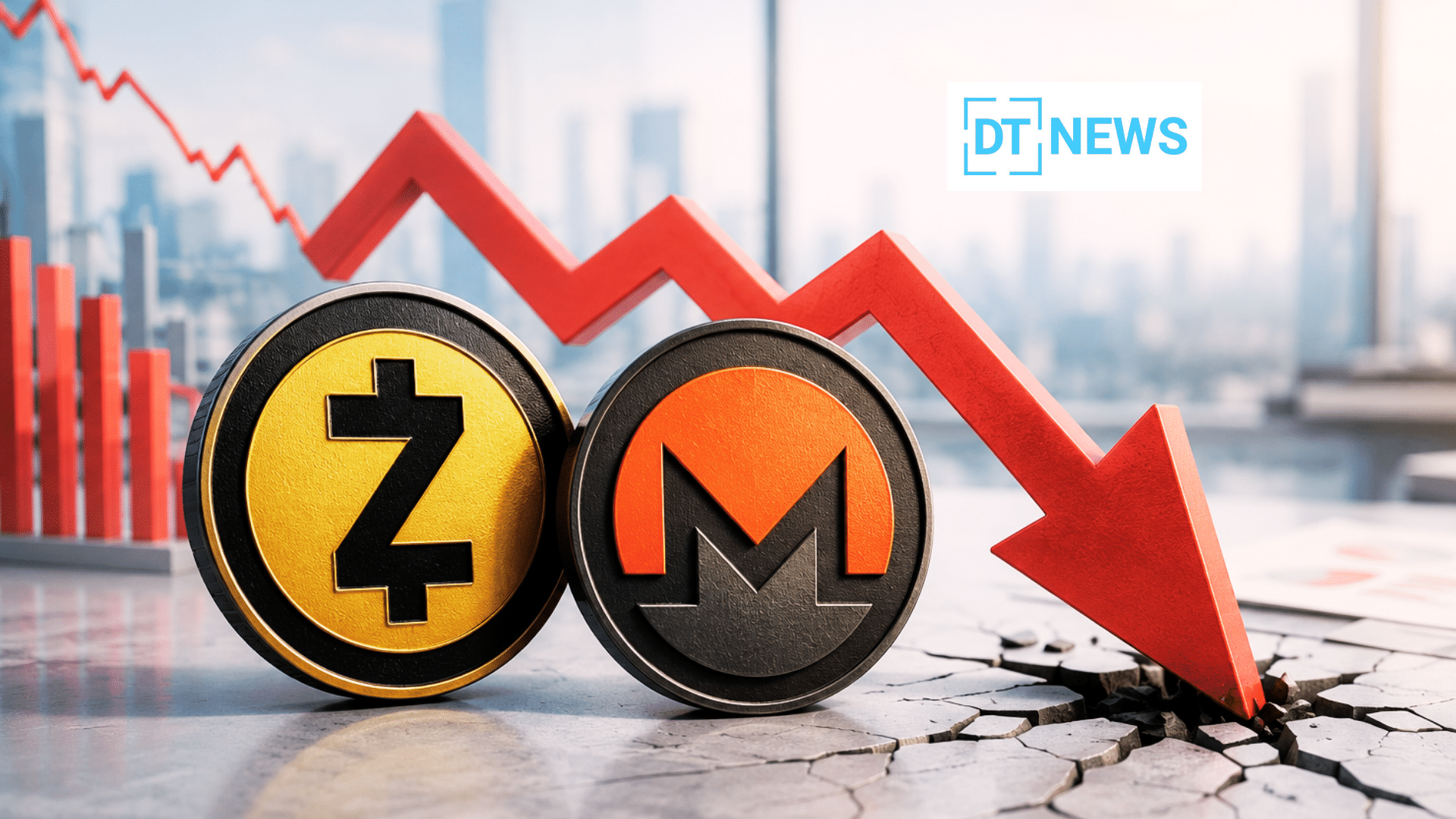

Privacy token markets turned volatile after renewed tensions in the Middle East pushed traders toward caution across crypto and commodity markets. Zcash and Monero posted some of the sharpest declines among major digital assets as investors reacted to fresh US military action linked to Iran and rising oil prices.
- How Did Privacy Token Assets React To The Market Pullback?
- Why Are Investors Watching Privacy Token Trends More Closely?
- What Happened Across The Broader Crypto Market?
- How Did US Military Action Influence Market Sentiment?
- Why Are Oil Prices And Inflation Concerns Important For Crypto?
- Conclusion
- Glossary
- Frequently Asked Questions About Privacy Tokens
Even with the latest decline, both assets remained among the strongest weekly performers in crypto, reflecting how recent institutional interest and privacy-focused narratives had fueled their rally before the pullback began. Broader crypto markets mostly stayed rangebound during the session, while traders closely watched oil prices, the US dollar, and geopolitical developments around the Strait of Hormuz.
How Did Privacy Token Assets React To The Market Pullback?
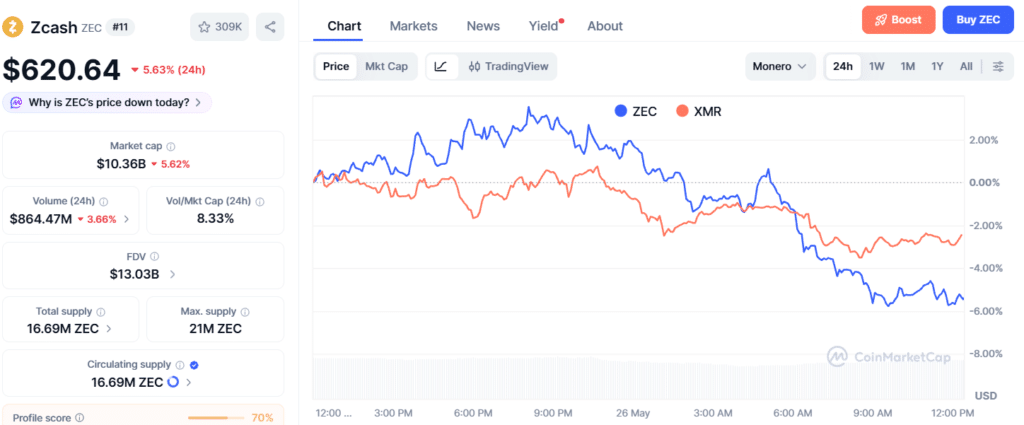
Privacy token assets were among the weaker performers during the latest crypto retreat as traders locked in gains following a strong multi-week rally. Zcash (ZEC) fell 5.70% over the past 24 hours to $622.33, underperforming a slightly negative broader crypto market. Monero (XMR) declined 2.62% to $379.80 during the same period as sentiment across major digital assets weakened.
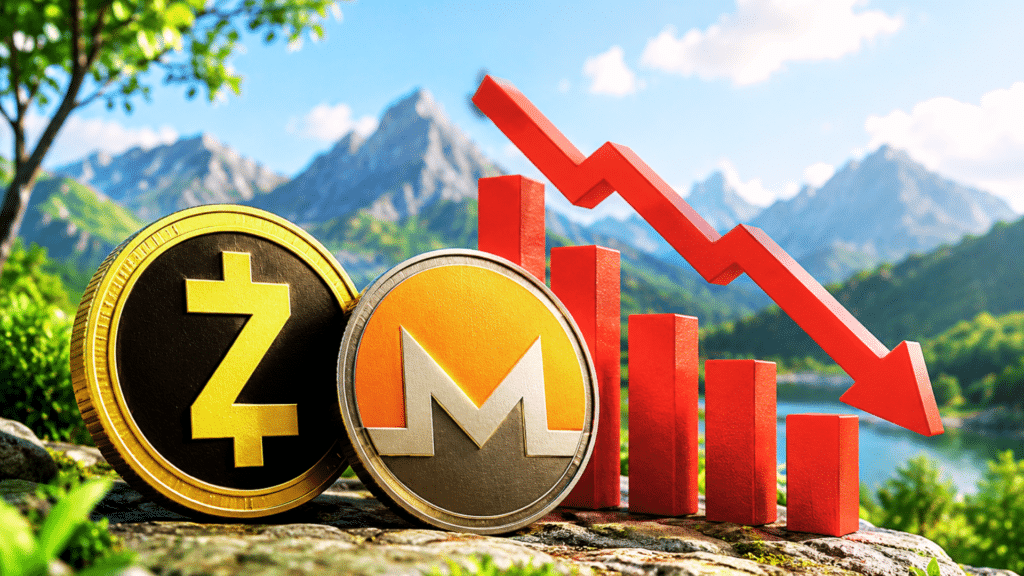
Despite the latest pullback, ZEC still held a 9.41% gain over the past seven days. Monero, meanwhile, remained down 2.28% on a weekly basis. Traders following the sector said the decline in Zcash appeared more like profit-taking after a sharp rally rather than aggressive fresh selling pressure.
Market participants also noted that structural buyers in privacy token projects had continued adding positions during the rally instead of distributing holdings into strength. The recent rally in privacy token assets gained momentum after Multicoin Capital disclosed its stake in Zcash earlier this month, reinforcing institutional interest around privacy-focused cryptocurrencies.
Why Are Investors Watching Privacy Token Trends More Closely?
Privacy token projects have regained attention as discussions around financial privacy and decentralized transactions continue expanding across the digital asset sector. Analysts said renewed institutional participation and stronger market narratives helped push Zcash and Monero ahead of many large-cap cryptocurrencies in recent weeks.
At the same time, the sector remains highly sensitive to broader market sentiment and macroeconomic uncertainty. Several traders described the latest pullback as a natural cooling phase after rapid gains rather than a collapse in demand. Privacy token assets also gave back the largest share of the gains crypto markets had managed to hold onto during the recent rally period.
What Happened Across The Broader Crypto Market?
Most major cryptocurrencies traded within narrow ranges despite rising geopolitical tensions and volatility in commodities. Bitcoin fell 0.66% over the past 24 hours to $76,872.93 while Ethereum slipped 0.34% to $2,099.27. Solana also declined 1.5% during the session to trade at $84.60 as broader market sentiment remained cautious.
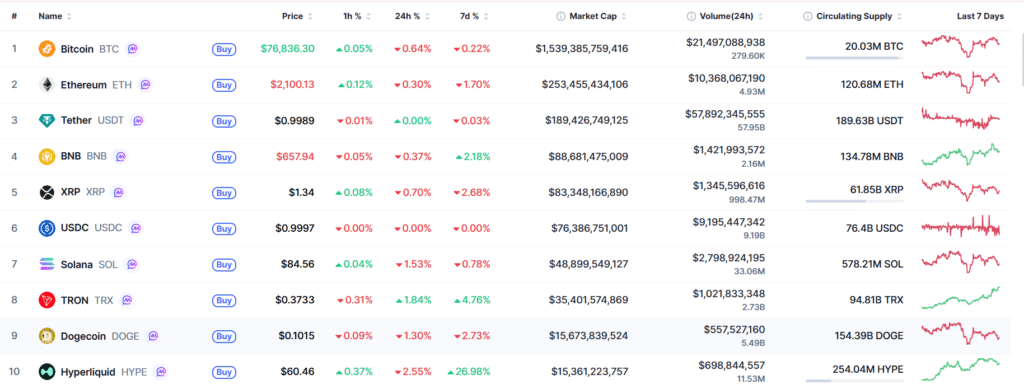
Tron (TRX) stood out as the lone gainer among the top 10 cryptocurrencies by market capitalization. TRX rose 1.86% over the past 24 hours to $0.3736 and maintained a weekly gain of 4.74%, outperforming most major digital assets during the broader market pullback. Meanwhile, Hyperliquid’s HYPE token briefly traded above Dogecoin’s market capitalization during Asian trading hours before retreating later in the session.
HYPE declined 2.66% over the past 24 hours to $60.56 but still held a strong 26.87% gain over the last seven days following the launch of SpaceX pre-IPO perpetual contracts on Hyperliquid. Dogecoin (DOGE) fell 1.29% to $0.1015 and remained down 2.57% over the past week amid broader weakness across meme-linked cryptocurrencies.
How Did US Military Action Influence Market Sentiment?
The cautious tone across crypto markets followed confirmation from US Central Command that defensive strikes had targeted missile launch sites in Iran and boats attempting to place mines in the Strait of Hormuz. Earlier military action around May 7 and 8 also targeted drone facilities and command infrastructure near Bandar Abbas and Qeshm after reported attacks on US Navy destroyers including the USS Truxtun, USS Rafael Peralta, and USS Mason.
Additional strikes on missile launch sites and boats in southern Iran were reported on May 25, 2026. President Donald Trump signaled openness toward diplomatic discussions with Iran while warning that further military responses could follow if threats continued. Analysts noted that markets have been closely monitoring the region for months as tensions escalated through several rounds of military operations dating back to 2025.
Why Are Oil Prices And Inflation Concerns Important For Crypto?
Investor attention also shifted toward the Strait of Hormuz because nearly one-fifth of the world’s oil supply moves through the region. Any disruption there tends to influence crude prices, inflation expectations, and broader risk sentiment. Brent crude climbed nearly 2% to $98 per barrel after falling sharply earlier in the week.

The US dollar strengthened against major global currencies while gold slipped 0.6% to $4,545. S&P 500 futures still posted a 0.6% gain after Monday’s US market closure. Market observers said higher energy prices could eventually affect Federal Reserve policy expectations, which often shape demand for risk-sensitive assets including cryptocurrencies.
Some analysts also pointed to June 2025 as a reference period when Bitcoin briefly fell below the $100,000 mark during earlier US-Iran tensions. While that decline did not last permanently, traders said it highlighted how geopolitical shocks can quickly pressure leveraged crypto positions.
Conclusion
Privacy token assets remain under close watch as traders evaluate whether the latest decline marks a temporary pause or the start of broader weakness across crypto markets. Several analysts said the current pullback still reflects a market digesting recent gains rather than a breakdown in long-term demand.
Institutional attention toward privacy token projects has remained active even as broader macro uncertainty continues influencing investor sentiment. Much of the short-term direction may depend on developments in the Middle East, movements in oil prices, and whether broader crypto markets can maintain stability during heightened geopolitical tensions.
Glossary
Privacy Tokens: Cryptocurrencies focused on protecting user privacy.
Zcash (ZEC): Privacy coin using encrypted transaction technology.
Monero (XMR): Digital currency built for anonymous payments.
Strait of Hormuz: Critical oil route affecting global markets.
Profit-Taking: Investors selling after strong market gains.
Frequently Asked Questions About Privacy Tokens
How much did Zcash drop?
Zcash declined around 5.7% during the latest crypto market selloff.
Did Monero also decline?
Yes, Monero fell about 2.6% as crypto market sentiment weakened.
How did Middle East tensions affect crypto markets?
Middle East tensions made investors more cautious across crypto and global markets.
Why is the Strait of Hormuz important for markets?
The Strait of Hormuz is a major global oil route that can affect energy prices.
Which major cryptocurrency gained during the pullback?
Tron (TRX) was among the few major cryptocurrencies that posted gains.