

Ethereum’s scaling economy is carrying more capital, users, and transactions, offering fresh evidence that its rollup-centered roadmap is gaining traction. Recent on-chain data places total value locked across Ethereum Layer 2 networks at about $37.41 billion, while transaction fees remain unusually low. Base leads by capital and activity, but Arbitrum and Optimism are also posting healthy transaction growth. The figures suggest Ethereum is becoming a layered financial system in which the mainnet provides settlement and security while faster networks handle everyday activity.
Ethereum Layer 2 Growth Reflects a Wider Network Shift
The clearest signal is the capital users have committed. Total value locked, or TVL, measures assets deposited into decentralized finance applications, bridges, and other protocols. A rising figure can indicate stronger liquidity and wider use, although token prices also influence its dollar value.
Ethereum Layer 2 TVL has reached roughly $37.41 billion, close to half the amount secured on Ethereum’s main chain. Base accounts for about $11.86 billion, placing it ahead of Arbitrum, ZKsync, and OP Mainnet in the referenced dataset.
TVL is not a complete scoreboard because capital can move quickly when incentives change. Lasting growth also requires recurring use and developer activity.
Base Leads Activity While Rivals Expand Faster
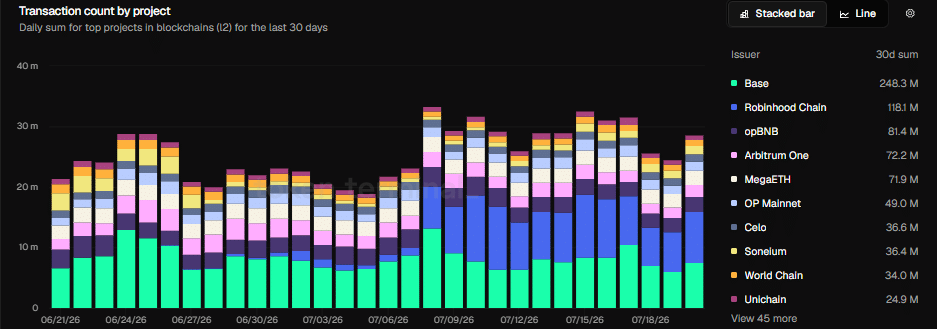
Base processed about 248.3 million transactions during the measured period, representing 29.1% of Layer 2 activity. Its transaction count rose 13.4%, while Arbitrum One increased 22.2% and Optimism gained 19.2%.
Base holds the largest share, yet established rivals are expanding at faster rates. Competition gives developers more choices around fees, tooling, governance, and application design.
Robinhood Chain reportedly recorded monthly transaction growth above 30,000%. Since small starting points can inflate percentages, analysts should compare that gain with absolute volume.
Low Fees Explain Why Rollups Attract Users
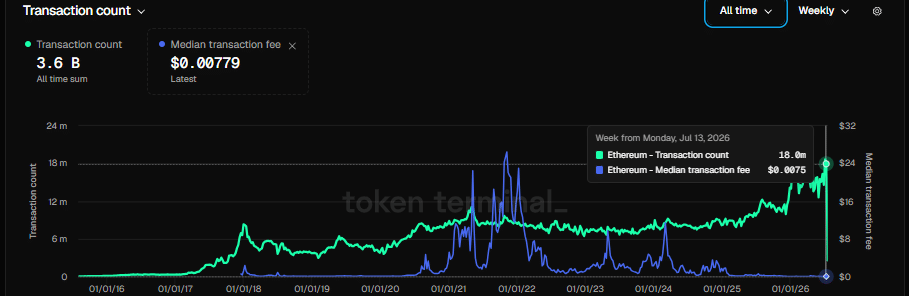
Ethereum’s main network has recorded heavy usage while its median transaction fee fell to about $0.008 during the cited period. Earlier crypto cycles often produced the opposite result, with rising demand pricing ordinary users out.
The present structure works differently as Ethereum Layer 2 networks bundle transactions and submit compressed information to the mainnet, spreading settlement costs across many users. Blobs created a cheaper data lane for rollups instead of forcing them to compete with normal mainnet transactions.
Pectra later doubled targeted blob throughput from 3 to 6 per block and lifted the maximum from 6 to 9. Fusaka and subsequent parameter upgrades expanded capacity further, allowing Ethereum to target 14 blobs and permit as many as 21 per block. That added room gives rollups a broader runway.
Blob Demand Connects Scaling Activity to Ethereum
Total blob fees have reached about 1.492 million ETH, showing that rollups are regularly purchasing Ethereum data availability.
Rollups rely on Ethereum to publish data, settle outcomes, and inherit security guarantees. Growing blob demand may strengthen its settlement role even when users rarely touch the mainnet.
For ETH investors, the relationship is not automatic. Cheap blobs can support more activity while producing modest fees, and rollups may capture much of the value. The key question is whether scale creates enough demand for ETH as gas, collateral, and settlement money.
Active Users Strengthen the Scaling Case
Monthly active Ethereum users increased 2.9% to around 8.3 million. The modest gain accompanies higher transaction volume and deeper capital deployment. Growth appears more durable when users, liquidity, and throughput rise together.
Investors should still monitor sequencer concentration, bridge security, proof systems, withdrawal delays, and upgrade controls. Many rollups remain less decentralized than Ethereum, so cheaper activity does not erase risk.
Conclusion
The $37.41 billion milestone shows that Ethereum Layer 2 networks are becoming central parts of the ecosystem. Base leads current activity, while Arbitrum and Optimism continue gaining ground. Low fees, rising blob use, and more active users indicate that Ethereum’s scaling roadmap is functioning.
The next test is quality. Ethereum Layer 2 networks must retain users, protect funds, decentralize critical systems, and generate lasting value after incentives cool.
Frequently Asked Questions
What is driving Layer 2 growth?
Lower fees, faster transactions, expanding applications, and greater Ethereum Layer 2 data capacity are attracting users and liquidity.
Which network currently leads?
Base leads the referenced Ethereum Layer 2 TVL and transaction figures, while Arbitrum and Optimism show faster percentage growth.
Does higher Layer 2 activity help ETH?
It can increase demand for settlement, blobs, gas, and collateral, although the value captured by ETH changes over time.
Glossary of Key Terms
TVL: The dollar value of assets deposited in blockchain protocols.
Rollup: A network that batches transactions before settling them on Ethereum.
Blob: Temporary data space designed to reduce rollup posting costs.
Sequencer: The system that orders transactions on many rollups.
Data availability: Assurance that transaction data can be accessed and verified.
Disclaimer: This article is for informational purposes only and does not provide financial or investment advice.