



Binance futures grabbed the spotlight in June after the world’s largest crypto exchange recorded an 80% jump in derivatives trading volume, even as crypto spot trading slipped to its weakest level in two years. The contrasting trends reveal more than a busy trading month. They suggest that market participants are changing how they approach risk in an uncertain environment.
According to verified data, Binance’s futures volume climbed to nearly $1.61 trillion in June from $893 billion in May. The increase came while Bitcoin traded within a relatively stable range and a large share of the market remained bearish. Rather than signaling renewed optimism, the sharp rise in Binance futures compared with stagnant crypto spot trading points to a deliberate shift in trader positioning instead of fresh capital flowing into digital assets.
Binance Futures Pull Further Ahead Despite a Slower Market
The latest figures strengthened Binance futures leadership over competing exchanges. OKX recorded roughly $609 billion in June futures volume, while Bybit reached around $434 billion. Although both exchanges reported monthly gains, neither matched Binance’s scale or growth.
The latest figures also reinforce how derivatives trading is becoming increasingly concentrated on dominant venues, with Binance widening its lead over competitors despite weaker market conditions.
June also marked an important milestone. Similar futures volumes were last seen in early 2026, but Binance not only returned to those levels, it surpassed them. The achievement becomes even more notable because the broader centralized exchange futures market continued to weaken. Total CEX futures volume declined from $17.6 trillion in the first quarter to $15.7 trillion in the second quarter, extending the market’s broader slowdown despite Binance’s exceptional performance.
Although the futures market remained in a downtrend, the quarterly decline was less severe than in previous quarters, suggesting selling pressure may be easing.

Stable Bitcoin Prices Reveal a Bigger Shift in Trading Behavior
One of the most surprising parts of the June data is that Bitcoin remained relatively stable while Binance futures activity surged. Large spikes in derivatives volume often accompany major price rallies or steep declines. This time, neither occurred.
Analyst commentary indicates the unusual combination reflects a shift in trader positioning rather than strong confidence in higher prices. Meanwhile, crypto spot trading remained subdued. Directional spot buying, which refers to investors purchasing cryptocurrencies because they expect prices to rise, showed little strength throughout June. That hesitation highlights the cautious mood that continues to shape the market.
Crypto Spot Trading Weakens as Derivatives Take the Lead
While Binance futures reached a yearly high, crypto spot trading continued losing momentum. Centralized exchange spot volume dropped to nearly $3 trillion during the second quarter, marking its weakest performance in two years.
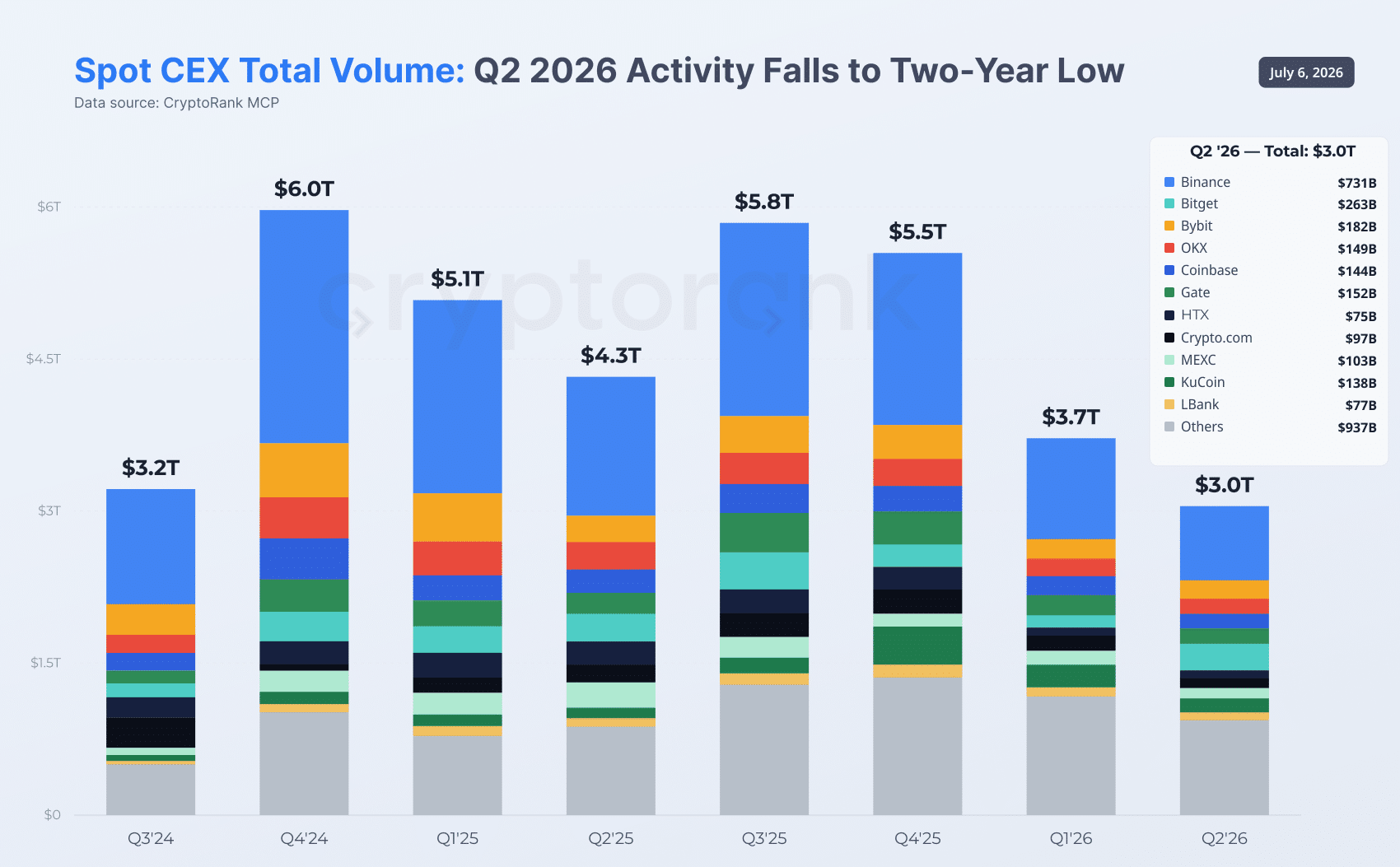
Binance remained the largest spot exchange, yet its market share declined from 27% to 24%. In contrast, its futures market share held steady at around 28%, reinforcing its dominance in derivatives.
The growing gap between Binance futures and crypto spot trading reflects a broader structural shift. More institutions are using derivatives for hedging, which helps reduce portfolio risk, and basis trades, which seek to profit from price differences between futures and spot markets. At the same time, frequent leverage washouts, where highly leveraged positions are forced to close during volatile moves, continue generating heavy derivatives activity even while direct spot demand remains weak.
The widening gap between derivatives and spot activity suggests professional traders remain active while long-term investors continue waiting on the sidelines. Even so, analysts remain cautious. High Binance futures volume does not automatically signal bullish sentiment. A large share of trading could reflect hedging, arbitrage, or market-neutral strategies rather than genuine confidence that prices will move higher.
MiCA’s Impact Remains the Market’s Next Big Test
The June surge also arrived just before the European Union’s Markets in Crypto-Assets (MiCA) framework entered a new enforcement phase on July 1. MiCA is the EU’s first comprehensive crypto regulation, designed to create consistent rules for exchanges and digital asset companies across member states. Binance’s decision to withdraw its Greek license application shortly before the transition raised fresh questions about future trading activity in Europe.
Europe contributes a significant share of derivatives trading for major centralized exchanges, making the region an important source of market liquidity. Early data shows Binance processed roughly $418 billion in futures volume during the first ten days of July, suggesting no immediate disruption. However, analysts caution that the sample remains limited. They are now watching whether June’s surge reflected traders front-running MiCA deadlines or genuine long-term demand for Binance futures.
Conclusion
The latest Binance futures data highlights a market increasingly driven by derivatives rather than direct ownership of digital assets. At the same time, weaker crypto spot trading shows many investors remain cautious despite rising trading activity.
Whether this marks a lasting transformation or a temporary reaction to market uncertainty remains unclear. The coming quarter will reveal whether this shift becomes a lasting trend, whether MiCA reshapes European participation, and whether trading activity continues concentrating on dominant exchanges like Binance or begins spreading across competing platforms.
Glossary of Key Terms
Binance Futures: Crypto derivatives contracts.
Crypto Spot Trading: Buying and selling crypto instantly.
Basis Trade: Profiting from spot and futures price differences.
Hedging: Reducing market risk using derivatives.
MiCA: The EU’s crypto regulatory framework.
FAQs About Binance Futures
Why did Binance futures surge?
Higher derivatives and hedging activity.
Why did spot trading fall?
Investor demand for direct crypto purchases weakened.
Does higher futures volume mean a bull market?
No. It may reflect hedging or arbitrage.
What is MiCA?
The EU’s framework for regulating crypto markets.