



The crypto bear market has become more than a prolonged period of weak prices. It has evolved into a debate over trust, transparency, and whether centralized exchanges have done enough to protect investors during periods of extreme volatility. Fresh remarks from OKX founder Star Xu and former Binance Chief Financial Officer Wei Zhou have revived questions about the October 2025 liquidation crisis and why institutional confidence has yet to fully recover.
According to the source, Xu publicly backed Zhou’s assessment that the ongoing crypto bear market reflects a confidence crisis rather than weak market demand alone. Their public discussion also reflected what many analysts increasingly describe as a broader industry consensus that transparency has become the biggest obstacle to institutional adoption. Xu stressed that rebuilding trust will take years, making stronger governance and clearer risk management essential for every major exchange.
The 33 Minutes That Reshaped the Crypto Bear Market
The debate centers on October 10, 2025, when nearly $19 billion in leveraged crypto positions were wiped out after the United States announced 100% tariffs on Chinese imports. While the tariff decision triggered panic across global markets, critics argue exchange infrastructure turned a sharp correction into a historic liquidation cascade.
Reports claimed a database read path issue caused roughly 33 minutes of processing delays on Binance during peak trading. At the same time, Binance allegedly valued cross collateral assets using prices from its own order books instead of external pricing oracles, which gather prices from multiple exchanges to determine a fair market value.
As liquidity weakened, assets including Ethena’s USDe, WBETH, and BNSOL reportedly traded well below their broader market prices. USDe briefly fell to around $0.65 on Binance while remaining close to $1 elsewhere. Margin valuation determines how much an exchange believes a trader’s collateral is worth. When that value suddenly dropped, automated liquidation engines reportedly closed thousands of leveraged positions. Critics argue many of those liquidations could have been avoided if external pricing oracles had been used.

Why Trust Became Crypto’s Biggest Currency
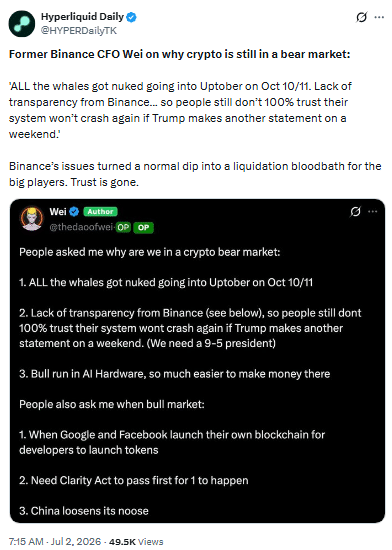
Zhou believes the crypto bear market continues because many centralized exchanges still operate critical risk systems as “black boxes.” According to him, hidden liquidation engines, unclear margin calculations, opaque collateral pricing, and undisclosed internal risk models make large institutional investors and high leverage trading firms reluctant to return.
His criticism carries additional weight because he served as Binance’s CFO between 2018 and 2021 before becoming CEO of Coins.ph. Previous investigative reports also suggested Zhou lacked full access to Binance’s consolidated financial records during his tenure, reinforcing his long standing concerns about transparency.
Bitcoin continues to trade near $60,000, well below previous highs, while a growing share of investment capital continues flowing into artificial intelligence. Analysts say this reflects the market’s ongoing preference for sectors offering stronger confidence, clearer regulation, and more predictable infrastructure than the current crypto bear market.
Three Catalysts That Could End the Crypto Bear Market
Zhou argues the crypto bear market cannot recover by relying on retail driven leverage cycles. Instead, the industry must shift its focus toward institutional infrastructure and clear regulatory frameworks.
He believes broader blockchain adoption by companies such as Google and Meta could bring compliant digital assets to mainstream users. He also points to the proposed U.S. CLARITY Act as a critical step toward giving financial institutions greater legal certainty. Finally, Zhou believes easing digital asset restrictions across China and other East Asian markets could unlock new liquidity and strengthen global participation.
Meanwhile, Binance has rejected allegations that its systems amplified the October crash. Changpeng Zhao described the accusations as “far-fetched” and maintained that macroeconomic shocks and excessive leverage drove the market collapse. The exchange also highlighted more than $600 million in customer relief through direct reimbursements and its Together Initiative after the incident.
Conclusion
The crypto bear market has become a test of credibility as much as market performance. While Binance disputes claims that its systems worsened the October 2025 crash, the broader debate has intensified calls for proof of reserves, which allows exchanges to verify customer assets publicly, alongside transparent risk engines, coordinated circuit breakers, and stronger governance.
As Star Xu noted, trust takes years to rebuild. Markets have recovered from severe downturns before, but confidence returns much more slowly than prices. Whether exchanges embrace greater transparency may determine not only when the crypto bear market finally ends, but also how resilient the next bull cycle becomes.
Glossary of Key Terms
Crypto bear market: A prolonged decline in cryptocurrency prices.
Pricing oracle: A tool that provides market prices from multiple sources.
Proof of reserves: A method for verifying an exchange’s asset holdings.
Liquidation: The automatic closure of a leveraged trading position.
FAQs About Crypto Bear Market
Why is the crypto bear market continuing?
Analysts cite weak investor confidence, transparency concerns, and regulatory uncertainty.
Why is Binance being criticized?
Critics claim its risk systems amplified the October 2025 liquidation event, a claim Binance denies.
What is proof of reserves?
It verifies that an exchange holds enough assets to back customer funds.
What could trigger the next bull run?
Greater transparency, clearer regulations, and stronger institutional adoption.