
dYdX Robinhood partnership marks a significant development for decentralized trading as dYdX Labs has unveiled Arcus, a newly branded decentralized exchange built in collaboration with Robinhood Crypto on the Robinhood Chain. The launch introduces a separate platform focused on tokenized stocks and perpetual trading while leaving the existing dYdX Chain unchanged.
- What does the dYdX Robinhood partnership mean for the existing ecosystem?
- Why was Arcus introduced?
- How will governance and validators continue to operate?
- How does Arcus strengthen Robinhood’s blockchain strategy?
- Why is competition in perpetual trading becoming more important?
- How does this compare with other major trading platforms?
- Conclusion
- Glossary
- Frequently Asked Questions About dYdX Robinhood Partnership
Arcus has been positioned as the Robinhood Chain’s leading decentralized exchange while expanding access to markets through blockchain infrastructure. The dYdX Foundation has also reaffirmed that the community-owned dYdX Chain, along with its governance, validators and staking ecosystem, continues operating without any changes.
What does the dYdX Robinhood partnership mean for the existing ecosystem?
The dYdX Robinhood partnership introduces Arcus as a new decentralized exchange created by dYdX Labs in collaboration with Robinhood Crypto. The dYdX Foundation clarified that Arcus is a separate and independent product built on different infrastructure and does not replace or modify the dYdX Chain.

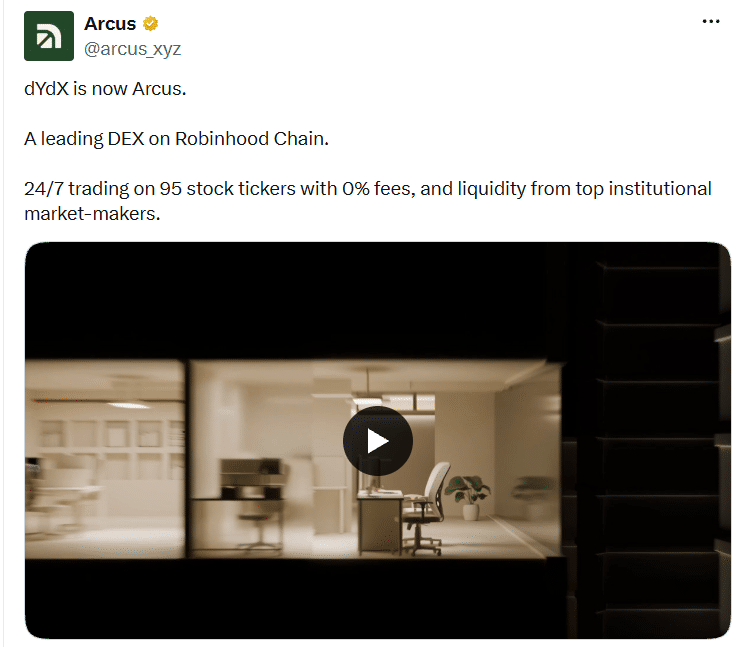
Arcus is expected to become the leading DEX on the Robinhood Chain, offering users perpetual products alongside fee-free trading of 95 tokenized stock tickers. Meanwhile, the Foundation stated that trading, deposits, withdrawals, staking, governance, validator operations and community infrastructure on the dYdX Chain continue as normal.
The Foundation also confirmed that the DYDX token remains the governance and staking token of the dYdX Chain. No token migration or swap has been announced, while staking rewards will continue to be distributed in USDC through protocol fees for as long as the blockchain remains operational.
Why was Arcus introduced?
The dYdX Robinhood partnership aims to expand access to financial markets by reducing limitations that have traditionally prevented many users from participating in global trading.
Until now, traders have been shut out of the most valuable markets on earth US equities, commodities, and indices because of where they live, market hours, and institutions restricting access. We built Arcus to reduce these barriers
Arcus statedThe platform said tokenized stock trading and perpetual products will go live this month. Users will be able to trade 95 tokenized stock tickers with 0% fees, use tokenized stocks as collateral for perpetual positions and gain access to pre-IPO markets.
The offering also extends access to markets linked to equities, commodities and indices through blockchain-based infrastructure that operates around the clock. Supporting information from dYdX Labs also noted that Arcus is designed to support 35 real-world asset perpetual products while spot trading is already live.
How will governance and validators continue to operate?
The dYdX Robinhood partnership does not alter the governance framework of the dYdX Chain. The dYdX Foundation said validators continue securing the blockchain under the existing governance process. Any future changes affecting validator requirements or the validator set would still require approval from the community.
The Treasury SubDAO and Operations SubDAO continue operating under their current mandates. Likewise, the Community Treasury and Rewards Treasury remain under governance control and can only be managed through community voting.
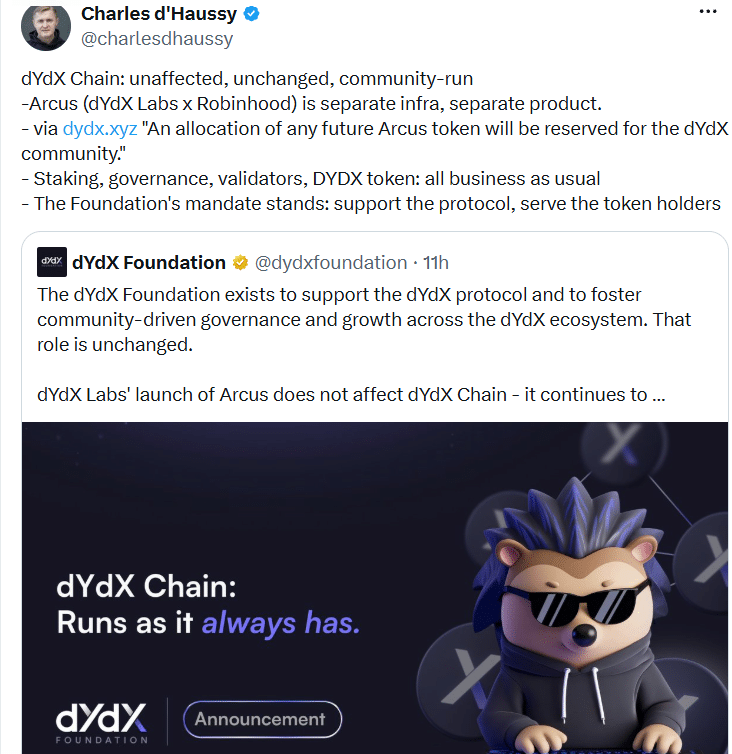
Charles d’Haussy, CEO of the dYdX Foundation, stated that Arcus is a separate product while the dYdX Chain remains community-run. He added that staking, governance, validators and the DYDX token continue as usual. He also noted that any future Arcus token allocation will reserve a portion for the dYdX community.
How does Arcus strengthen Robinhood’s blockchain strategy?
The dYdX Robinhood partnership forms part of Robinhood’s broader expansion into tokenized assets and perpetual trading. Arcus launched alongside the Robinhood Chain, an Arbitrum-based Ethereum Layer-2 blockchain developed for tokenized assets and decentralized financial applications. Robinhood Crypto also confirmed an investment in Arcus, although financial details were not disclosed.
Additional information from dYdX Labs said Robinhood Chain is EVM-compatible and designed to support tokenized equities alongside perpetual products. Arcus is led by CEO Eddie Zhang and is expected to serve users across more than 120 countries, although it is unavailable in the United States, Canada, the United Kingdom and other restricted jurisdictions.
Why is competition in perpetual trading becoming more important?
Robinhood’s expansion into perpetual trading comes as perpetual contracts and tokenized assets have recently seen a sharp rise in popularity across the digital asset industry. The company is seeking to attract traders who have increasingly migrated to Hyperliquid, whose token has climbed nearly. 150% this year as the platform gained market share in perpetual futures trading.
The broader market is also witnessing increased institutional and regulatory interest in products tied to tokenized assets and perpetual trading. At the same time, a recent regulatory discussion has highlighted that the CFTC chair said perpetual trading is not suitable for all assets under the agency’s oversight, reflecting ongoing regulatory scrutiny as these markets continue to evolve.
How does this compare with other major trading platforms?
The dYdX Robinhood partnership arrives as major retail-focused platforms continue expanding beyond traditional cryptocurrency services. Coinbase has recently broadened its offering by adding access to thousands of stocks, while its Ethereum Layer-2 blockchain Base has grown into the fifth-largest Layer-2 network by value locked, according to DeFiLlama.

Robinhood is also expanding its blockchain ecosystem through additional integrations. Bitget Wallet announced support for Robinhood Chain to enable tokenized stock trading, while decentralized exchange 1inch confirmed it would be among the first major swap platforms supporting the network.
Conclusion
dYdX Robinhood partnership reflects a broader shift toward blockchain-based access to tokenized financial markets while preserving the existing dYdX ecosystem. Arcus has been introduced as the leading decentralized exchange on the Robinhood Chain, bringing 24/7 trading for 95 tokenized stock tickers with 0% fees and preparing to launch perpetual products and tokenized stock trading this month.
The dYdX Foundation has reiterated that governance, staking, validators and the DYDX token remain fully operational under community ownership with no changes to the blockchain’s existing structure. As Robinhood expands its blockchain ecosystem and competition in perpetual trading continues to grow, Arcus represents a separate platform focused on widening access to equities, commodities and indices through decentralized infrastructure.
Glossary
Arcus DEX: A decentralized platform for tokenized and perpetual trading.
Robinhood Chain: Robinhood’s Layer 2 blockchain for digital assets.
dYdX Chain: The blockchain powering the dYdX protocol.
dYdX Labs: The team behind the Arcus platform.
Perpetual Trading: Trading contracts with no expiry date.
Frequently Asked Questions About dYdX Robinhood Partnership
What is the dYdX Robinhood partnership?
The dYdX Robinhood partnership is a collaboration to launch the Arcus decentralized exchange on Robinhood Chain.
Does Arcus replace the dYdX Chain?
No. Arcus is a separate platform, and the dYdX Chain continues to operate as usual.
What can users trade on Arcus?
Users can trade tokenized stocks and perpetual products on Arcus.
Why was Arcus created?
Arcus was created to give more people access to global financial markets through blockchain technology.
Can users stake on the dYdX Chain after the Arcus launch?
Yes. Staking, governance, and validator activities on the dYdX Chain remain unchanged.