

This article was first published on Deythere.
- Why BlackRock Allocates a 1% to 2% Bitcoin Portfolio Allocation
- Bitcoin ETF Growth Makes Rebalancing More Important
- Not Everyone Expects Forced Selling to Dominate
- Conclusion
- Glossary
- Frequently Asked Questions About Bitcoin Portfolio Allocation
- What is BlackRock’s recommended Bitcoin portfolio allocation?
- Why do Bitcoin rallies tend to trigger selling?
- What happens if a 2% Bitcoin portfolio allocation doubles?
- Does BlackRock think investors should have more than 2% of their portfolio in Bitcoin?
- Are Bitcoin ETFs still pulling in new investors ?
- References
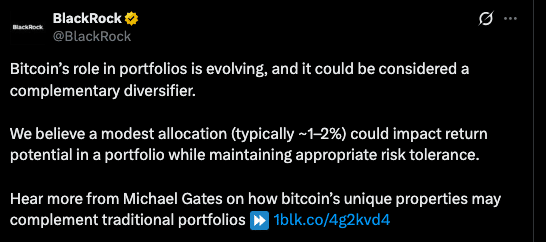
BlackRocks recent advice that investors should consider a 1% to 2% Bitcoin portfolio allocation is being taken as another form of acceptance from institutional investors.
However, that recommendation could have the unwanted side effect of encouraging financial advisors to dump Bitcoin at the peak of a rally, just to keep the portfolio in line with pre-set limits.
This discussion is currently being deliberated upon in markets circles as the value of institutional ownership of Bitcoins held in exchange traded funds (ETFs) continues to surge especially after the rapid growth of BlackRocks iShares Bitcoin Trust (IBIT).
Even though the allocation guidelines are meant to encourage more adoption, they also introduce a set of rules for managing the portfolio that could lead to a lot of selling pressure every time Bitcoin starts to outperform stocks and bonds.
This is an issue that has emerged at an awkward time, when the scrutiny of ETF flows is still high. Citigroup just cut its 12 month forecast for the price of Bitcoin down to $82,000 from $112,000 and also reduced its predicted ETF inflows to zero from $10 billion, citing lower investor demand and continued outflows from ETFs.
Why BlackRock Allocates a 1% to 2% Bitcoin Portfolio Allocation
For BlackRock, the decision is based on the level of risk an investor is willing to take on rather than guessing not much they might get back.
According to the asset manager, a 1% to 2% Bitcoin portfolio allocation is a reasonable range if investors actually believe that Bitcoin adoption will continue and can tolerate sharp price swings.
The firm argues that larger allocations of Bitcoin can actually increase the overall risk of a portfolio, because its value is so unpredictable.
Their analysis suggests that a 1% allocation to Bitcoin contributes about 2% to the overall risk of a regular 60/40 portfolio. A 2% Bitcoin portfolio allocation increases that to roughly 5%, while a 4% allocation would take the risk contribution to around 14%.
The challenge comes up when Bitcoin outperforms other assets.
A 2% allocation can easily creep up towards 3% after a 51.5% Bitcoin rally, if the rest of the portfolio is left alone. A 104% rally would push theBitcoin portfolio allocation close to 4%, and at that point advisors might need to sell a portion of their holdings just to restore the original target.
Bitcoin ETF Growth Makes Rebalancing More Important
Portfolio rebalancing wasn’t a major issue when most Bitcoin was held by retail investors and long term holders. This has changed with the rise of the ETF era.
BlackRock’s IBIT has taken in nearly 60 billion dollars in net inflows, making it one of the biggest investment products out there that has Bitcoin exposure. As the funds continue to grow, decisions from advisors will likely begin influencing the market in more visible ways.
The ETF market has had a rough time lately. U.S. spot Bitcoin ETFs saw more than 2.7 billion dollars withdrawn over a ten trading day period from late June and July 1. And on top of that, year-to-date inflows have started to look quite fragile. All this prompted Citigroup to take a look at its Bitcoin forecast and decide to lower it.
If advisors use the same sort of rebalancing procedures that they do for traditional assets to keep their Bitcoin investments in line, then strong rallies could trigger systematic selling. In which case, the gains themselves would actually become a source of selling pressure in the future.
The effect is likely to become more visible as model portfolio assets continue to grow in number. Industry data points to an expansion in assets linked to third party model portfolios, up from $400 billion in 2023 to over $645 billion by 2025.
Not Everyone Expects Forced Selling to Dominate
Some industry participants are of the opinion that concerns about widespread ETF-driven selling are overblown.
Kelly Ye, co-founder and chief investment officer at CoinBridge, reckons that while advisors do play a role in Bitcoin ETF activity than many people think, they are still a minority of the action.

Citing data from major wealth management platforms, she notes that about 80% of Bitcoin ETF trading is done by people managing their own portfolios, rather than through advisors who are buying and selling on behalf of their clients, while only about 20% flows through financial advisors.
She also pointed out the fact that big advisory firms typically require six to twelve months of performance history, compliance reviews and operational due diligence before approving a new ETF for centralized models.
Even after adoption, advisors have alternatives to outright sales.
Many have choices, such as expanding their ‘tolerance bands’, redirecting new client contributions, rebalancing their portfolios in a more gradual way or even placing Bitcoin exposure in accounts like IRAs or Roth accounts. These measures allow them to reduce the pressure on selling while still leaving their clients exposed to the asset over the long term.
Conclusion
The way people own Bitcoin really may be the factor that determines which of these scenarios play out.
Bitcoin had always been about a ‘buy and hold’ culture where most investors didn’t worry too much about allocation limits. But that is changing now that institutions are getting in and bringing with them a completely different way of thinking about risk budgets, compliance standards and portfolio maintenance.
The growing popularity of options strategies could also change the game. Market data is showing strong growth in IBIT options activity, giving advisors new ways to generate income or hedge risk without affecting their Bitcoin exposure.
If widely available rebalancing bands and derivatives become more common, it is possible Bitcoin could continue to grow within institutional portfolios with very little selling pressure. On the other hand, if advisors adopt stricter portfolio rules, there could be major rallies triggering scheduled reductions.
At the end of all this, investors are not talking just about price targets anymore. As Bitcoin becomes a mainstream portfolio asset, they are discovering that adoption doesn’t just bring more demand, it also brings new, more complex portfolio management rules.
Glossary
Bitcoin Portfolio Allocation: The percentage of an investment portfolio dedicated to Bitcoin.
Portfolio Rebalancing: Adjusting investments to keep them in line with target asset mix.
Spot Bitcoin ETF: An exchange-traded fund that directly holds Bitcoin
IBIT: BlackRock’s iShares Bitcoin Trust ETF
Risk Contribution: How much a particular asset is adding to the volatility in your overall portfolio
Model Portfolio: A standardized investment portfolio used by financial advisors.
Frequently Asked Questions About Bitcoin Portfolio Allocation
What is BlackRock’s recommended Bitcoin portfolio allocation?
According to BlackRock, a 1-2% Bitcoin allocation can be a reasonable target for diversified portfolios that can handle high levels of volatility.
Why do Bitcoin rallies tend to trigger selling?
The reason is simple: as Bitcoin goes up, its weighting in a portfolio goes up too. Advisors may then sell part of the position to bring the allocation back down to target levels.
What happens if a 2% Bitcoin portfolio allocation doubles?
If a 2% allocation managed to double, it would increase to around 4% and that could require some rebalancing to get back on track.
Does BlackRock think investors should have more than 2% of their portfolio in Bitcoin?
BlackRock’s researchers have found that allocating more than 2% of an investor’s portfolio to Bitcoin can end up increasing the overall risk level of their investments.
Are Bitcoin ETFs still pulling in new investors ?
ETF demand has been mixed. Some periods have seen strong inflows, while recent weeks recorded outflows across several Bitcoin ETF products.