

Bitcoin liquidity imbalance is emerging near the $80,000 zone as derivatives positioning and technical structure converge around a key decision area for traders. The market is gradually stabilising after repeated defenses of lower support levels, while momentum signals on shorter timeframes continue to show early signs of recovery.
- How is Bitcoin liquidity imbalance shaping the current market structure?
- What does derivatives positioning reveal about market risk?
- Why is derivatives activity dominating Bitcoin liquidity imbalance?
- How are spot and futures flows diverging?
- Which price levels are traders monitoring next?
- What risks could disrupt the current Bitcoin liquidity imbalance?
- What does the technical structure suggest next?
- Conclusion
- Glossary
- Frequently Asked Questions About Bitcoin Liquidity
Bitcoin liquidity conditions are becoming increasingly sensitive to leveraged positioning as price compresses below a major resistance band. This setup is shaping expectations for a potential volatility-driven move once key thresholds are tested.
How is Bitcoin liquidity imbalance shaping the current market structure?
Bitcoin liquidity imbalance is now concentrated around the $80,000 level, where leveraged positioning has created a dense cluster of potential forced liquidations. The market is currently trading around $77,338 while continuing to hold above the key $76,100 support level. The market has repeatedly defended this support over two sessions, building a short-term base that traders are closely monitoring.
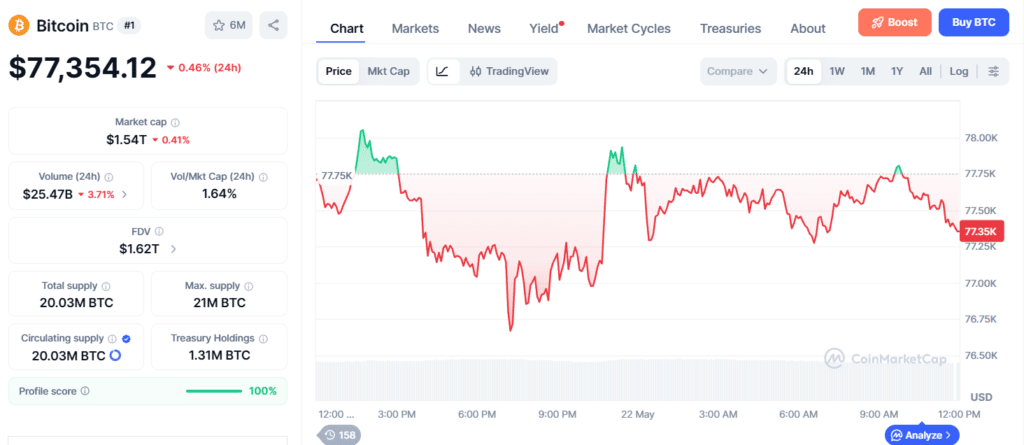
Price has also retested the $78,000 region, with improving momentum and higher lows forming on lower timeframes. Bitcoin liquidity imbalance is becoming more visible as price approaches resistance, where liquidity gaps may act as acceleration zones if broken.
Market structure also shows an emerging inverse head-and-shoulders pattern beneath a descending trendline. A fair-value gap between $79,500 and $80,300 remains unfilled. A fair-value gap (FVG) is an untraded price zone left by a sharp move. These gaps often act as magnets for price as algorithmic orders and stops sit nearby.
What does derivatives positioning reveal about market risk?
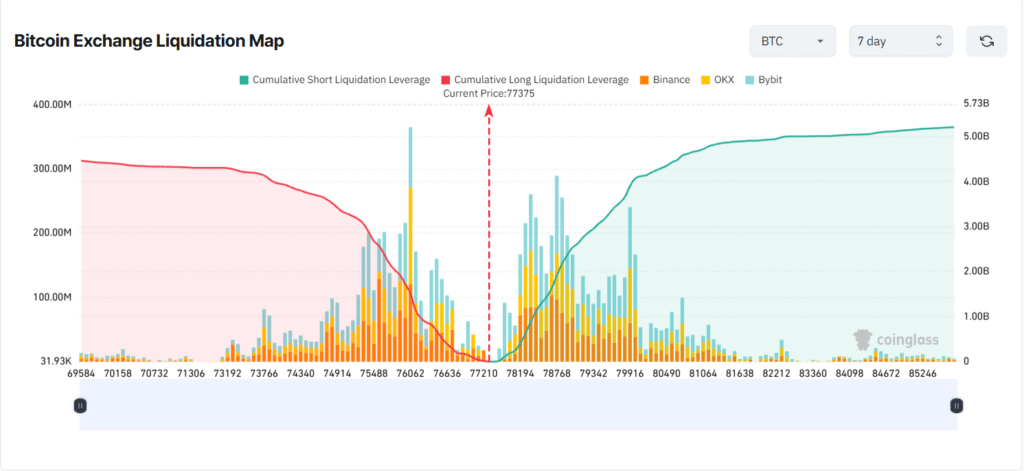
Bitcoin liquidity imbalance highlights a heavily skewed derivatives market where short positions dominate above current price levels. CoinGlass reports more than $4 billion in cumulative short exposure stacked above $80,000. This represents leveraged positioning that could be vulnerable to forced liquidations if a rapid upward move occurs. Actual realized impact depends on leverage levels and stop placement.
At the same time, a drop toward $75,000 would expose roughly $3 billion in long liquidations, creating a two-sided risk structure. Bitcoin liquidity imbalance therefore reflects both upside pressure and downside vulnerability depending on which boundary breaks first. This setup is often linked to sharp volatility expansions, where liquidation cascades amplify price movement once key levels are breached.
Why is derivatives activity dominating Bitcoin liquidity imbalance?
Derivatives markets are currently playing a stronger role than spot demand in shaping Bitcoin liquidity imbalance. Liquidation data shows more than 103,963 traders were wiped out in a 24-hour period, totalling $286.08 million in losses. Short positions accounted for nearly $175 million of this figure, indicating that bearish leverage has already begun to unwind.
The largest single liquidation event reached $3.04 million on Binance’s BTCUSDT pair. Open interest has also declined from around 120,000 BTC to 116,800 BTC, suggesting traders are reducing leverage rather than building new positions. This reflects a de-risking phase following volatility rather than fresh speculative expansion.
How are spot and futures flows diverging?
Spot and futures markets are showing a clear divergence that reinforces the current Bitcoin liquidity imbalance. Spot cumulative volume delta stands at -$483 million, signalling net selling pressure during the recovery phase. In contrast, futures CVD has turned slightly positive at around +$34 million, indicating that leveraged traders are supporting the move higher.
Funding rates are positive, meaning longs pay shorts. This indicates a short-term bullish skew among leveraged traders. Bitcoin liquidity imbalance is therefore being driven more by futures positioning than organic spot accumulation. Weak spot participation suggests that conviction from cash market buyers remains limited.
Which price levels are traders monitoring next?
Key levels define the evolving Bitcoin liquidity imbalance and map where volatility may accelerate. Immediate support remains at $76,100, while $78,000 continues to act as the near-term breakout trigger. Above this, the $79,500 to $80,300 fair-value gap represents a low-liquidity zone where price could move quickly if momentum strengthens.
On the downside, a loss of $76,100 could accelerate moves toward $75,000, where long liquidations remain clustered. Shifts in funding rates, spot CVD moving toward neutral or positive territory, and a rebound in open interest would indicate changing market conditions.
What risks could disrupt the current Bitcoin liquidity imbalance?
Bitcoin liquidity imbalance could shift quickly if price fails to hold key technical levels or if leveraged positions unwind suddenly. A rejection near $78,000 could push Bitcoin back toward lower support levels, while another failed attempt to break above $80,000 may trigger sharp reversals as leveraged positions begin to close.
Highly leveraged market conditions also remain vulnerable to false breakouts, particularly as spot demand continues to stay weak. Macro developments, ETF-related flows, or sudden changes in funding rates could alter market direction without warning.
What does the technical structure suggest next?
The current structure suggests a tightening range where Bitcoin liquidity imbalance continues building between support and resistance levels. The inverse head-and-shoulders pattern points to weakening bearish pressure, while the unfilled fair-value gap above current price remains an area traders are closely watching.

A move above $78,000 would place the $80,000 level firmly in focus, where liquidity concentration remains highest. However, another rejection could send Bitcoin back toward mid-range support levels as leveraged positions reset. The next move will likely depend on liquidity flows, derivatives activity, and whether spot demand begins to strengthen.
Conclusion
Bitcoin liquidity imbalance is now defining a compressed market structure where both upside breakout potential and downside liquidation risk remain elevated. The $80,000 zone continues to act as the key battleground for the next directional move.
If resistance breaks with strength, short liquidation pressure could accelerate upside momentum. If it fails, price may return to lower supports where long exposure becomes vulnerable. Bitcoin liquidity imbalance will remain the central force guiding short-term volatility as traders monitor positioning and liquidity shifts closely.
Glossary
Bitcoin Liquidity: How easily Bitcoin can be traded without sharp price swings.
Leverage: Borrowed funds used to increase trading size and risk.
Fair-Value Gap (FVG): A price area left unfilled after a rapid move.
Inverse Head-and-Shoulders: A bullish pattern that may signal a breakout higher.
Funding Rate: A fee between futures traders showing market sentiment.
Frequently Asked Questions About Bitcoin Liquidity
Why is the $80,000 level important for Bitcoin?
The $80,000 level holds a large number of short positions that could be liquidated.
What happens if Bitcoin moves above $80,000?
A move above $80,000 could trigger billions of dollars in short liquidations.
Why are futures markets influencing Bitcoin more than spot markets?
Futures traders are currently using more leverage, which is driving short-term price action.
Can Bitcoin still fall below current levels?
Yes, Bitcoin can still decline if support levels break and selling pressure increases.
Why are traders watching the $76,100 support level?
Traders are watching it because Bitcoin has defended this level several times recently.