

This article was first published on Deythere.
- Why Hyperliquid and Paradigm are Challenging the Proposal
- The DeFi Concern Behind the GENIUS Act Debate
- Treasury’s Goal Is Combating Illicit Finance
- Conclusion
- Glossary
- Frequently Asked Questions About GENIUS Act
- What is The GENIUS Act?
- Why are Hyperliquid and Paradigm objecting?
- What does the Treasury proposal require?
- How could the rules affect Decentralized Finance?
- When will the GENIUS Act take effect?
- References
Crypto Firms have warned that proposed rules under the GENIUS Act could end up pushing regulated dollar backed stablecoins out of Decentralized Finance.
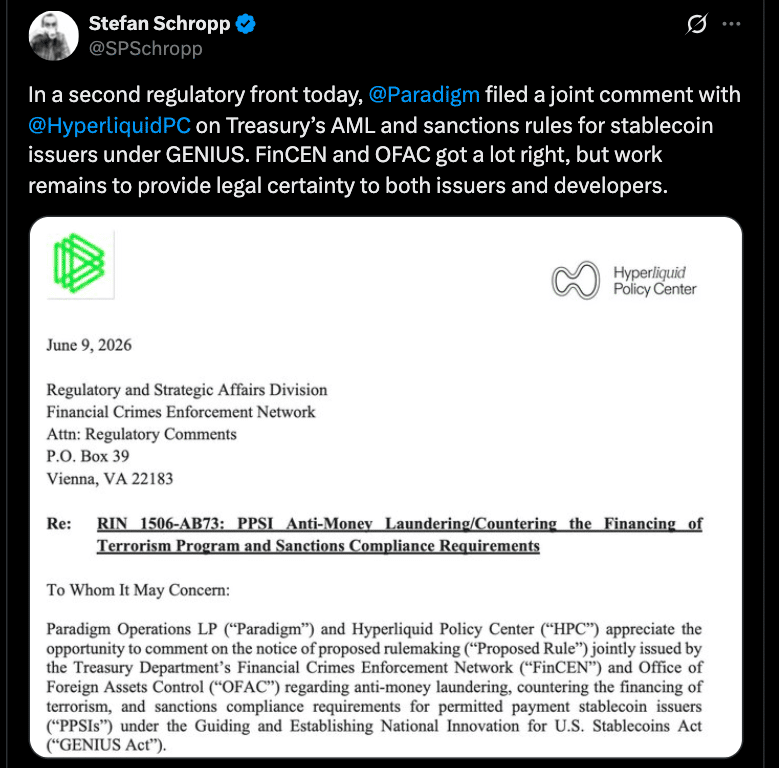
Just recently, the Hyperliquid policy centre and crypto investment firm Paradigm sent a joint letter to the US Treasury Department, urging them to revise parts of a proposed anti money laundering and sanctions framework tied to the GENIUS act.
The companies made the case that stablecoin issuers really can’t be expected to keep tabs on every single wallet interaction on public blockchains and that if they try to enforce this rule, it’ll scare off participation in Decentralized Finance altogether.
Why Hyperliquid and Paradigm are Challenging the Proposal
This argument stems from a joint rule proposed back in April by the US Treasury’s ‘Financial Crimes Enforcement Network ‘ (FinCEN) and the ‘ Office of Foreign Assets Control ‘ (OFAC). The proposal seeks to implement the AML and sanctions provisions contained in the GENIUS Act. Its intention is to treat permitted stablecoin issuers like banks and get them to implement AML and sanctions compliance programs.
Under the proposal, issuers will need to be able to block, freeze or reject any transaction that breaks sanctions laws or other rules. The framework also extends certain obligations beyond direct customer relationships.
Hyperliquid and Paradigm support applying compliance obligations in the primary market, where issuers have direct customer relationships and access to user information. However, they argue that applying similar expectations to secondary-market activity on permissionless blockchains creates obligations that issuers “cannot meaningfully police.”
Their letter contends that issuers often see wallet addresses and transaction data but have no practical way to identify every participant interacting with a stablecoin after issuance.
The DeFi Concern Behind the GENIUS Act Debate
The main cause of the disagreement is not whether stablecoins should comply with anti-money laundering rules but about where responsibility should begin and end.
Hyperliquid and Paradigm are saying that the risk of being held responsible for secondary-market activity is making issuers think about going back to permissioned environments where everyone is known and verified.
As is known, moving to that sort of setup would almost certainly reduce stablecoin activity out of decentralized exchanges, lending protocols and all other DeFi applications.
The firms warn that if that happens, users might just go to offshore alternatives that operate outside of US regulatory oversight.
Therefore, there is a bigger worry for the crypto world that the Anti money laundering rules will end up making dollar backed stablecoins weaker at a time when the US is trying to strengthen U.S. leadership in digital payments.

Treasury’s Goal Is Combating Illicit Finance
Treasury officials have defended the proposal as a necessary safeguard.
When the rule came out in April, Treasury Secretary Scott Bessent said it was designed to protect the financial system while supporting innovation in payment stablecoins. Treasury stated that the proposal seeks to address money laundering, sanctions evasion, and other illicit-finance risks associated with digital assets.
The proposed rule would require stablecoin issuers to implement AML compliance measures similar to those used by traditional banks
Supporters of the rule say that stablecoins have reached a point in terms of their importance in the global payments and financial systems, which is why the need for stricter procedures like those enforced by traditional financial institutions, has become more pressing.
The GENIUS Act was signed into law in 2025 and set out a comprehensive framework for the regulation of payment stablecoins in the US, and since then federal agencies have been working on finalizing the rule. They are now at a stage where the rules are almost ready to take effect, a deadline they’re expected to hit by January 2027 at the latest.
In the meantime, there are ongoing discussions about the CLARITY Act, a separate crypto market structure bill that could further define responsibilities for developers, platforms, and digital asset intermediaries.
Conclusion
The public comment deadline for the Treasury proposal concluded on June 9, placing industry feedback from groups such as Hyperliquid and Paradigm directly before regulators as they evaluate the final version of the framework.
It is worth noting that the GENIUS Act is still a work in progress, with the focus now turning from Congress to the regulators that have to turn the law into workable rules on the ground.
Glossary
GENIUS Act: The US legislation which sets out federal rules for payment stablecoins
Stablecoin: A cryptocurrency that is designed to maintain a stable value which is usually pegged to the US dollar.
Decentralized Finance (DeFi): Decentralized finance applications that use blockchain based smart contracts to provide financial services.
Anti-Money laundering (AML): regulations designed to prevent financial crime.
OFAC: The US agency in charge of enforcing sanctions.
Financial Crimes Enforcement Network (FinCEN): A US Treasury arm focused on combating financial crime.
Frequently Asked Questions About GENIUS Act
What is The GENIUS Act?
The GENIUS Act is the US law that sets out the regulatory framework for payment stablecoins and the people who issue them.
Why are Hyperliquid and Paradigm objecting?
They think the proposed AML and sanctions rules that apply to the secondary market are too broad and would be near impossible to enforce on public blockchains which don’t have permission to operate.
What does the Treasury proposal require?
The proposal requires stablecoin issuers to put in place AML and sanctions compliance procedures as well as having the capability to block, freeze or reject transactions that are not allowed.
How could the rules affect Decentralized Finance?
Some critics are saying that overly stringent compliance requirements could scare off issuers from using stablecoins in Decentralized Finance activities.
When will the GENIUS Act take effect?
Regulators are aiming to finalize the rule making and get the rules implemented by January 2027 at the latest.
References