



Goldman Sachs has reshaped market discussion around XRP and Solana after reducing exposure to both assets while maintaining a major Bitcoin allocation during Q1 2026.
- How Is Goldman Sachs Repositioning Its Crypto Exposure?
- Why Is XRP Struggling to Break Out?
- What Is Pressuring Solana Near the $85 Level?
- Why Are Institutions Prioritizing Bitcoin and Large-Cap Assets?
- What Does Goldman Sachs’ ETF Strategy Reveal?
- Could Altcoin Liquidity Conditions Remain Weak?
- Conclusion
- Frequently Asked Questions About Goldman Sachs
The latest portfolio disclosures have triggered fresh debate across the crypto market over whether institutional investors are temporarily rotating capital or making a deeper structural shift toward large-cap digital assets. Both XRP and Solana still have catalysts ahead, yet recent price action shows that investors remain cautious as liquidity conditions across the altcoin sector continue to tighten.
The move from Goldman Sachs comes during a period when neither XRP nor Solana managed to secure a decisive breakout despite favorable windows in the broader market. Analysts say the development reflects a transition phase for crypto markets where institutional capital is becoming more selective and increasingly focused on assets with deeper liquidity and clearer regulatory frameworks.
How Is Goldman Sachs Repositioning Its Crypto Exposure?
Goldman Sachs reduced exposure to XRP and Solana-linked products while preserving nearly $700 million in Bitcoin ETF holdings. The bank also sharply reduced Ethereum ETF exposure during the same quarter, though ETH continues to remain part of the broader institutional large-cap category alongside Bitcoin.

The repositioning by Goldman Sachs reflects a shift away from higher-beta altcoins and toward digital assets that offer stronger liquidity and more transparent pricing structures. Market analysts noted that institutions managing large allocations often prioritize assets that provide easier entry and exit conditions during periods of volatility.
The bank reportedly liquidated nearly $150 million in XRP ETF exposure and approximately $100 million tied to Solana products after holding those positions for only one quarter. Even with those reductions, some analysts believe the latest move reflects current market positioning rather than a permanent institutional retreat from altcoins.
Why Is XRP Struggling to Break Out?
XRP continues to trade within a narrow range between $1.38 and $1.42 as buyers defend support near $1.35. XRP is currently trading around $1.38, up 0.26% over the past 24 hours, while resistance remains firm around the $1.50 level where the asset has repeatedly failed to sustain upward momentum in recent weeks. Analysts tracking XRP said the token is currently moving more in line with broader altcoin flows rather than XRP-specific developments.
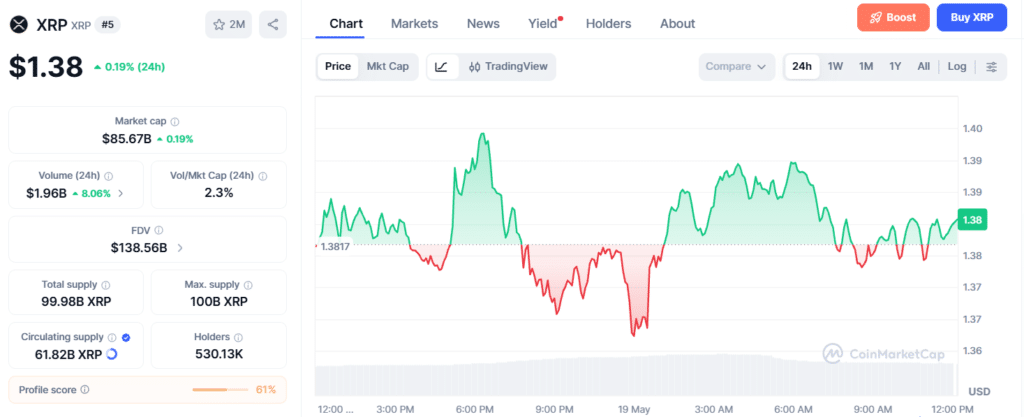
While the regulatory overhang surrounding XRP has largely eased, the market has yet to see a standalone catalyst strong enough to drive a decisive breakout. Several traders noted that XRP had multiple opportunities to move higher during recent sessions but failed to maintain momentum.
That pattern has strengthened the view that broader macro sentiment and overall risk appetite remain the primary drivers behind short-term price action. Some market participants also believe that if liquidity conditions improve across altcoins, XRP could benefit due to its established market presence and clearer regulatory standing compared with several smaller digital assets.
What Is Pressuring Solana Near the $85 Level?
Solana has faced heavier downside pressure after declining nearly 11.58% over the past week. SOL is currently trading around $85.28, up 0.71% over the past 24 hours, with analysts describing the $85 region as a key support zone for the token’s short-term market structure. A hold above $85 could allow SOL to attempt a recovery toward $95. However, traders warned that a break below $80 may expose previous consolidation zones with weaker technical support underneath.
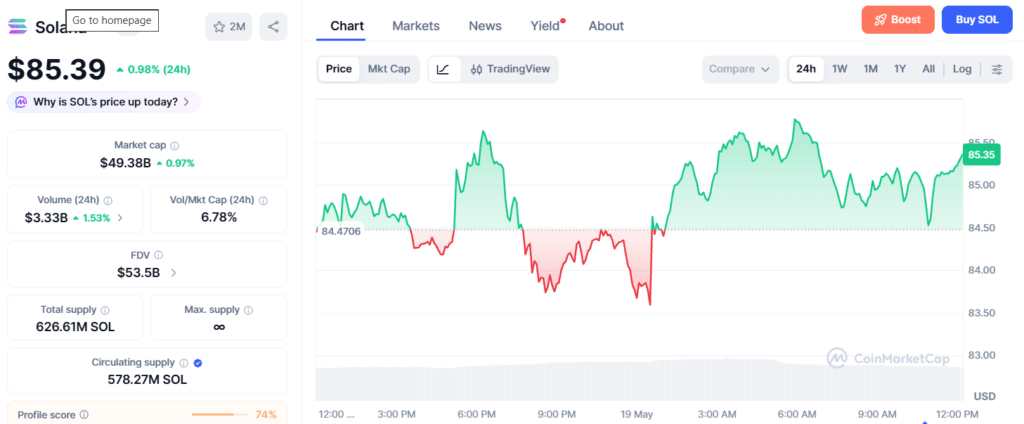
Recent weakness has also revived discussion around Solana’s connection to speculative meme coin activity. Some traders argue that the network’s rapid growth in meme coin trading created short-term momentum that became difficult to sustain once broader market sentiment weakened. Still, supporters within the Solana ecosystem continue highlighting the network’s long-term roadmap.
A post shared by the Solana Community account quoted Solana Foundation President Lily Liu as saying, “Memecoins don’t define Solana.” Analysts added that planned developments such as Alpenglow and new MEV design changes could strengthen Solana’s long-term infrastructure and transaction environment. However, they also stressed that these upgrades are unlikely to remove immediate selling pressure in the near term.

Why Are Institutions Prioritizing Bitcoin and Large-Cap Assets?
Institutional investors are increasingly concentrating exposure around assets that provide stronger liquidity depth and clearer compliance structures. Goldman Sachs maintained its large Bitcoin ETF position because Bitcoin continues to offer the deepest institutional liquidity among crypto assets. Bitcoin ETFs also benefit from a more established regulatory framework, making them easier for large financial institutions to manage from a compliance and fiduciary standpoint.
At the same time, Ethereum still remains part of the institutional large-cap category despite the reduction in exposure during the quarter. Analysts believe institutions continue viewing BTC and ETH as foundational crypto assets while becoming more cautious toward speculative altcoin allocations. Institutional flows are increasingly concentrating around Bitcoin-focused products as firms prioritize liquidity, transparency, and regulatory clarity during volatile market conditions.
What Does Goldman Sachs’ ETF Strategy Reveal?
Goldman Sachs is also preparing to launch its own Bitcoin Premium Income ETF. The proposed product would invest at least 80% of assets into Bitcoin-related instruments, primarily spot Bitcoin ETFs issued by other firms. The strategy would involve selling call options against portions of the fund’s Bitcoin exposure in order to generate premium income.
Market participants view the approach as an effort to combine Bitcoin exposure with income-generating structures that may appeal to institutional investors seeking more controlled risk profiles. The latest filing also signals that Goldman Sachs continues to view Bitcoin infrastructure products as an important part of long-term institutional participation in crypto markets.
Could Altcoin Liquidity Conditions Remain Weak?
Liquidity across the altcoin market has weakened in recent weeks as institutional appetite shifts toward larger digital assets and infrastructure-focused products. Analysts said the latest actions from Goldman Sachs reinforce the idea that institutions are becoming more selective with crypto allocations during volatile periods. The broader market is also entering what some traders describe as a transition phase.

In that environment, altcoins without strong liquidity support or consistent institutional demand may continue facing pressure even if broader crypto sentiment stabilizes. At the same time, analysts cautioned against interpreting the latest repositioning as a complete rejection of altcoins. Several market participants believe institutional interest could return if regulatory clarity improves further and market conditions become more favorable for higher-risk assets.
Conclusion
Goldman Sachs has intensified focus on how institutional investors are approaching digital assets during a period of weaker altcoin momentum and tighter liquidity conditions. The bank’s decision to reduce XRP and Solana exposure while preserving significant Bitcoin holdings reflects a broader market preference for liquidity, transparency, and regulatory clarity.
XRP remains trapped within a tight trading range while Solana continues defending critical support near $85. Both assets still retain longer-term catalysts, including XRP’s improved regulatory position and Solana’s infrastructure upgrades tied to Alpenglow and MEV changes. Goldman Sachs’ latest portfolio shift shows that institutional money is currently staying closer to larger crypto assets instead of moving aggressively into speculative altcoins.
Glossary
Goldman Sachs: Major Wall Street investment bank.
Bitcoin ETF: Fund linked to Bitcoin’s price.
Crypto Exposure: Investment placed in crypto assets.
Regulatory Overhang: Market pressure from legal uncertainty.
Large-Cap Assets: Leading cryptocurrencies with high market value.
Frequently Asked Questions About Goldman Sachs
Why did Goldman Sachs reduce XRP and Solana exposure?
Goldman Sachs reduced exposure as institutions became more cautious about altcoin investments.
Did Goldman Sachs completely exit XRP and Solana?
No, Goldman Sachs only lowered its exposure to XRP and Solana products.
What is happening with XRP’s price?
XRP is moving in a narrow range and struggling to break key resistance levels.
What is the key support level for Solana?
Analysts consider the $85 level a major support zone for Solana.
Why are institutions focusing on large-cap crypto assets?
Institutions prefer large-cap assets because they offer stronger liquidity and stability.
Sources: