

The real-world asset market has become one of crypto’s strongest growth narratives, but the latest data shows a gap that investors can no longer ignore. RWA tokenization is approaching $30 billion in on-chain value, yet only about $2.47 billion is actively used inside DeFi protocols. That means most tokenized bonds, funds, commodities, and equities are visible on-chain, but not deeply connected to the lending, trading, collateral, and yield systems that made decentralized finance valuable in the first place.
- RWA Tokenization Growth Is Outpacing Real DeFi Use
- The Key Indicator: DeFi Active TVL
- Why Permissioned Assets Create a Marketing Problem
- Private Credit Shows What Better Integration Looks Like
- What It Means for Crypto Markets
- Marketing Analysis: The Narrative Must Mature
- Conclusion
- Frequently Asked Questions
RWA Tokenization Growth Is Outpacing Real DeFi Use
RWA tokenization has attracted banks, asset managers, fintech platforms, and crypto-native issuers because it promises faster settlement, better transparency, fractional ownership, and new market access. In plain English, it takes assets such as Treasuries, private credit, gold, real estate, and equities and represents them as blockchain-based tokens.
The headline growth looks strong. The problem sits beneath the surface. A tokenized product can exist on a blockchain without being useful across DeFi. If it cannot move freely into lending markets, liquidity pools, derivatives, or collateral systems, then it behaves more like a digital wrapper around traditional finance than a live crypto asset.
That distinction matters for marketing as much as technology. The market has spent years selling tokenization as a bridge between Wall Street and DeFi. Now the bridge is being tested, and a fair amount of traffic is still stuck at the gate.
The Key Indicator: DeFi Active TVL
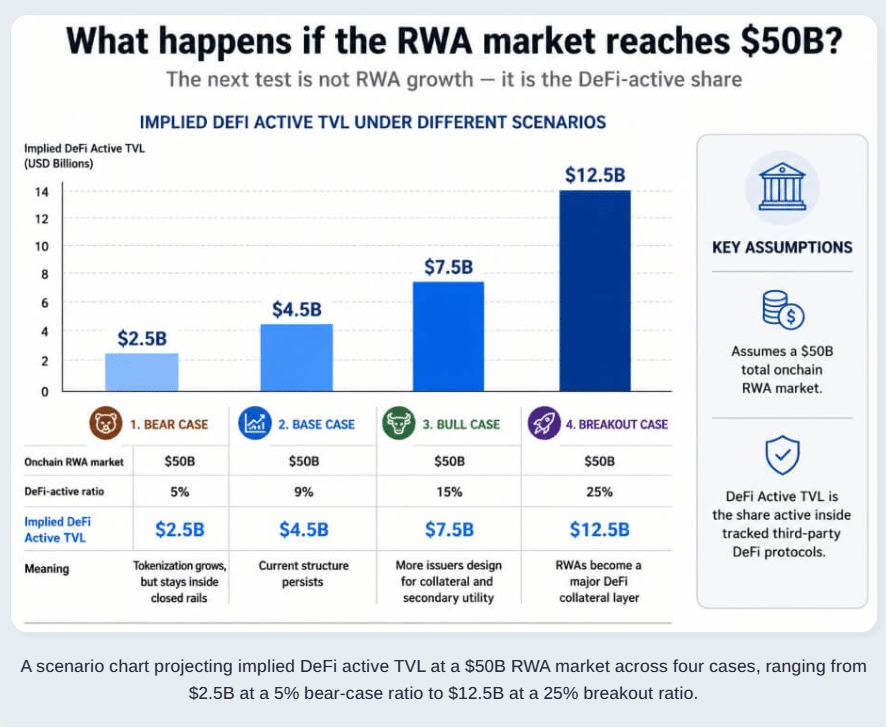
The most important metric here is DeFi active TVL, which tracks how much tokenized real-world asset value is actually deposited or pooled inside third-party DeFi protocols. Current data puts that figure at around $2.47 billion, compared with a tokenized RWA market near $30 billion. That is a utilization rate below 10%, which is not weak growth, but it is a clear sign that adoption is uneven.
For crypto investors, this indicator works like volume behind a price move. A market cap can look impressive, but without active use, liquidity depth, and protocol demand, the narrative may be thinner than it appears.
Bonds and money market products remain the largest category, with more than $16.6 billion on-chain, but less than $1 billion reportedly active in DeFi. Gold and commodities also show a wide gap, with billions tokenized but only a small portion plugged into DeFi rails. Tokenized equities show a similar pattern, where regulatory and transfer restrictions make open composability difficult.
Why Permissioned Assets Create a Marketing Problem
The core issue is not whether institutions want blockchain. They clearly do. The issue is whether their products are built for open financial networks.
Many tokenized assets use permissioned structures, including whitelists, know-your-customer controls, transfer agents, and restricted wallet access. These features help issuers meet compliance standards, but they also limit how freely assets can move between DeFi platforms. A token that only approved wallets can hold is not easy to plug into an open lending pool or automated market maker.
That creates a messaging challenge for issuers. RWA tokenization sounds simple to market, but buyers increasingly need to know what kind of tokenization they are getting. Is it a token that settles faster inside a controlled system, or is it an asset that can be borrowed against, traded, and used across open DeFi?
Those are not the same product.
Private Credit Shows What Better Integration Looks Like
Private credit stands out because it is more naturally aligned with DeFi lending models. Data cited in the latest market update shows private credit with roughly $3.226 billion on-chain and about $1.257 billion active in DeFi, giving it a much higher usage ratio than tokenized bonds, commodities, or equities.

That matters because private credit protocols were often built around lending from day one. Their assets are not merely displayed on-chain. They are structured around borrowing, yield, repayment, risk assessment, and collateral. In marketing terms, this gives private credit a clearer product-market fit inside crypto.
For RWA tokenization to become more than a compliance-friendly database upgrade, more asset classes may need this kind of DeFi-native design.
What It Means for Crypto Markets
There are three key indicators traders and analysts should watch:
First, DeFi active TVL must rise faster than the total tokenized asset value. If total value grows while active DeFi use stays flat, the market is expanding in name but not in utility.
Second, collateral acceptance matters. When major lending protocols begin accepting more tokenized assets under controlled risk frameworks, demand can deepen.
Third, secondary liquidity is vital. Tokenized assets need reliable buyers, sellers, pricing, and redemption processes. Without that, users may treat them as static holdings rather than working capital.
RWA tokenization also affects market sentiment. It gives crypto a more institutional narrative at a time when investors want real yield, regulated products, and practical use cases. Still, if most assets remain locked inside permissioned environments, DeFi may capture only a fraction of that upside.
Marketing Analysis: The Narrative Must Mature
The next phase of RWA tokenization marketing cannot rely only on big asset-value numbers. The stronger message will focus on usable liquidity, transparent risk, redemption quality, legal clarity, and protocol integration.
This is where the market gets more serious. Retail investors may respond to large market-size forecasts, but institutions and sophisticated crypto users will ask harder questions. Who holds the underlying asset? What rights does the token holder have? Can the token be transferred? Can it be used as collateral? What happens during default, redemption pressure, or smart contract failure?
Global regulators have also warned that tokenization can create investor confusion if buyers do not clearly understand whether they own the asset itself or a tokenized claim linked to it. That makes disclosure a marketing asset, not just a legal checkbox.
Conclusion
RWA tokenization remains one of the most important crypto trends, but the latest data shows that market size alone does not prove DeFi adoption. The real test is composability. Assets must move, settle, trade, generate yield, and serve as collateral without losing the compliance standards institutions require.
The opportunity is still large. Some analysts have projected tokenized real-world assets could reach $2 trillion by 2028, but the winners will likely be platforms that solve both sides of the equation: regulated asset access and real DeFi utility.
For now, RWA tokenization is growing fast, but the market is learning a simple lesson. Putting assets on-chain is only step 1. Making them useful is where the real race begins.
Frequently Asked Questions
What is RWA tokenization?
RWA tokenization is the process of representing real-world assets such as bonds, funds, gold, credit, or real estate as blockchain-based tokens.
Why is DeFi usage still low?
DeFi usage is low because many tokenized assets are permissioned, meaning they require approved wallets, KYC checks, and restricted transfers.
Why does DeFi active TVL matter?
It shows how much tokenized asset value is actually being used inside DeFi protocols, rather than simply sitting on-chain.
Which RWA category is more active in DeFi?
Private credit appears more active because its structure fits lending, yield, and collateral use cases more naturally.
Glossary of Key Terms
DeFi: Blockchain-based financial services such as lending, trading, and yield markets without traditional intermediaries.
TVL: Total value locked, meaning assets deposited into a protocol or market.
Composability: The ability for one blockchain asset or protocol to work easily with another.
Permissioned asset: A tokenized asset that only approved users or wallets can hold or transfer.
Collateral: An asset pledged to secure a loan or borrowing position.
Sources
Disclaimer: This article is for informational and educational purposes only. It is not financial advice, investment guidance, or a recommendation to buy, sell, or hold any crypto asset.