

The Cardano hard fork has entered a critical testing phase, and the broader crypto market is watching closely. Developers, validators, and ADA holders now face an important question: can the network achieve the required Stake Pool Operator participation before Protocol Version 11 moves toward mainnet activation?
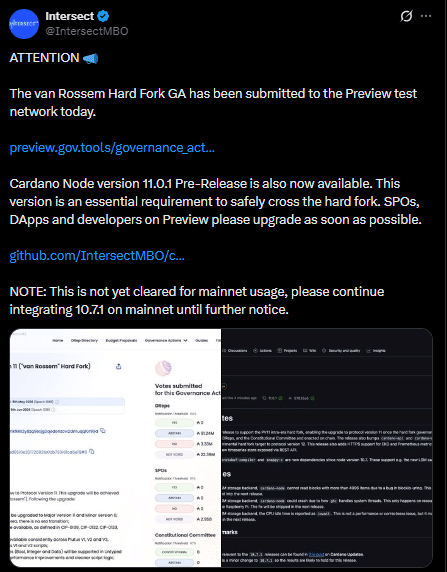
According to the source, the latest Cardano hard fork reached the Preview test network on May 5 after Intersect confirmed both the governance action submission and the release of Cardano Node version 11.0.1 Pre-Release. The latest ADA upgrade now shifts focus almost entirely toward validator readiness under Cardano’s Voltaire governance framework.
Interestingly, some reports referenced an 80% milestone during the rollout discussion. However, Cardano’s formal constitutional requirement still remains 85% of active stake before the governance action can proceed toward ratification.
Cardano Hard Fork Introduces Smoother Network Upgrades
The current Cardano hard fork introduces Cardano’s first fully supported intra-era hard fork mechanism. In simple terms, the blockchain can now upgrade protocol versions without leaving the Conway era entirely.
That distinction matters because transaction structures remain unchanged throughout the process. Wallets, decentralized applications, and exchanges can continue operating without major compatibility concerns. As a result, the latest ADA upgrade minimizes ecosystem disruption while reducing fears around broken applications or unstable integrations.
The release also upgrades cardano-api and cardano-cli into their 11.0 series. These tools support developers, exchanges, node operators, and infrastructure providers across the ecosystem. At the same time, the update references experimental work toward Protocol Version 12. The early reference to Protocol Version 12 signals Cardano’s development cycle is accelerating beyond the current ADA upgrade and preparing for future governance-driven improvements.
Why the 85% Threshold Controls the Entire ADA Upgrade
The biggest challenge surrounding the latest Cardano hard fork is the mandatory 85% SPO threshold. Under Cardano’s governance framework, validators representing at least 85% of active stake must install the updated software before ratification can move forward.
This rule exists to prevent dangerous chain splits during upgrades. If too many validators continue running outdated software, incompatible blocks may emerge after activation.
The network learned that lesson during a late-2025 incident involving a malformed delegation transaction. That event triggered emergency coordination between validators and forced rapid upgrades toward Node 10.5.3 to stabilize the chain. The situation showed that SPO coordination acts as a real security layer rather than a simple procedural step.
Historically, larger professional stake pools complete upgrades within 72 to 96 hours after release. Smaller home-hosted pools often require one to two weeks before fully migrating. Platforms such as PoolTool and Cardano Scan are now tracking the active stake percentage as the Cardano hard fork advances through Preview testing.

Expanded Plutus Functions Could Strengthen the Cardano Hard Fork
The latest Cardano hard fork also introduces major improvements for Plutus smart contracts. The release bundles five new primitive sets tied to CIP-0109, CIP-0132, CIP-0133, CIP-0138, and CIP-0153.
More importantly, existing Plutus V1 and V2 scripts now gain access to expanded built-in functions without requiring developers to rewrite older contracts. This allows older decentralized applications to access newer scripting capabilities without expensive migration work.
For developers, the latest ADA upgrade creates a smoother path toward stronger decentralized finance applications while preserving compatibility with older systems. That balance between innovation and ecosystem stability remains one of the most important technical strengths behind the current Cardano hard fork.
In an official governance update, Intersect urged SPOs, developers, and dApps to upgrade immediately before the proposal advances further.
Ecosystem Coordination May Decide the Success of the ADA Upgrade
Even if validators quickly cross the threshold, the Cardano hard fork still depends on broader ecosystem coordination. Exchanges, wallets, and decentralized applications must prepare their infrastructure before activation reaches mainnet.
The earlier Chang hard fork exposed weaknesses in ecosystem timing when exchange and dApp delays slowed rollout progress even after validators upgraded successfully. Because of that experience, the current ADA upgrade now places pressure across the full infrastructure stack instead of validators alone.
Conclusion
The latest Cardano hard fork represents more than a technical milestone. It acts as a large-scale test of decentralized governance, validator coordination, and long-term ecosystem maturity under the Voltaire era.
If the network successfully clears the 85% requirement, the current ADA upgrade could strengthen Cardano’s position as one of crypto’s most carefully coordinated blockchain ecosystems. The coming weeks may ultimately reveal whether decentralized governance can scale efficiently under real-world pressure.
Glossary of Key Terms
Stake Pool Operator (SPO): Validators responsible for producing and verifying Cardano blocks.
Voltaire Era: Cardano’s governance phase focused on decentralized community voting.
Plutus: Cardano’s smart contract programming platform.
Protocol Version 11: The upcoming network upgrade currently under Preview testing.
DRep: Delegate Representatives participating in governance voting.
FAQs About Cardano Hard Fork
What is the Cardano hard fork?
The Cardano hard fork is a network upgrade that improves blockchain functionality and governance systems.
Why is the 85% SPO threshold important?
The threshold helps prevent network splits by ensuring most validators upgrade together.
What does the ADA upgrade improve?
The ADA upgrade improves smart contracts, governance coordination, and ecosystem compatibility.
Has the Cardano hard fork reached mainnet yet?
No, the upgrade currently remains on the Preview test network.