



This article was first published on Deythere.
- Massive Ethereum Whale Transfers Put ETH Under Pressure
- Institutional Interest in Ethereum Continues to Weaken
- Ethereum Exchange Inflows Surge as Selling Activity Climbs
- Technical Indicators Show Ethereum at a Critical Phase
- Conclusion
- Glossary
- Frequently Asked Questions About Ethereum Whale Activities
- Why are Ethereum whale transfers important?
- Who is Garrett Jin?
- Why is Ethereum struggling below $2,400?
- Can Ethereum still have a recovery this year?
- References
Ethereum is once again facing major market pressure as whale activity, combined with hopes for institutional sentiment, increases fears of another huge sell-off phase. While the overall crypto market has tried to consolidate after recent selloff, the Ethereum price was unable to sustain above the $2400 region, leaving traders cautious about the asset’s short-term direction.
The latest pressure point came after a massive ETH transfer linked to prominent Ethereum whale Garrett Jin triggered fresh market anxiety. Additionally, on-chain data showed increasing exchange inflows and deteriorating institutional demand, raising worries that whales may be preparing to offload additional ETH into an already fragile market.
ETH price has struggled to hold late-April recovery and has changed hands around the $2,300 zone. Now, the rejection near $2,400 has emerged as a key technical level; as analysts analyze whether Ethereum can maintain support zones or head towards lower price targets in future sessions.
Massive Ethereum Whale Transfers Put ETH Under Pressure
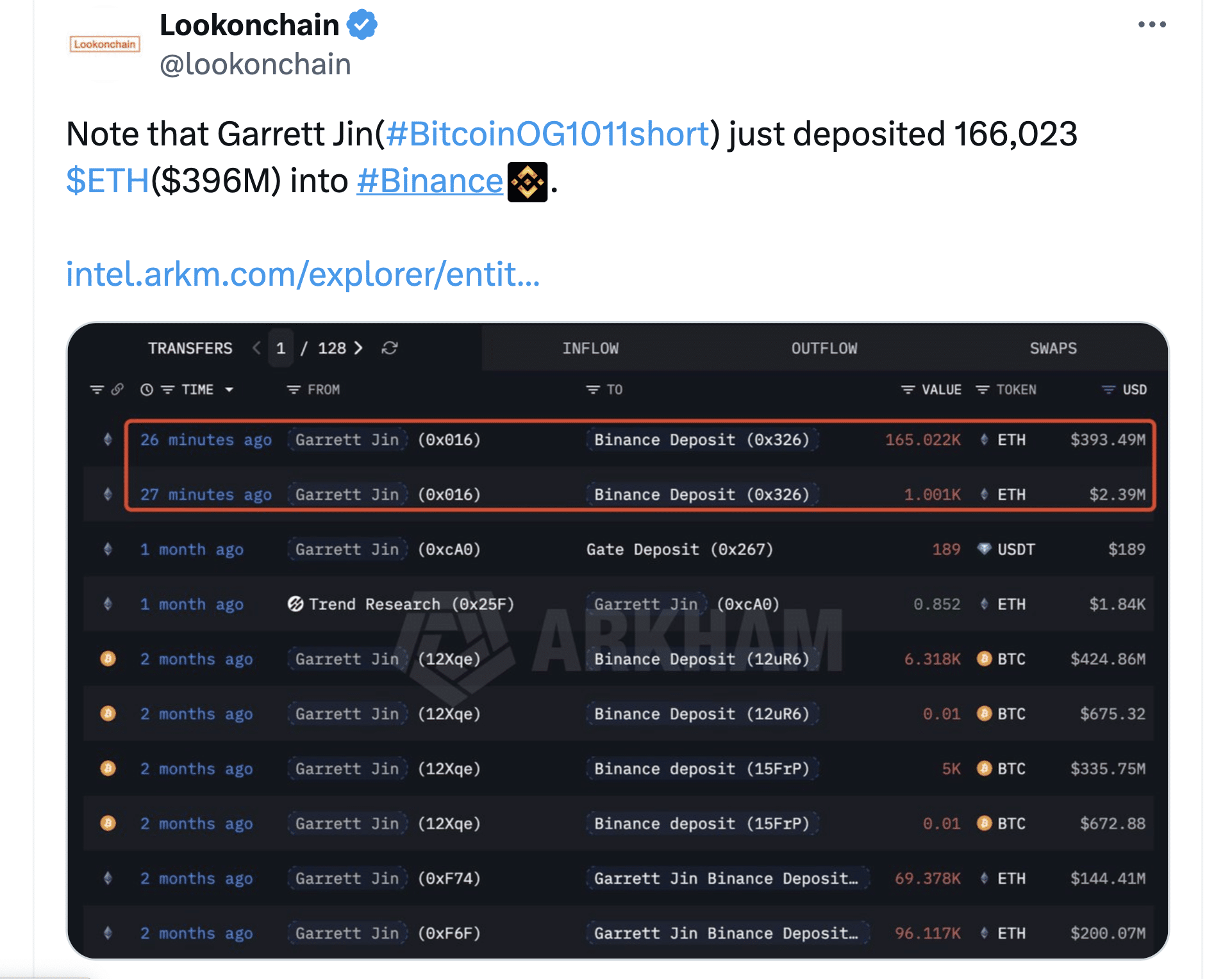
The biggest development this week was a whale movement of almost $400 million worth of ETH pulled onto Binance.
Blockchain tracker Lookonchain reports that Garrett Jin, known in crypto circles as BitcoinOG1011 sent 166,023 ETH (about $396 million) to Binance. Market observers interpreted the move as a potential sign of incoming sell pressure because large deposits to exchanges are commonly associated with preparations to sell.
Because Jin has been associated with some of the largest exchange inflows in market history, the transfer garnered immediate attention. During a previous volatile trading period, over 260,000 ETH, valued at more than $543 million dollars, reportedly moved to Binance from wallets tied to the same entity earlier in February 2026.
Although Garrett Jin’s transfer was only recent, he still reportedly holds over 381,000 ETH valued at approximately $900 million, and traders are still watching out for any other incoming exchange deposits that may follow on from this to place more selling pressure.
Meanwhile, venture capital firm Paradigm Capital also increased the bearish sentiment after four accounts related to Paradigm diverted 11,615 ETH ($27.29M) to FalconX, a fast-growing institution-focused crypto brokerage platform.
The assets were not sold instantly, however professionals in the market interpreted the transfer as a brand new indication that institutions may be reducing exposure after Ethereum’s inability to hold above resistance.
The mix of institutional deposits and Ethereum whale transfers are worsening fears that ETH recovery rally is losing steam right as wider market uncertainty is returning.
Institutional Interest in Ethereum Continues to Weaken
Ethereum’s institutional view hasn’t been so good recently and multiple signals indicate that large investors are becoming even more defensive.
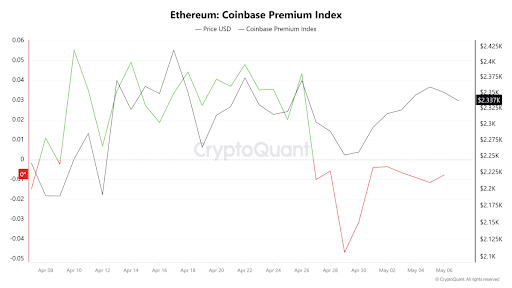
One main weakness that has been a clear identifier has been the Coinbase Premium Index. This indicator which measures the price difference between Coinbase vs. offshore exchanges, has been negative for almost 10 straight days. A negative reading typically suggests weaker demand from U.S.-based institutional investors.
Market research released earlier this month had similarly revealed that spot ETH ETFs experienced significant outflows in late April. Tracked data from Deep Blue Alpha showed ETH ETF outflows of nearly $184 million net in four days, as institutional appetite abated amid the recent volatility.
That pressure comes at a sensitive time for Ethereum. ETH remains way below its 2025 highs, while competition from networks such as Solana and Hyperliquid continues attracting users, liquidity, and trading activity away from Ethereum-based applications.
While many institutions are still optimistic in the long run, short term positioning is filled with caution. Tom Lee’s Bitmine however continues accumulating ETH despite unrealized losses.
The macro conditions in general have added pressure as well. Persistent inflation, high treasury yield levels and indecision about future interest at the Federal Reserve are still keeping risk-on sentiment suppressed across crypto markets.
Ethereum, which used to react strongly to liquidity conditions, has struggled to regain sustained upside momentum under those conditions.
Ethereum Exchange Inflows Surge as Selling Activity Climbs
This extends beyond Ethereum whale speculation as on-chain data indicates an increase in Ethereum sell-side activity.
According to the market metrics, Ethereum’s Exchange Netflow surged to 160,900 ETH on May 6, marking the highest monthly level recorded recently. Roughly 983,300 ETH flowed into exchanges during the same period, pointing to a sharp increase in available supply.
Many consider positive exchange netflows bearish because they imply that investors are moving assets onto exchanges where it can be sold.
The Exchange Supply Ratio also reversed upward after falling previously, rising from 0.121 to 0.122 within two days. While the increase may appear small numerically, analysts monitor these changes closely because they can show growing market willingness to distribute holdings rather than accumulate.
Looking back, spikes in exchange balances during periods of weak momentum have often preceded deeper corrections for Ethereum and other major cryptocurrencies.
However, not every whale movement guarantees immediate selling. Some may involve collateral management, over-the-counter trading preparation or internal fund restructuring for transferring assets.
As a result, analysts are still monitoring whether real selling volume will build in the following days before declaring that a more macro distribution phase has indeed been arranged.
Technical Indicators Show Ethereum at a Critical Phase
The technical structure of Ethereum has weakened after repeated failures around the $2,400 level.
Ethereum’s Directional Movement Index (DMI) reportedly formed a bearish crossover as the positive directional indicator (+DI) slipped below the Average Directional Index (ADX).
This type of setup generally signals weakening bullish momentum even when the broader trend remains active.
Analysts note that if the bearish momentum grows even further, and if sellers continue to widely dominate exchange flows, then ETH may once again fall below $2,250 in the short term.
Meanwhile, Ethereum is preserving key support levels at the same time. The $2,300 level continues to be watched from a technical perspective as a main defensive area that the bulls must maintain to avoid causing an even larger drawback.
Recent market analysis also highlighted the importance of the $2,361 to $2,367 resistance cluster formed by Ethereum’s 50-day and 200-day moving averages. A successful breakout above that zone could reopen upside targets near $2,550 or even $2,750 later this quarter.
This means the next few trading sessions may determine if Ethereum is stabilizing following a period of whale behavior or entering another broader phase of correction.
Conclusion
The decline in sentiment around ETH is driven by multiple bearish factors, including Ethereum whale transfers, institutional caution and increased exchange inflows.
Recently, Garrett Jin moved $396 million worth of ETH to Binance which has fueled concerns about a new wave of selling pressure as institutional gauges continue to flash weakness.
Ethereum still appears to have a weak technical structure following recent rejections near $2,400. Netflows and supply ratio indicate increased onslaught from sellers while momentum ratios imply bulls are slowly losing grip.
Nonetheless, Ethereum continued to hold out for a long-term outlook. Institutional investors are still accumulating selectively, network upgrades still in progress and some analysts forecast a recovery for ETH if there’s an improvement of the general market conditions.
Glossary
Ethereum (ETH): The second largest cryptocurrency by market cap and Ethereum’s native asset.
Exchange Netflow: A measure of the amount of cryptocurrency flowing into or out of exchanges.
Coinbase Premium Index: An indicator comparing Coinbase prices with offshore exchanges to estimate U.S. institutional demand.
Whale: A crypto investor or entity that owns large amounts of cryptocurrency.
Directional Movement Index(DMI) : A technical analysis indicator used for trend strength measurement, momentum.
Frequently Asked Questions About Ethereum Whale Activities
Why are Ethereum whale transfers important?
Big Ethereum whale transfers to exchanges may suggest selling activity, thus contributing to volatility and downside pressure on the market.
Who is Garrett Jin?
Garrett Jin, also known as BitcoinOG1011 is a crypto whale that conducts huge Bitcoin and Ethereum transactions.
Why is Ethereum struggling below $2,400?
Ethereum is under pressure from decelerating institutional demand, higher inflows to exchanges and mixed macroeconomic environment.
Can Ethereum still have a recovery this year?
Yes. If ETH reclaims major resistance levels and market liquidity improves, analysts believe Ethereum could still resume a broader recovery trend.