

Ethereum outperforms Bitcoin as fresh capital rotation, changing ETF flows, and a strong rise in network activity come together to influence short-term market trends. The situation shows a clear gap forming between the two largest digital assets, with ether gaining strength while bitcoin continues to face steady fund outflows.
- How does Ethereum outperforms Bitcoin reflect a shift in market structure?
- What do recent price movements indicate about this rotation?
- Why is Ethereum network activity rising so sharply?
- Does higher activity translate into stronger economic value?
- How is Bitcoin responding to ETF outflows?
- What role does historical context play in evaluating this trend?
- Can this rotation sustain in the coming weeks?
- Conclusion
- Glossary
- Frequently Asked Questions About Ethereum Outperforms Bitcoin
Market positioning is gradually shifting as institutional money movement and on-chain data begin to move in the same direction after several months. This change is attracting attention from traders and market participants who are closely watching for early signals of a wider trend shift.
How does Ethereum outperforms Bitcoin reflect a shift in market structure?
Ethereum outperforms Bitcoin as capital shifts away from U.S. spot Bitcoin ETFs and moves into ether-linked products. On April 13, bitcoin ETFs saw net outflows of $325.8 million, according to SoSoValue data, pointing to a slowdown in what had been a key source of demand.

The biggest withdrawals came from Fidelity’s FBTC with $229 million and ARK’s ARKB with $63 million. This trend shows that institutional interest in bitcoin exposure is easing for now.
In comparison, ether funds are seeing renewed interest. Ethereum outperforms Bitcoin as ether ETFs recorded daily inflows of $7.7 million, while weekly inflows reached $187 million for the period ending April 10.
This is the strongest weekly inflow recorded in 2026 and follows three straight weeks of outflows totaling around $308 million. Cumulative ETH ETF inflows have now reached a record $11.68 billion, showing continued institutional participation despite recent market volatility.
What do recent price movements indicate about this rotation?
Ethereum outperforms Bitcoin as price movement follows the shift in capital flows. Ether is currently trading at $2,366.55, rising 7.71% in the last 24 hours, while bitcoin is priced at $74,446.60 with a 4.78% gain in the same period. The difference becomes clearer over a longer timeframe. Over the past week, ether has climbed 12.67%, compared to bitcoin’s 8.63% increase.
On a monthly basis, the gap remains visible. Ether is up 12.37% over the past month, while bitcoin has gained 4.14%. The widening spread between the two suggests that the move is building gradually, rather than being driven by a brief or isolated price jump.
Why is Ethereum network activity rising so sharply?
Ethereum outperforms Bitcoin as activity on the network picks up pace within a short period. Daily transactions on Ethereum have jumped 41% week over week to nearly 3.6 million, data from Artemis shows. Just a few days earlier, on April 10, the network was handling around 2.5 million transactions. The sharp rise indicates that usage has increased quickly over a brief timeframe.
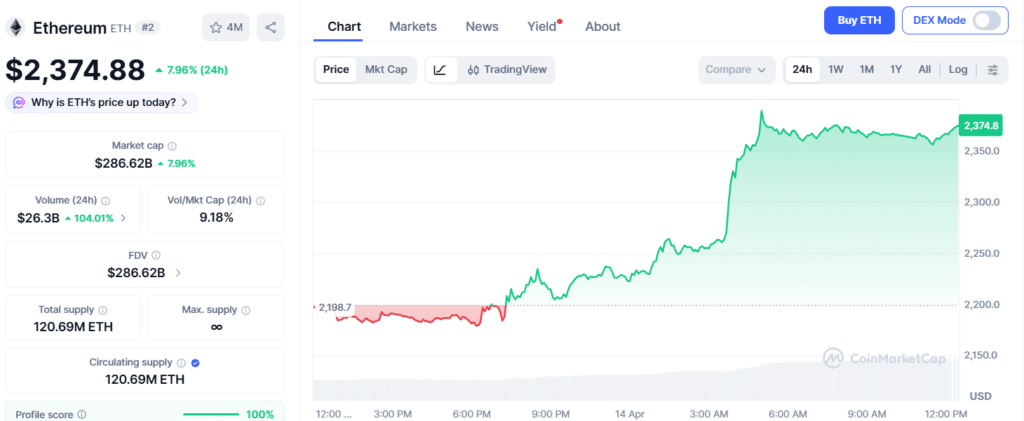
At the same time, broader market indicators are also moving higher. Ethereum’s market cap stands at $285.87 billion, up 7.87%, while 24-hour trading volume has climbed to $26.27 billion, marking a sharp 105.12% increase. The volume-to-market cap ratio is currently at 9.18%, reflecting stronger trading activity.
Compared to other major blockchains, only Sonic and TON have posted higher percentage gains. However, both come from much smaller starting points, which makes Ethereum’s growth more significant given its scale.
Does higher activity translate into stronger economic value?
Ethereum outperforms Bitcoin in activity growth, but the underlying economic strength appears uneven. While transactions are up 41%, stablecoin transfer volume has dropped 42.6% over the same period. Network fees have also declined by nearly 50%.
This indicates that although more transactions are taking place, they involve smaller values and reduced economic throughput. The divergence between activity and value suggests that the current surge may not fully reflect stronger capital movement on-chain.
How is Bitcoin responding to ETF outflows?
Ethereum outperforms Bitcoin even as bitcoin shows resilience under pressure. Despite significant ETF outflows, bitcoin prices have remained relatively stable, as highlighted in Glassnode’s weekly report. Bitcoin is absorbing selling pressure without a sharp correction.
This indicates the presence of underlying spot demand even as ETF-driven demand weakens. At the same time, momentum indicators suggest that the asset is operating in an overbought range, which could influence near-term price behavior.
What role does historical context play in evaluating this trend?
Ethereum outperforms Bitcoin in the current phase, but earlier benchmarks highlight a key difference. During the stablecoin-driven rally of 2025, Ethereum recorded strong transaction growth alongside rising transfer volumes from USDC and USDT.
That period supported a move toward $4,000, driven by higher economic throughput. In contrast, the current trend shows rising transaction counts but declining stablecoin volume. This gap indicates that the present activity lacks the same level of economic backing seen in previous rallies.
Can this rotation sustain in the coming weeks?
Ethereum outperforms Bitcoin for now, but its durability depends on several factors. Continued inflows into ETH funds will be necessary to maintain momentum. At the same time, bitcoin must continue absorbing ETF outflows without triggering a broader correction.

The balance between these factors will determine the strength of the rotation. The quality of Ethereum’s network activity will remain an important factor, especially in narrowing the gap between rising transaction numbers and the lower value being transferred on-chain.
Conclusion
Ethereum outperforms Bitcoin in a clear short-term shift supported by ETF inflows, price gains, rising network activity, and a sharp increase in trading volume. However, the underlying data still shows a mixed trend. Capital shifts alongside rising transaction activity, yet declining stablecoin volume and lower fees signal weaker economic depth on the network.
Meanwhile, Bitcoin stays stable despite ongoing institutional outflows. The coming weeks will determine whether this shift develops into a sustained trend or remains a temporary divergence shaped by short-term market flows.
Disclaimer: This article is meant for general information only. It should not be taken as financial or investment advice. Crypto markets can change quickly, so readers should make decisions carefully.
Glossary
ETF Flows: Movement of capital into or out of exchange-traded funds
Bitcoin ETF Outflows: Capital exiting bitcoin-linked ETFs
Network Activity Surge: Sharp rise in blockchain transactions and usage
Week-on-Week Growth: Performance change compared to the previous week
Stablecoin Volume: Total value transferred using stablecoins like USDT or USDC
Network Fees: Charges paid to process transactions on a blockchain
Frequently Asked Questions About Ethereum Outperforms Bitcoin
Why is Ethereum outperforming Bitcoin right now?
Ethereum is outperforming Bitcoin because more money is moving into ETH while Bitcoin ETFs are seeing outflows.
How much money left Bitcoin ETFs recently?
About $325 million left Bitcoin ETFs in a single day, showing weaker demand.
Are Ethereum ETFs seeing inflows?
Yes, Ethereum ETFs are seeing new inflows, showing growing investor interest.
What is happening to stablecoin activity on Ethereum?
Stablecoin transfer volume has dropped, even though total transactions are rising.
Can Ethereum keep outperforming Bitcoin?
Ethereum can continue outperforming if ETF inflows stay strong and activity improves in quality.
Sources: