

Wall Street risk-on rotation is no longer a background shift as it is now steering global capital, and Bitcoin is moving with it. When large funds leave safety and seek growth, the impact spreads across markets.
According to the source, equity funds absorbed about $118 billion over four weeks, while money-market funds recorded a sharp $173 billion weekly outflow. Together, this forms a $292 billion signal that capital is rotating toward risk.
A $292 Billion Wave Signals Rising Confidence
The strength of Wall Street risk-on rotation becomes clearer when looking at how flows built over time. Equity inflows climbed from $15 billion to $23.47 billion, then to $31.26 billion, and finally reached $48.72 billion.
This steady rise reflects growing conviction, not sudden speculation. At the same time, the $173 billion exit from cash marked the largest weekly withdrawal since 2018. A recent analysis noted that “risk appetite is rising across global markets” .
Such synchronized movement signals a broader shift. Investors are not testing the waters. They are repositioning for opportunity.
Why Wall Street Risk-On Rotation is Redefining Bitcoin
The effect of Wall Street risk-on rotation becomes more visible through Bitcoin’s changing behavior. Data shows Bitcoin’s correlation with equities stands near 0.58, while its link with gold remains weak.
This shift shows Bitcoin no longer acts like a defensive hedge. Instead, it follows capital flows tied to growth. A recent report highlights that “Bitcoin increasingly reflects global liquidity conditions” .
Bitcoin now behaves like a liquidity beta, rising and falling with global capital conditions. As risk appetite grows, Bitcoin inflows increase, reinforcing this trend.
On-Chain Data Reveals a Reset, Not Just Accumulation
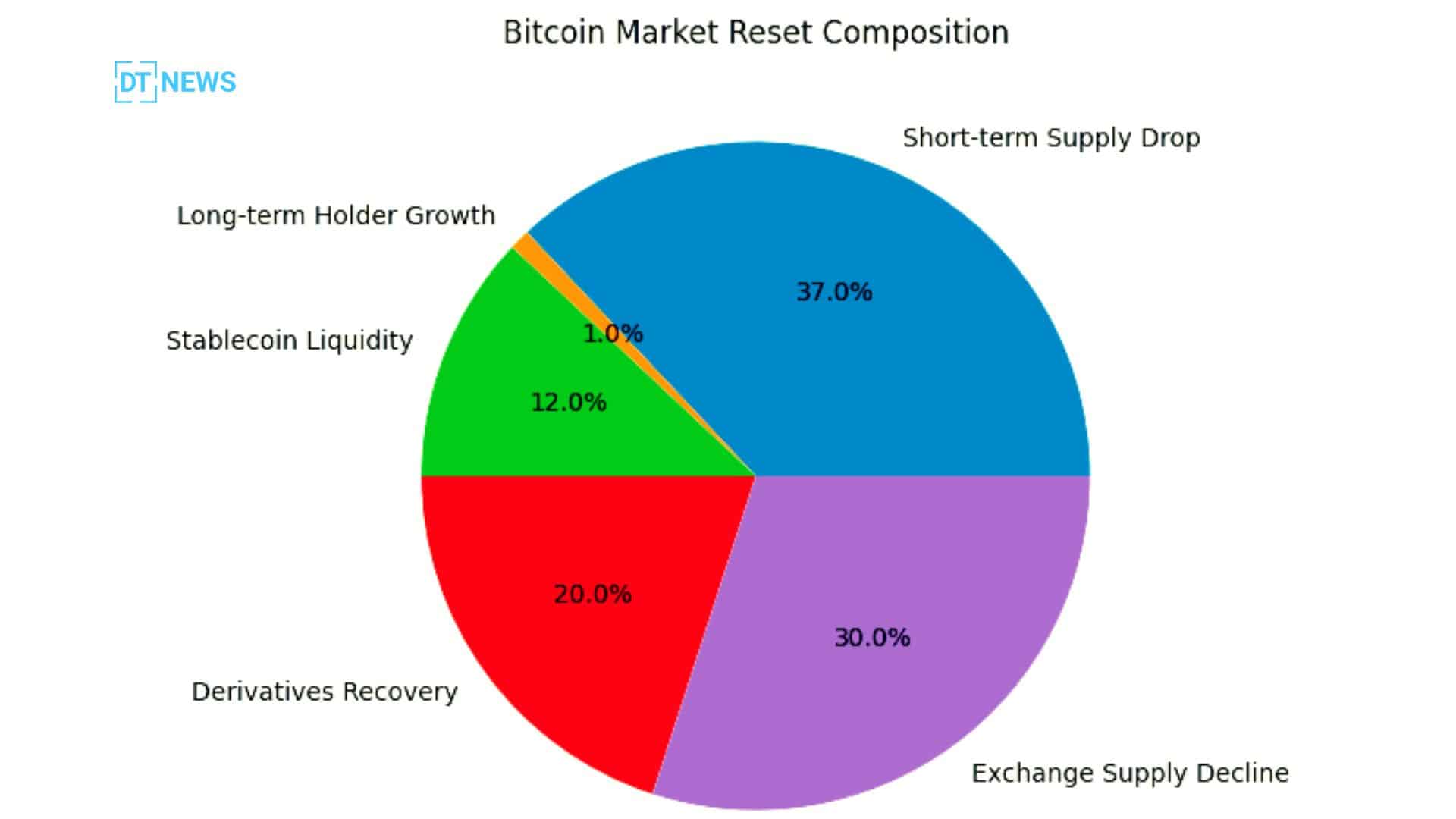
Blockchain signals confirm that the market has gone through a reset phase. Supply held for less than three months dropped by 37 percent, while long-term holdings increased by one percent.
This shows weaker holders exited during the downturn, while experienced investors accumulated. The Puell Multiple fell to 0.7, indicating miner revenue stayed below average levels, a pattern often linked to accumulation zones.
At the same time, Bitcoin inflows into long-term wallets continued rising. Exchange balances declined, reducing selling pressure. Stablecoin supply also increased from $308 billion to $320 billion, showing that liquidity stayed within the ecosystem.
Derivatives data adds more clarity. Options open interest rose by 2.4 percent, while perpetual futures increased by 8.6 percent. This was not just accumulation. It was a clean deleveraging followed by a measured rebuild.
Bull And Bear Paths Hinge on Macro Momentum
The bullish case depends on whether Wall Street risk-on rotation continues expanding into high-yield credit, private credit, and emerging markets. If that happens, Bitcoin stands to benefit from broader capital inflows.
A survey of 91 investors conducted between March 16 and April 7 shows 75 percent of institutions and 61 percent of retail participants view Bitcoin as undervalued. Only a small portion sees it as overpriced.
What this means is, we now have a trepid market and not an overheated one. This long under-owned positioning leaves space for expansion as Bitcoin inflows increase. The 12 to 20 percent increases, to a range of $87,500 to $94,000 are based on institutional capital rotation and not speculative retail demand.
This outlook is additionally supported by a softer dollar. The dollar index fell back 0.8%, easing liquidity conditions. Bitcoin often rides with global liquidity trends.
However, risks remain. Persistent inflation, rising oil prices and geopolitical tensions could cause investors to flock back to cash. If so, Bitcoin might slip to levels ranged $66,500, $72,000 thanks to macro-driven pressure.

Conclusion
The Wall Street risk-on rotation is creating a more disciplined than euphoric market. Bitcoin has stopped moving just on hype alone. It’s reacting to liquidity, institutional positioning, and structural changes.
It is evidence of an uptrend, established on the back of slow and subdued but persistent accumulation / capital rotation. However, it all comes down to one thing. Global markets, are they still believers in risk or do cautious investment thinkers return? That answer will define the next chapter of Bitcoin.
Glossary of Key Terms
Risk-on rotation: Movement of capital from safe assets into higher-risk investments like equities and crypto.
Bitcoin inflows: Capital entering Bitcoin markets through buying activity.
Liquidity beta: An asset that moves in response to changes in global liquidity conditions.
Puell Multiple: A metric comparing miner revenue to historical averages.
On-chain data: Blockchain-based metrics that track investor behavior.
FAQs About Wall Street Risk-On Rotation
What is Wall Street risk-on rotation?
It refers to investors shifting funds from cash into riskier assets such as stocks and Bitcoin.
Why does Bitcoin benefit from this trend?
Bitcoin behaves like a liquidity-driven asset, so it rises when global risk appetite increases.
Are Bitcoin inflows increasing?
Yes, both institutional and long-term holders are driving steady Bitcoin inflows.
What could weaken this trend?
Macroeconomic risks like inflation, oil prices, or geopolitical tensions could push investors back to safer assets.