

Real-world asset markets are moving beyond tokenized Treasury bills, and energy is now becoming one of the more serious tests for blockchain infrastructure. Recent RWA data shows that XRP Ledger tokenization has climbed to about $3.6 billion in real-world asset value, excluding stablecoins, with tokenized energy commodities driving much of the growth. The headline number is important, but the bigger signal is more practical: blockchain is being used to track contracts, energy value, and settlement records for assets tied to the physical economy.
- XRP Ledger Tokenization Moves Into Energy Assets
- Why Energy Fits Real-World Asset Infrastructure
- The Key Indicators Crypto Investors Should Watch
- Institutional Controls Give XRPL an Advantage
- Why the $3.6B Figure Needs Context
- Conclusion
- Frequently Asked Questions
- What is driving XRP Ledger’s RWA growth?
- Does this mean XRP price will rise?
- Why is energy being tokenized?
- Is tokenized energy the same as buying electricity?
- Glossary of Key Terms
XRP Ledger Tokenization Moves Into Energy Assets
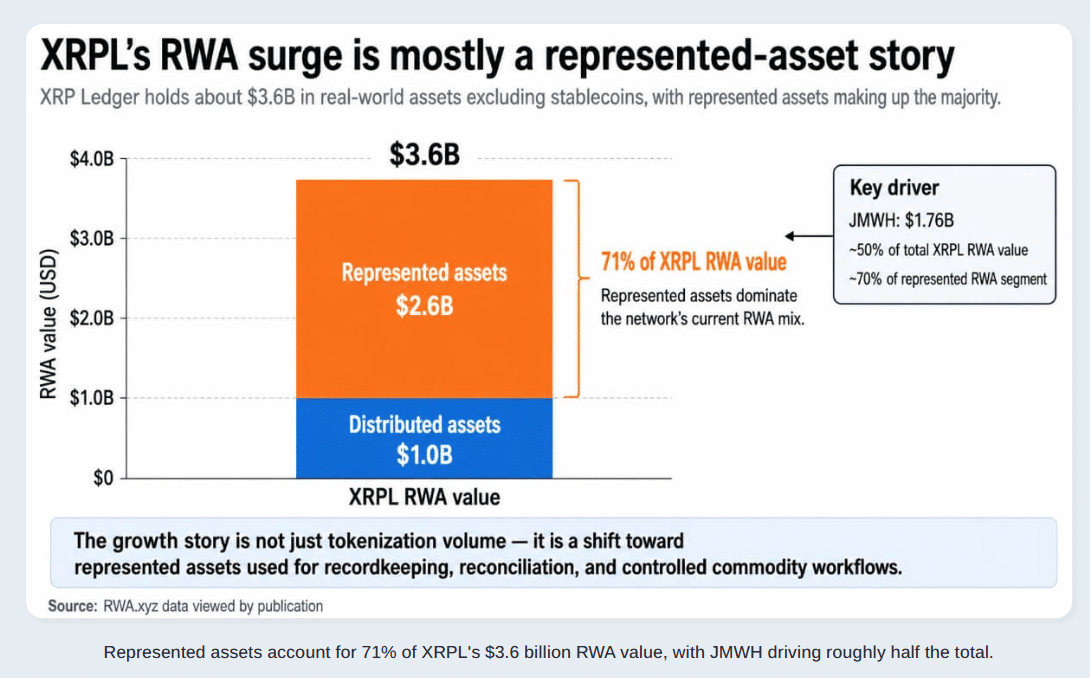
The strongest activity is coming from JMWH, an energy-backed asset where each token represents 1 real megawatt-hour of energy. Public RWA data lists JMWH at around $1.76 billion in total value, after rising more than 104% over 30 days. That makes it one of the main reasons XRP Ledger tokenization is now being discussed as more than a payments or exchange-use case.
This is not just another crypto token chasing market attention. The asset links digital records with real energy commitments, which gives it a different profile from speculative coins. It works more like a digital claim and tracking layer for energy value, rather than a meme-style market product.
Why Energy Fits Real-World Asset Infrastructure
Energy is hard to manage because contracts, delivery, billing, audits, and environmental records often sit across different systems. That creates delays and gaps, especially when large producers and corporate clients need proof of supply or traceability. XRP Ledger tokenization offers a shared record where represented assets can be issued, assigned, tracked, and reconciled with less manual friction.
The energy angle also matters because commodities are not simple financial products. A Treasury bill has a clear issuer and maturity date, while electricity is produced, delivered, consumed, and reported through operational systems. That makes tokenization more useful when it supports accounting, compliance, and traceability, not just trading.
The Key Indicators Crypto Investors Should Watch
The first indicator is total RWA value, because it shows whether assets are actually being deployed on-chain. The second is asset concentration, since JMWH makes up a large share of the total. If one product carries the market, growth can look stronger than the broader ecosystem really is.
The third indicator is 30-day growth, which shows momentum. A rise of more than 104% in JMWH value suggests fast adoption, but investors should check whether the increase came from new demand, larger issuance, or a one-time program expansion. The fourth indicator is transfer volume, because real use normally leaves a footprint beyond headline valuation. The fifth is the number of asset holders or participating entities, as wider distribution gives the market more depth.
For crypto readers, the final indicator is whether this creates direct demand for XRP. At this stage, the link appears indirect. XRP Ledger tokenization can increase network relevance, but that does not automatically mean XRP price appreciation. Markets often price narrative faster than actual utility, and that is where caution matters.
Institutional Controls Give XRPL an Advantage
Represented real-world assets need more control than open crypto tokens. Issuers often require authorization, freeze functions, clawback options, metadata, and delegated administration. These tools help platforms meet legal and operational needs when tokens reflect real contracts or commodities.
That is one reason XRP Ledger tokenization is gaining attention in controlled RWA markets. Institutions usually do not want fully loose assets moving without oversight. They need rails that support compliance, auditability, and administrative safeguards. In that sense, XRPL is competing less with meme-driven blockchains and more with enterprise-grade settlement systems.
Why the $3.6B Figure Needs Context
The number looks strong, but it needs to be read carefully. A large share of XRPL’s RWA value comes from represented assets, and JMWH alone accounts for roughly half of total RWA value on the network. That is impressive, but it also creates concentration risk. If more tokenized commodity projects follow, XRP Ledger tokenization could build a deeper base. If not, the current growth may remain tied to one large energy program.
This is where the market should avoid easy hype. One strong project can prove infrastructure works, but a durable RWA market needs repeatable adoption across issuers, regions, and asset classes.
Conclusion
The rise of XRP Ledger tokenization in energy commodities shows how blockchain is slowly moving into the less glamorous but more useful parts of finance. Tokenized energy is not only about price charts. It is about records, contracts, delivery, audits, and trust between real companies. That makes the latest XRPL growth worth watching, especially as the RWA sector keeps expanding beyond stablecoins and tokenized bonds.
Still, investors should separate network adoption from token price assumptions. XRP Ledger tokenization may strengthen XRPL’s role in real-world asset markets, but the long-term value will depend on whether more issuers bring serious commodity, credit, and infrastructure products on-chain.
Frequently Asked Questions
What is driving XRP Ledger’s RWA growth?
The main driver is tokenized energy, especially JMWH, which represents real megawatt-hours of energy and accounts for a large portion of XRPL’s RWA value.
Does this mean XRP price will rise?
Not automatically. XRP Ledger tokenization can improve network utility, but XRP price depends on many factors, including liquidity, market sentiment, demand, regulation, and broader crypto conditions.
Why is energy being tokenized?
Energy is being tokenized to improve tracking, settlement, reporting, and accountability. It can help companies connect real-world energy contracts with digital records.
Is tokenized energy the same as buying electricity?
No. A tokenized energy asset may represent a claim, record, or contractual commitment linked to energy value. Investors should review the issuer, structure, rights, and legal terms before making any decision.
Glossary of Key Terms
RWA
RWA means real-world asset. It refers to physical or traditional financial assets represented on a blockchain.
JMWH
JMWH is a tokenized energy asset where each token represents 1 megawatt-hour of real energy.
Megawatt-Hour
A megawatt-hour is a unit used to measure electricity over time. It is common in energy production and billing.
Tokenization
Tokenization means turning rights, claims, or records tied to an asset into digital tokens on a blockchain.
Represented Asset
A represented asset is a token that reflects a real-world asset or contractual value, rather than existing only as a native crypto asset.
Source