
Ethereum staking ETF fees are no longer a quiet detail buried in fund documents. They are now front and center, shaping how investors judge value in crypto markets. A recent move by BlackRock has added fuel to that debate, and the timing feels anything but random.
According to the source, the iShares Staked Ethereum Trust launched in March under ETHB, entering the growing Ethereum ETF space with a structure that looks simple on paper but feels layered in practice.
Ethereum Staking ETF Fees Are Not as Simple as They Seem
The structure behind Ethereum staking ETF fees tells a deeper story. BlackRock applies a 0.25% management fee and takes an 18% cut from staking rewards. On paper, it sounds straightforward. In reality, it complicates return expectations.
The fund already holds about $318 million in staked Ethereum. The commission is shared with Coinbase, which handles custody and validator operations.
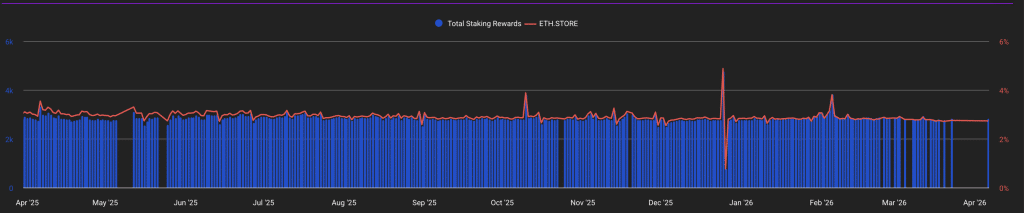
At current yields near 2.74%, these Ethereum staking ETF fees shave off roughly 49 basis points before the base fee even kicks in. That detail matters more than it first appears, especially for institutional models built on predictable costs.
When Ethereum Staking ETF Fees Meet Bitcoin’s Zero-Fee Playbook
This is where things get interesting. Bitcoin ETFs rewrote the rules fast. Fees dropped to zero within a year. Issuers waived costs just to pull in assets, following what many call the index fund playbook.
But Ethereum staking ETF fees do not follow that same script. An Ethereum ETF that includes staking carries extra weight. Validators must stay online. Slashing risks must be managed. Rewards must be distributed fairly.
Industry data explains why these layers exist. Another breakdown suggests that while fees may drop, they are unlikely to reach zero.
Fee Pressure Builds as Rivals Push Back
Competition rarely stays quiet. Fidelity Investments already offers an Ethereum ETF staking product with about a 10% commission. That gap is hard to ignore.
Reactions across the market feel mixed. Tyrone Ross recently noted that fee structures often end up favoring large institutions, raising concerns for retail investors. On the other hand, Ethan Buchman expects Ethereum staking ETF fees to drift lower over time, possibly closer to 10%.
Still, there is a catch. Harriet Browning warned that cutting Ethereum staking ETF fees too fast could weaken validator quality. That trade-off is not easy to ignore.
A Quiet Shift Beyond Fees: LiquidChain’s Bigger Bet
While Ethereum staking ETF fees dominate headlines, another story is unfolding in the background. LiquidChain is positioning itself as a Layer 3 solution that connects Bitcoin, Ethereum, and Solana liquidity into one system.
Its model rests on four ideas. A Unified Liquidity Layer pools assets across chains. Single-Step Execution simplifies transactions. Verifiable Settlement ensures trust. The Deploy-Once system allows developers to build once and scale everywhere.
This may not directly change Ethereum ETF pricing today, but it hints at where the market could move next.
Conclusion
Ethereum staking ETF fees now sit at a turning point. BlackRock’s 18% move may look expensive, yet it reflects real operational costs. At the same time, competition is already pulling prices downward.
The future of the Ethereum ETF market will likely settle somewhere in between. Not free like Bitcoin, but not this high forever either. For investors, the real edge lies in understanding what sits behind the fee, not just the number itself.
Glossary of Key Terms
Ethereum ETF: A fund that tracks Ethereum and offers exposure without direct ownership.
Staking Rewards: Earnings generated by locking ETH in the network.
Validator: A system that verifies blockchain transactions.
Expense Ratio: The yearly cost of managing a fund.
Slashing Risk: Penalty when validators fail to perform properly.
FAQs About Ethereum Staking ETF Fees
What are Ethereum staking ETF fees?
They include management fees and a share of staking rewards taken by the fund.
Why are Ethereum ETF fees higher than Bitcoin ETFs?
Ethereum staking requires infrastructure and active management, which increases costs.
Will Ethereum staking ETF fees fall over time?
Yes, competition is expected to push fees lower gradually.
Are lower fees always better?
Not always. Lower fees may impact security and validator performance.