

Crypto self-custody has entered a new stage as the digital asset ecosystem becomes more complex and interconnected. Controlling private keys remains the foundation of ownership, but it no longer answers every challenge users face after assets reach their wallets.
- How is crypto self-custody changing in 2026?
- Why did centralized exchanges become the preferred choice for many users?
- Why did the ownership debate evolve into an execution debate?
- What makes execution its own infrastructure layer?
- How can wallet-to-wallet execution reduce operational complexity?
- What risks remain even after removing long-term custody?
- How is execution infrastructure continuing to develop?
- Conclusion
- Glossary
- Frequently Asked Questions About Crypto Self-Custody
Every transaction now requires decisions about liquidity, pricing, blockchain networks, and execution quality before funds reach their destination. In 2026, the discussion around crypto self-custody is no longer limited to who controls digital assets. It increasingly focuses on how those assets move safely and efficiently without recreating the same risks users sought to avoid by leaving custodial platforms.
How is crypto self-custody changing in 2026?
The meaning of crypto self-custody has expanded because ownership and execution are now separate responsibilities. For years, self-custody was defined by one principle: holding assets outside exchanges, lending platforms, or other custodial services. That principle remains unchanged.
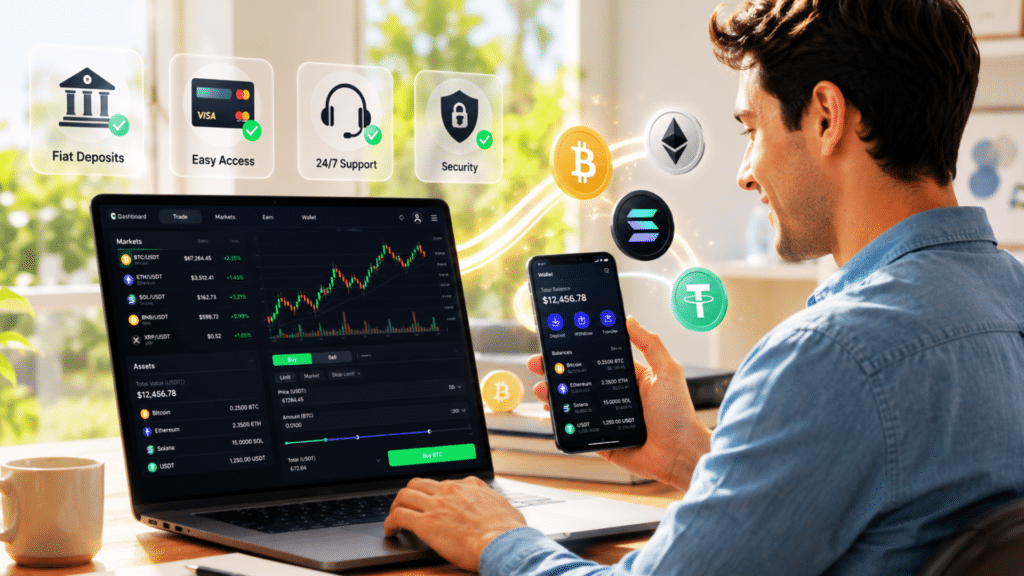
However, once funds are stored inside a personal wallet, users still need reliable ways to exchange assets, choose blockchain networks, compare liquidity, understand fees, decide between fixed and floating rates, and recover when transactions encounter delays. Ownership has largely settled one debate within the industry. Execution has opened another. The challenge is no longer simply controlling private keys but completing transactions without unnecessarily introducing new operational risks.
Why did centralized exchanges become the preferred choice for many users?
Centralized exchanges became popular because they solved problems that early self-custody could not. During the 2010s, they gathered liquidity that was previously scattered across peer-to-peer markets and early trading platforms. They simplified access through familiar account systems, supported fiat deposits, and replaced seed phrases with usernames, passwords, two-factor authentication, and customer support.
For many newcomers, this convenience made crypto significantly easier to use. The trade-off was that users exchanged direct ownership for accessibility. Assets held on an exchange became balances maintained within the platform’s internal records, while withdrawals ultimately depended on the platform’s solvency, operational controls, internal policies, and regulatory relationships.
For years, many users accepted that compromise because it provided convenience, deep liquidity, and an easier trading experience. The underlying custody risks became more visible only after several major platform failures.
Why did the ownership debate evolve into an execution debate?
The shift followed several events that demonstrated different forms of risk across the crypto ecosystem. The principles behind self-custody trace back to the Cypherpunk movement established in 1992 by Eric Hughes, Tim May, and John Gilmore, who promoted privacy and individual control through cryptography rather than institutional trust.
Bitcoin reinforced those ideas when its genesis block was mined on January 3, 2009. Seven days later, Hal Finney received the first peer-to-peer transaction of 10 BTC from Satoshi Nakamoto. Satoshi Nakamoto wrote, “The root problem with conventional currency is all the trust that’s required to make it work.” The phrase “Not your keys, not your coins” later became one of crypto’s defining principles.
Events over the following years strengthened that message. Mt. Gox collapsed in 2014 after around 850,000 BTC were lost. In 2022, Celsius froze withdrawals, Voyager suspended customer access, and FTX entered bankruptcy with roughly $8 billion in missing customer funds. During the same year, Ronin lost $625 million, Wormhole lost $325 million, and Nomad lost approximately $190 million through separate infrastructure exploits.
Those incidents differed in nature. Some reflected custodial failures while others exposed weaknesses during asset movement across systems. Together, they demonstrated that ownership reduces one category of risk but does not eliminate every challenge users face after taking custody of their assets.
Pavel Nikienkov, co-founder of Zano, said the next decade of the industry will be defined by how seriously projects preserve self-custody and permissionless access, arguing that rebuilding custodial systems under different forms ultimately recreates the same model users originally sought to avoid.
What makes execution its own infrastructure layer?
Execution has become a separate operational layer because owning assets does not automatically determine how they move. Once a user decides to swap one asset for another, an entirely different set of systems becomes involved. These include pricing engines, liquidity discovery, routing mechanisms, execution paths, transaction monitoring, confirmation systems, and customer support if something interrupts the process.
Liquidity in 2026 is distributed across centralized exchanges, decentralized exchanges, bridges, multiple blockchain networks, request-for-quote systems, and aggregation services. The best execution path can vary depending on the trading pair, available liquidity, transaction size, and market conditions. Neo, Head of Product at ELLIPAL, summarized this shift by saying, “Self-custody is not a one-time decision. It is a discipline you keep every time you move funds.”
For active traders, this often means comparing several liquidity sources before each transaction. Investors reallocating larger positions may focus on reducing price impact while limiting exchange exposure. Wallet-first users continue to prioritize direct ownership while seeking execution methods that preserve that approach throughout the transaction.
How can wallet-to-wallet execution reduce operational complexity?
Wallet-to-wallet execution services aim to simplify transactions while allowing users to retain direct ownership of their assets. Instead of requiring accounts across numerous trading venues, these services compare available liquidity, identify execution routes, process transactions, and deliver converted assets directly into wallets controlled by users.
The Swapzone Team said direct ownership is no longer the industry’s primary debate, adding that future infrastructure will focus on simplifying execution while handling technical complexity behind the scenes. For many users, this approach can reduce manual comparisons across providers and can reduce the need to maintain long-term balances on centralized exchanges. However, execution remains separate from ownership, and completing a transaction still requires reliable infrastructure operating behind the scenes.
What risks remain even after removing long-term custody?
Reducing custody exposure does not remove every operational risk. Users remain responsible for confirming wallet addresses, selecting the correct blockchain network, understanding exchange rate types, reviewing final receive estimates, and knowing how to reach customer support if transactions are delayed.
Execution services also introduce temporary trust surfaces. Intermediate custodial hops, relayer services, or off-chain settlement legs can hold or process funds during a swap. That exposure is usually limited to the duration of the transaction, but it still creates counterparty and operational risk that users should understand.
Common failure modes include bridge exploits, failed cross-chain hops that require manual recovery, relayer or provider outages that stall transactions, and decentralized exchange MEV or sandwich attacks that can increase execution costs. Ownership therefore remains only one part of responsible asset management. Execution introduces its own responsibilities without replacing the original principles of self-custody.
How is execution infrastructure continuing to develop?
Modern execution systems combine multiple operational functions into a single transaction flow. They connect with liquidity providers, compare available prices, determine execution routes, process conversions, monitor transaction status, and provide support if unexpected delays occur. SimpleSwap reports connections with more than 20 liquidity providers across centralized and decentralized markets.
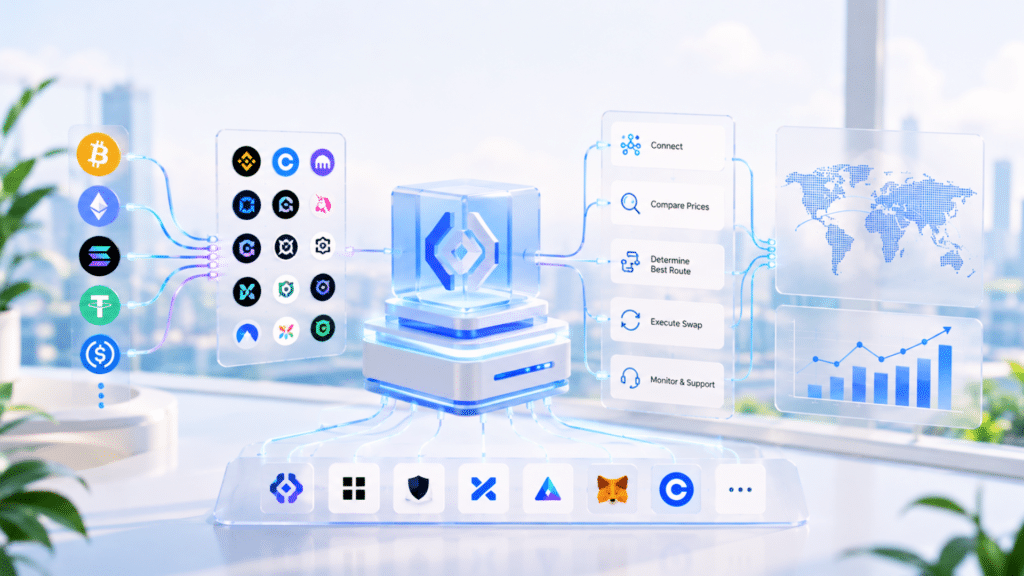
It also reports support for more than 2,800 digital assets and over 3.2 million trading pairs while integrating its execution engine into more than 6,000 partner products, including Exodus and Tangem. It further reports 99.998% estimate accuracy across the majority of floating-rate swaps and says customer support is available 24/7 with an average response time of around four minutes.
Rick Cramer, Head of Analytics, said, “Boring is the highest compliment you can pay infrastructure. Boring means it worked.” As execution infrastructure develops further, users are increasingly evaluating not only where their assets are stored but also how efficiently transactions are completed once movement begins.
Conclusion
Crypto self-custody has evolved beyond the original question of ownership as digital asset markets continue to mature. Holding private keys remains central to protecting assets from long-term custodial exposure, yet every transaction now introduces a separate execution process involving liquidity discovery, routing, pricing, confirmation, and operational reliability.
Crypto self-custody therefore represents both control and responsibility, requiring users to understand not only who holds their assets but also how those assets move across increasingly fragmented infrastructure. As the industry develops, ownership may have settled one debate, but execution continues to shape the next phase of self-custody.
Glossary
Crypto Self-Custody: You control your own crypto with your wallet
Custodial Exchange: A platform that holds your crypto for you
MEV: Extra profit taken from transaction ordering
Cross-Chain Transaction: Transfer between different blockchains
Cold Storage: Offline crypto storage for safety
Frequently Asked Questions About Crypto Self-Custody
Why do people use crypto self-custody wallets?
People use self-custody wallets because they want full control over their crypto and private keys.
Why did centralized exchanges become popular?
Centralized exchanges became popular because they made trading easier and more convenient for users.
What risks still exist in self-custody?
Risks still exist in self-custody because users can still make mistakes with addresses, networks, or transaction steps.
Does self-custody remove all crypto risks?
No, self-custody does not remove all risks because transaction and execution risks still remain.
What is the main idea of crypto self-custody today?
The main idea today is that crypto self-custody is about both controlling assets and completing safe transactions.