

CLARITY Act is advancing through the U.S. Senate at a time when policymakers are attempting to establish a clearer regulatory framework for digital assets while preserving safeguards against illicit finance and national security threats. The measure recently cleared the Senate Banking Committee in a 15-9 vote, setting the stage for a Senate floor debate that could shape the future structure of cryptocurrency regulation in the United States.
- How Could the CLARITY Act Reshape Digital Asset Regulation?
- Why Are National Security Provisions Drawing Attention?
- Why Has Senator Elizabeth Warren Opposed the Bill?
- What Consumer Protection Arguments Are Supporters Making?
- How Does the Proposal Fit Within Existing Compliance Practices?
- What Does the Bill Mean for Secondary Market Trading?
- Conclusion
- Glossary
- Frequently Asked Questions About the CLARITY Act
The legislation proposes a framework that separates regulatory oversight between the Securities and Exchange Commission (SEC) and the Commodity Futures Trading Commission (CFTC). It also directs attention toward risks associated with foreign adversaries and digital asset intermediaries. As discussions continue, lawmakers remain divided over whether the bill strikes the right balance between regulatory clarity, consumer protection, and financial security.
How Could the CLARITY Act Reshape Digital Asset Regulation?
The CLARITY Act seeks to establish clear regulatory regimes for digital assets, including stablecoins, while defining when regulatory responsibility should fall under the SEC or the CFTC. A central feature of the proposal is its Certification of Decentralization, or maturity pathway. Under this framework, issuers can seek a rebuttable presumption that a sufficiently decentralized asset qualifies as a digital commodity under CFTC oversight rather than SEC rules.

The legislation also attempts to address longstanding uncertainty surrounding digital assets that transition from issuer-controlled projects into decentralized networks. By creating a formal pathway for regulatory classification, the bill aims to provide clearer rules for market participants operating in the sector.
Why Are National Security Provisions Drawing Attention?
The bill includes several measures intended to address foreign adversary risks in digital asset markets. The CLARITY Act preserves existing Bank Secrecy Act requirements, FinCEN authority, and Treasury Department enforcement tools, including sanctions authorities. It also calls for studies examining foreign adversary activities connected to digital asset intermediaries, including potential data collection practices and intellectual property risks linked to jurisdictions such as China, Russia, Iran, and North Korea.
Importantly, the decentralization pathway does not override existing national security, sanctions, or illicit finance requirements. U.S.-regulated entities would still be required to comply with sanctions screening and related obligations under current law.
Why Has Senator Elizabeth Warren Opposed the Bill?
Critics of the legislation argue that the proposal could weaken standards designed to combat illicit finance. Senator Elizabeth Warren has been among the most vocal opponents of the measure. In a public statement, Warren said, “It’s already too easy for terrorists and criminals to launder huge sums of money and move it across borders.”
She also warned against reducing existing safeguards, stating, “If we water down global illicit finance standards, we’ll open the door to more cross-border sanctions evasion, money laundering, and terrorist financing, and give other countries cover to adopt similarly weak rules.” Warren has argued that the legislation should not pass in its current form because of concerns surrounding sanctions enforcement and financial crime risks.

What Consumer Protection Arguments Are Supporters Making?
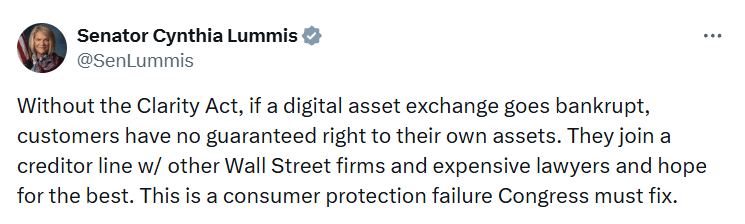
Supporters of the bill contend that regulatory uncertainty has left digital asset users exposed in situations involving exchange failures. Senator Cynthia Lummis pointed to customer asset protections as a key reason for advancing the legislation.
In a statement, she said that without the CLARITY Act, customers of a bankrupt digital asset exchange have no guaranteed right to recover their own assets and may be forced into creditor proceedings alongside other claimants. Backers of the legislation argue that a clearer legal framework could provide stronger protections for customers while reducing uncertainty surrounding ownership rights during insolvency events.
How Does the Proposal Fit Within Existing Compliance Practices?
Many of the compliance measures discussed in the bill already exist across regulated financial institutions and digital asset firms. Compliance teams routinely conduct sanctions screening and monitor exposure to high-risk jurisdictions. U.S.-domiciled stablecoins such as USDC are often viewed as having structural compliance advantages because of issuer transparency and reserve reporting practices.
Institutional caution regarding assets connected to higher-risk jurisdictions also predates the legislation. Existing anti-money laundering requirements and sanctions rules administered by federal authorities continue to influence investment and trading decisions regardless of the bill’s progress. Market observers note that any future liquidity shifts or pricing impacts would depend on broader market conditions, venue-specific dynamics, and ongoing enforcement of current regulations.
What Does the Bill Mean for Secondary Market Trading?
The legislation arrives amid a broader effort by lawmakers to address uncertainty surrounding secondary-market trading of digital assets. A key policy objective within ongoing legislative discussions is separating a token’s status in secondary markets from the transaction through which it was originally sold. Market participants have long argued that uncertainty in this area has complicated listing decisions, custody services, and liquidity provision.

The proposal moves toward a framework in which sufficiently decentralized assets may transition into a commodity-style regulatory structure while maintaining compliance obligations for issuers and affiliated parties. Supporters believe this approach could provide a more predictable legal environment for exchanges, custodians, and investors.
Conclusion
CLARITY Act now heads toward a Senate floor vote following its approval by the Senate Banking Committee. While the legislation represents one of the most significant attempts to define digital asset market structure in the United States, several legislative steps remain before it can become law.
Lawmakers are expected to continue debating issues related to decentralization standards, consumer protections, illicit finance safeguards, and foreign adversary risks. The outcome could influence how digital assets are regulated in the years ahead while determining whether policymakers can deliver greater regulatory clarity without altering existing national security and compliance obligations.
Glossary
CLARITY Act: U.S. bill aimed at creating clearer crypto regulations.
Digital Commodity: A decentralized crypto asset treated as a commodity.
Bank Secrecy Act (BSA): U.S. law focused on preventing financial crime.
OFAC: U.S. agency that enforces economic sanctions.
FinCEN: U.S. regulator that tracks and combats financial crime.
Frequently Asked Questions About the CLARITY Act
What does the CLARITY Act regulate?
The CLARITY Act regulates digital assets, stablecoins, and crypto market activities.
Does the CLARITY Act remove existing sanctions rules?
No, the CLARITY Act keeps existing sanctions and compliance requirements in place.
Why does Elizabeth Warren oppose the CLARITY Act?
She believes the bill could weaken protections against money laundering and financial crime.
How could the CLARITY Act help crypto users?
The CLARITY Act could provide clearer legal protections for crypto investors and customers
What happens next for the CLARITY Act?
The CLARITY Act is expected to move to the Senate floor for further debate and voting.