

The CLARITY Act has suddenly become one of Washington’s biggest crypto battles, and Wall Street is no longer staying quiet. What once looked like a smooth push toward digital asset clarity is now colliding with banking pressure, political uncertainty, and growing fears around decentralized finance. In just one week, prediction markets slashed approval odds for the bill, showing how fragile crypto optimism can become when traditional finance pushes back.
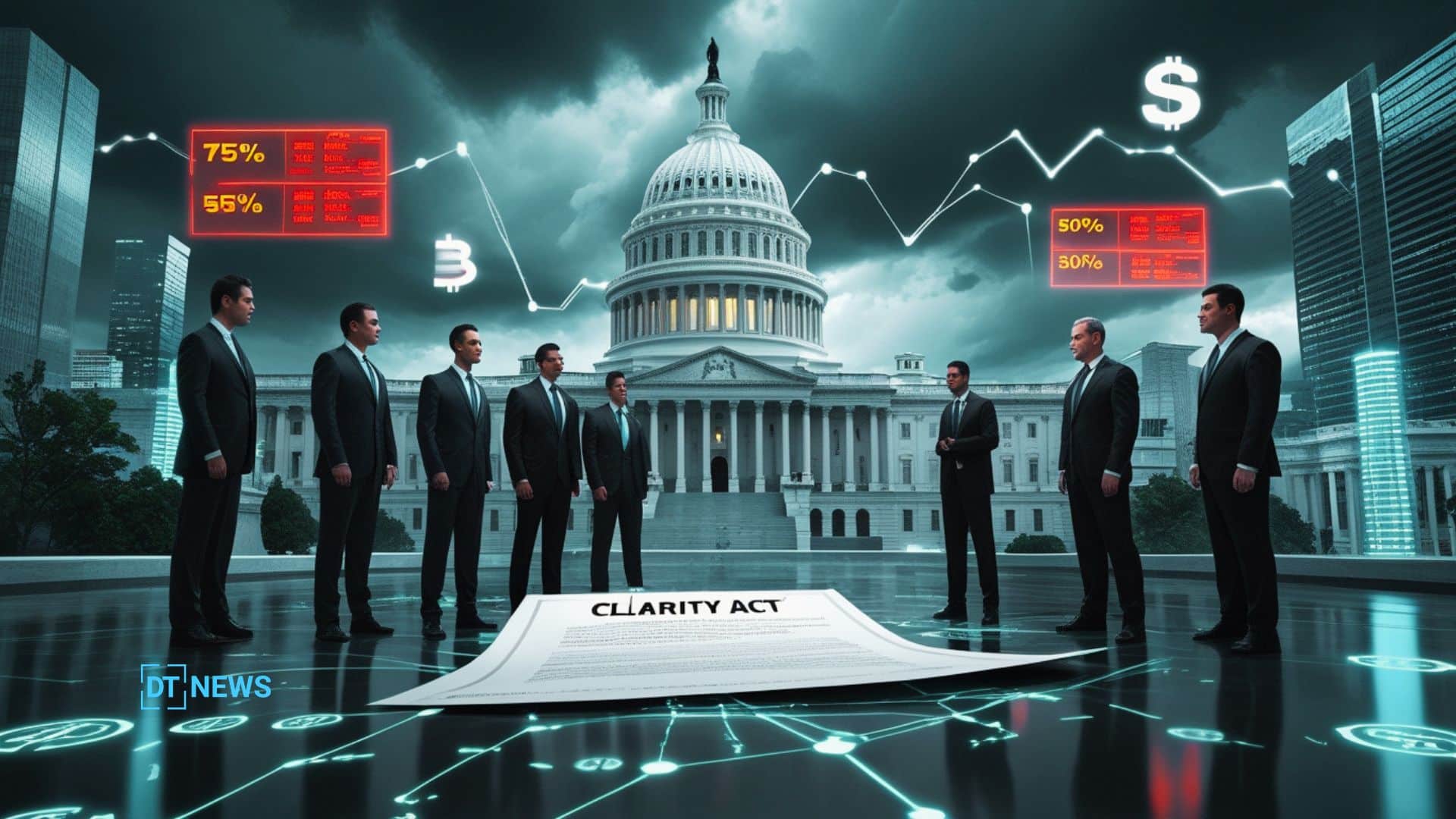
According to the source, Kalshi reported on May 23 that the likelihood of the CLARITY Act passing before 2027 dropped from nearly 75% to 50%. Odds for approval before July 2026 fell to 14%, while chances before August slipped to 37%. The sharp decline reflected growing concerns over stablecoin regulation, amendments delaying the process, and fears that yield-bearing stablecoins could disrupt established banking systems.
Why Kalshi Turned Cautious While Polymarket Stayed Bullish
One of the most interesting parts of the story is the growing divide between Kalshi and Polymarket traders. Kalshi markets reacted negatively as concerns around stablecoin regulation intensified across Washington and Wall Street. Polymarket, however, showed renewed optimism after Senator Cynthia Lummis defended the bill publicly.
The disparity highlights two very different trader mindsets. Kalshi users often focus on macroeconomics and political delays, while Polymarket attracts a more crypto-native audience that remains optimistic about blockchain adoption and regulatory progress.
This divide matters because the CLARITY Act is no longer just another crypto bill. It has evolved into a broader fight between traditional finance and decentralized systems. As Washington debates the future of stablecoin regulation, traders are reacting to very different visions of financial innovation.
Senate Approval Did Not Remove Washington Uncertainty
Support for the CLARITY Act gained momentum on May 14 after the Senate Banking Committee approved the legislation by a 15-9 vote during a markup session. Still, committee approval only opened the next stage of a difficult political process.
Several amendments remain under discussion before the final Senate floor vote. Some lawmakers want tighter stablecoin regulation and stronger consumer protections. Others worry aggressive rules could push blockchain innovation overseas.
This uncertainty explains why approval odds suddenly weakened despite the committee victory. In Washington, even strong committee support does not guarantee final passage. Political negotiations can quickly reshape legislation behind closed doors.
Wall Street Fears Stablecoins Could Reshape Banking
The banking industry now represents one of the strongest obstacles facing the CLARITY Act. Large financial institutions worry that yield-bearing stablecoins may compete directly with traditional savings accounts and weaken bank deposit systems.
During remarks covered by JPMorgan Chase, CFO Jeremy Barnum warned that allowing stablecoins to generate yield could disrupt the broader financial structure. Analysts believe banks fear losing low-cost customer deposits that support lending and profitability.
The debate also raises ethical concerns tied to stablecoin regulation. Critics question whether stablecoin issuers should operate like banks without facing the same oversight rules. Others warn unregulated yield products may expose consumers to hidden financial risks during periods of market stress.
Wall Street’s growing influence over the debate is slowing momentum behind the CLARITY Act and reshaping the political conversation around crypto policy.
Why the CLARITY Act Matters for DeFi and Blockchain Innovation
The stakes behind the CLARITY Act stretch far beyond political headlines. Stablecoins serve as the liquidity engine of decentralized finance, powering lending, trading, and on-chain payments across blockchain networks.
Without clear stablecoin regulation, many developers and crypto firms remain trapped in legal uncertainty. Blockchain builders struggle to scale products confidently inside the United States while investors wait for clearer compliance rules.
Supporters argue the CLARITY Act could encourage institutional adoption and prevent innovation from moving offshore. Senator Cynthia Lummis recently emphasized Wyoming’s early crypto framework in remarks highlighted by Polymarket, arguing the federal government must stop falling behind emerging technologies.
For many in the crypto industry, the bill represents a defining test for America’s leadership in digital finance.
Conclusion
The sharp drop in approval odds shows the CLARITY Act faces far more resistance than crypto markets expected only weeks ago. Banking pressure, Washington uncertainty, and growing concerns around stablecoin regulation have transformed the legislation into a battle over the future of money itself.
Yet the bigger risk may extend beyond one bill. If the United States fails to create workable crypto rules, blockchain innovation and DeFi development could continue shifting toward friendlier global markets. The outcome of the CLARITY Act may ultimately decide whether America leads the next financial era or watches it develop elsewhere.
Glossary of Key Terms
CLARITY Act: A proposed U.S. crypto bill focused on creating clearer digital asset rules.
Stablecoin Regulation: Government oversight designed to manage stablecoins and related financial activity.
Yield-Bearing Stablecoins: Stablecoins that offer users interest-like rewards or returns.
Decentralized Finance: Blockchain-based financial systems operating without traditional banks.
Senate Banking Committee: A U.S. Senate committee responsible for financial and banking legislation.
FAQs About CLARITY Act
Why did CLARITY Act approval odds fall?
Banking opposition and political uncertainty weakened market confidence around the bill.
Why are Kalshi and Polymarket showing different predictions?
Each platform reflects different trader communities and reactions to crypto regulation.
Why are banks worried about stablecoins?
Banks fear stablecoins may attract deposits away from traditional financial institutions.
Why does the CLARITY Act matter for DeFi?
Stablecoins power decentralized finance systems, making regulatory clarity important for blockchain growth.