



A single crypto wallet in Thailand quietly moved more than $122.5 million in ten months, and nobody outside a small circle of investigators noticed until it was almost too late. That is the unsettling detail sitting at the center of a fresh crypto fraud case Interpol disclosed this week, one tied to a sprawling romance scam network and a 20-year-old suspect who authorities say sat near the center of the money trail.
The case did not happen in isolation, it landed as part of Operation First Light 2026, a coordinated sweep spanning 97 countries that produced 5,811 arrests and intercepted 293 million dollars in illicit assets. For anyone tracking how criminal networks launder money through digital assets, this one is worth slowing down for.
The Wallet That Moved $122.5 Million
Thai police arrested two individuals connected to the scheme, which funneled proceeds from romance scams through crypto wallets before scattering the funds across multiple blockchains. Interpol has not named the wallet publicly, nor has it disclosed which tokens or networks were used to move the money.
What investigators did confirm is that the 122.5 million dollar figure represents cumulative activity over ten months, not a static balance sitting untouched. That distinction matters. A crypto fraud operation moving that kind of volume through a single address suggests a level of coordination that goes well beyond a lone scammer working from a laptop.
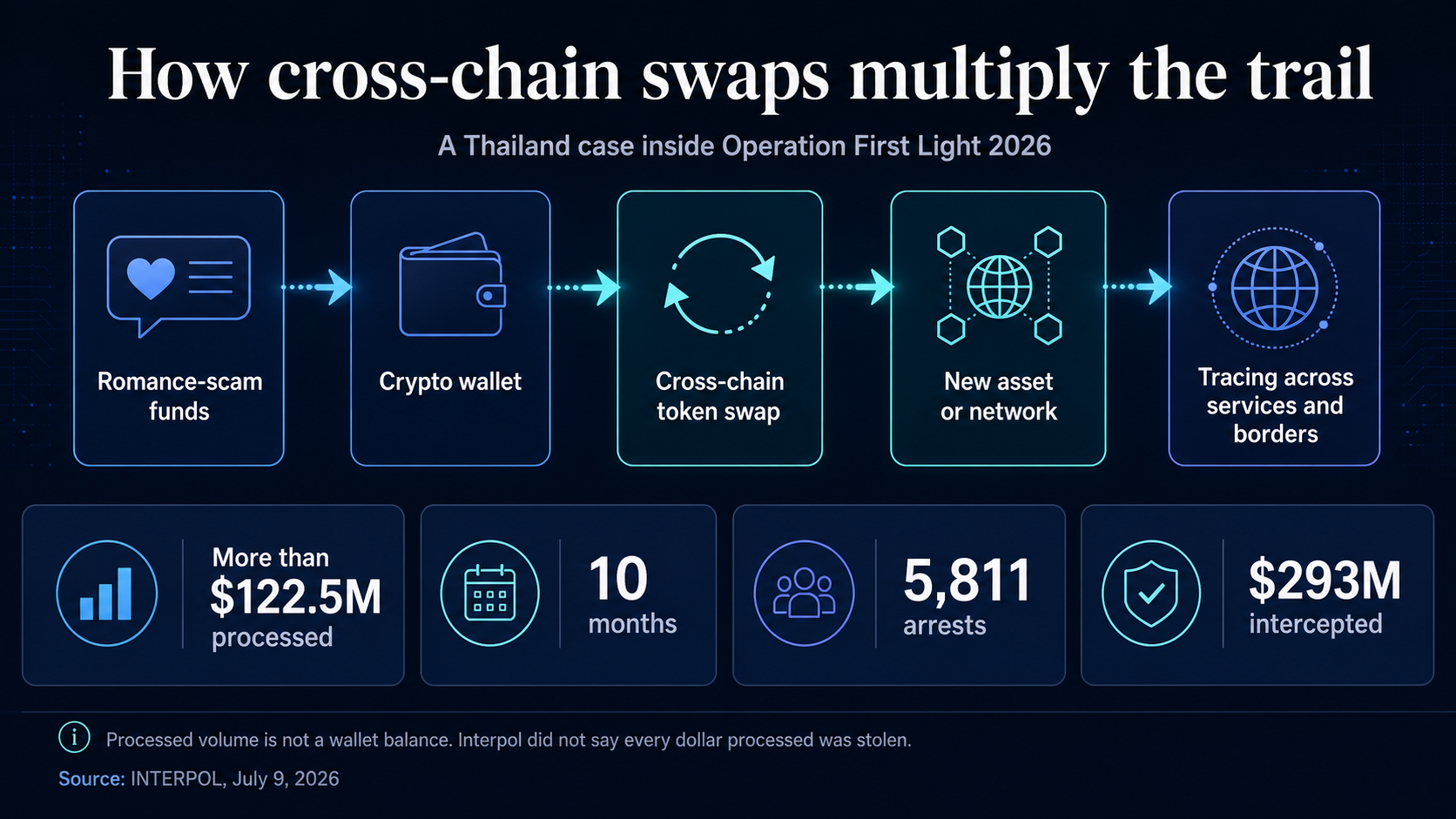
How Cross-Chain Swaps Fuel Crypto Fraud
Here is where things get genuinely tricky for investigators, and honestly, for anyone who thinks blockchain transparency automatically means criminals get caught fast. Cross-chain token swaps let bad actors push funds from one asset or network onto another almost instantly, and each hop forces authorities to reconcile records across separate ledgers, separate exchanges, and separate jurisdictions.
It is a bit like trying to follow a shipment that swaps trucks, license plates, and drivers at every state line. Technically traceable, sure, but painfully slow in practice. The Financial Action Task Force flagged this exact vulnerability back in March, warning that cross-chain activity often slips through gaps in existing anti-money-laundering frameworks. Investigators are now racing to build the technical expertise needed to keep pace, and this Thailand case shows just how far behind the curve enforcement can still be.
A Global Crackdown Across 97 Countries
Operation First Light ran from January 15 through April 30, following an earlier intelligence-gathering phase that helped investigators map out networks before moving in. The results speak for themselves: nearly 6,000 arrests, close to 300 million dollars seized, and more than 142,000 identified victims worldwide.
Interpol leaned on its I-GRIP mechanism, a tool designed to freeze illicit flows across both traditional banking and virtual assets, alongside raids and formal notices issued through member countries. It is one of the larger coordinated pushes against organized crypto fraud in recent memory, and Thailand’s wallet case became one of its most cited examples.

Why Romance Scams Keep Feeding These Networks
Romance scams remain one of the most reliable feeder systems for large-scale crypto fraud, and this case fits the pattern almost perfectly. Victims are groomed over weeks or months, convinced they are building a genuine relationship, then gradually persuaded to send funds that get converted into digital assets and funneled through wallets like the one Thai police just seized, the emotional manipulation involved makes these schemes brutally effective, and the crypto layer gives operators a fast, semi-anonymous way to move proceeds before victims even realize what happened.
What This Means for Investors and Regulators
For everyday crypto users, the takeaway is not paranoia, it is awareness. Exchanges, wallet providers, and swap services now sit under growing pressure to flag suspicious flows before funds disappear across chains. Regulators in places like Australia have already tightened transfer rules this year, and more jurisdictions are likely to follow. The Thailand case is a reminder that crypto fraud investigations increasingly hinge on speed, not just eventual detection.
Conclusion
This case will not be the last time a single wallet exposes a much larger criminal network. What it does show is that enforcement agencies are getting sharper at tracing digital money trails, even as the tools criminals use grow more sophisticated. The gap between detection and prevention is narrowing, slowly, and that shift matters for anyone who holds or trades digital assets today.
Frequently Asked Questions
What did Interpol find in this case?
A Thai wallet linked to a 20-year-old suspect processed over 122.5 million dollars in ten months through romance scam proceeds.
How many arrests came from Operation First Light 2026?
Authorities made 5,811 arrests across 97 countries and territories.
Why are cross-chain swaps a problem for investigators?
They scatter funds across different blockchains and services, forcing investigators to piece together records from multiple sources before tracing the money.
How much money did the operation recover overall?
Interpol reported 293 million dollars in intercepted illicit assets globally.
Glossary of Key Terms
Cross-chain swap: A transaction that moves funds from one blockchain or token to another.
Off-ramp: A service that converts cryptocurrency into traditional currency, often linked to a verified identity.
Romance scam: A fraud scheme where a criminal builds a fake emotional relationship with a victim to extract money.
I-GRIP: An Interpol mechanism used to freeze illicit financial flows across both fiat and virtual assets.
Money laundering: The process of disguising illegally obtained funds to make them appear legitimate.
Disclaimer: This article is for informational purposes only and does not constitute financial, legal, or investment advice.
Sources