



BlackRock Q1 2026 earnings mark a 17% year over year growth driven by strong inflows, rising ETF adoption and expanding institutional participation across global markets. The results released on April 14 show GAAP net income of $2.2 billion supported by diversified revenue streams across ETFs, active strategies and private markets.
- BlackRock Q1 2026 earnings what do the results show?
- How did assets under management evolve?
- What role did Bitcoin ETFs play in performance?
- Why are profitability and margins closely watched?
- How do BlackRock Q1 2026 earnings compare to Q1 2025?
- Conclusion
- Glossary
- Frequently Asked Questions About BlackRock Q1 2026 Earnings
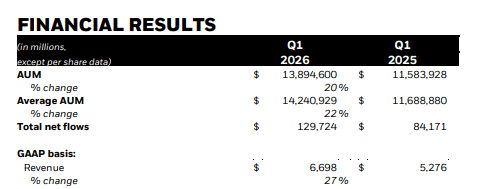
Revenue increased to $6.698 billion compared to $5.276 billion in the same period last year. Broader financial markets during the quarter reflected uneven performance across equities and bonds, shaped by shifting rate expectations and cautious institutional positioning.
BlackRock Q1 2026 earnings what do the results show?
The quarter delivered a 17% increase in net income compared to the previous year, with GAAP earnings at $2.2 billion and adjusted earnings showing a more moderated but steady trend. Diluted EPS stood at $14.06 on a GAAP basis and $12.53 on an adjusted basis, highlighting the difference between reported and normalized profitability. Net inflows reached $129.72 billion, broadly aligned with expectations and slightly below consensus estimates.

Despite that, ETF demand and active fixed income flows remained stable contributors across the platform. Performance was spread across multiple business lines rather than concentrated in one area. Equity strategies, fixed income products and private markets all played a role in supporting overall results, reflecting a more balanced revenue structure.
How did assets under management evolve?
As part of BlackRock Q1 2026 earnings, assets under management rose to about $13.895 trillion, marking a 20% increase year over year. This expansion was supported by consistent inflows along with positive market performance across global asset classes. Average assets under management climbed to $14.241 trillion, strengthening the firm’s fee generating base.
ETF products remained the primary driver of growth, while institutional mandates and private markets added additional support. Private market assets declined slightly to $320.4 billion from $322.6 billion in the prior quarter, showing mild softness in that segment even as the broader platform expanded.
What role did Bitcoin ETFs play in performance?
Bitcoin ETF exposure, led by IBIT, contributed to inflows but did not define overall performance. The product operated as one component of a wider ETF ecosystem that includes equity and fixed income strategies.
IBIT attracted $34.7 million in inflows even as broader spot Bitcoin ETFs saw $291 million in outflows, reflecting selective rather than uniform investor demand across digital asset products. Still, IBIT remains part of a larger flow picture where outcomes are increasingly shaped by broader ETF demand, asset allocation trends and overall market sentiment rather than Bitcoin alone.
Why are profitability and margins closely watched?
BlackRock Q1 2026 Earnings demonstrate enhanced profitability through a GAAP operating margin of 42% and an adjusted margin of 44.5%, signaling stronger financial efficiency. This improvement reflects scale benefits combined with operating discipline across business units. Net income attributable to shareholders reached $2.068 billion on an adjusted basis, supported by recurring fee income and stronger market-driven asset levels.

However, expenses remained elevated due to ongoing investments and restructuring efforts. Technology and subscription revenue came in at $530 million, as more investors and institutions relied on analytics platforms and data-focused tools, helping the company maintain steady and reliable income over time.
How do BlackRock Q1 2026 earnings compare to Q1 2025?
Assets under management surged from $11.58 trillion to $13.895 trillion year over year, signaling robust structural growth. Revenue and earnings climbed too, backed by higher fee generating assets and favorable market conditions. Earnings per share advanced year over year, highlighting better operating leverage and asset based income.
Growth spread across multiple segments, reflecting balanced contributions rather than single driver dependence. The stock traded at $1,061.43 after the release which showed steady investor sentiment without sharp price swings
Conclusion
BlackRock Q1 2026 earnings showcase broad based growth fueled by ETFs, active strategies and private markets with net income hitting $2.2 billion and inflows reaching $129.72 billion. This performance underscores a diversified structure where multiple business segments drove meaningful contributions to total results.
BlackRock Q1 2026 earnings reveal IBIT’s supporting role in a broader investment ecosystem, not as the main growth driver. Future performance hinges on sustained ETF adoption and wider market stability. BlackRock Q1 2026 earnings cap the quarter with steady expansion in scale and profitability. They reinforce diversified flow drivers across global investment markets.
Glossary
IBIT (iShares Bitcoin Trust): BlackRock’s spot Bitcoin ETF tracking BTC price
AUM (Assets Under Management): Total value of assets managed for clients
Operating Margin: Percentage of revenue that remains after operating costs
Private Markets: Investments made outside public exchanges
Bitcoin ETF: Fund offering Bitcoin exposure without direct ownership
Frequently Asked Questions About BlackRock Q1 2026 Earnings
How much did BlackRock earn in Q1 2026?
BlackRock earned about $2.2 billion in net income in Q1 2026.
How much did BlackRock Q1 2026 earnings grow?
BlackRock’s earnings grew by 17% compared to the same time last year.
How did BlackRock’s AUM change?
BlackRock’s assets under management rose to about $13.9 trillion showing strong growth.
Did Bitcoin ETFs help BlackRock’s growth?
Bitcoin ETFs like IBIT supported inflows but were only one part of overall growth.
What is BlackRock’s operating margin?
BlackRock’s operating margin was around 42%. Which shows solid profitability.