


Solana futures funding rate turned negative after traders increased bearish exposure following SOL’s rejection at $98 on May 11. The derivatives shift coincided with a 15% correction that later tested the $83 level as decentralized exchange activity and broader network demand slowed across the Solana ecosystem. While the market has started pricing in short-term caution, Solana still remains one of the largest blockchain ecosystems by total value locked and decentralized application revenue despite mounting competition from rival networks.
- How Does Solana Futures Funding Rate Reflect Market Sentiment?
- Why Has Activity Across Solana’s Ecosystem Slowed?
- Are Hyperliquid and Base Increasing Competitive Pressure?
- Did Automated Trading Activity Raise Questions About Solana Network Volume?
- Could SOL Still Avoid a Retest of $78?
- Conclusion
- Glossary
- Frequently Asked Questions About Solana Futures Funding Rate
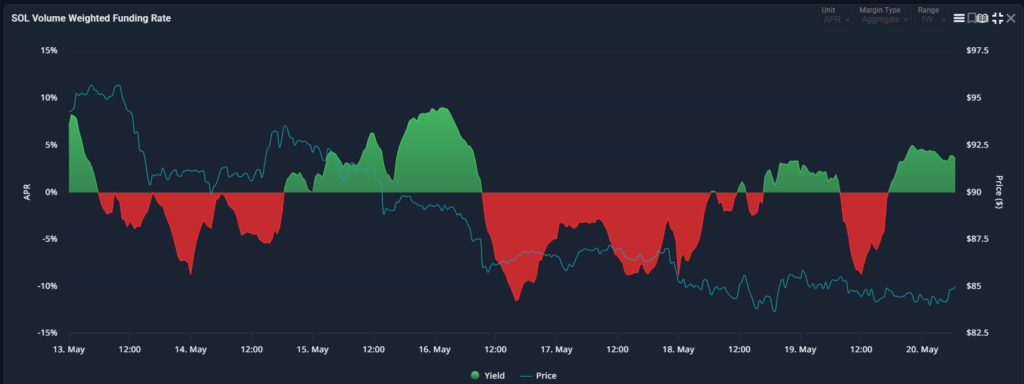
SOL is currently trading around $84.83, down 0.51% over the past 24 hours. The futures data showed a sharp change in market positioning. The Solana futures funding rate dropped to -3% on Tuesday after standing near +8% on Saturday. In neutral conditions, the metric usually trades close to +9% to reflect exchange risk and the cost of capital. The reversal signaled that traders were increasingly favoring bearish leverage after SOL slipped below the $90 level.
How Does Solana Futures Funding Rate Reflect Market Sentiment?
The Solana futures funding rate is used to measure positioning in perpetual futures markets. When the rate turns negative, it generally means traders holding short positions are paying premiums to maintain bearish bets. The latest decline followed SOL’s rejection at $98 and the subsequent pullback toward $83. Market participants interpreted the move as a sign that leverage demand on the bullish side had weakened significantly over the past several sessions.

At the same time, analysts noted that the Solana futures funding rate should be viewed as a sentiment indicator rather than a guaranteed signal of another sharp decline. Negative funding can reinforce downside pressure, though it can also create conditions for short-covering rallies if market sentiment changes quickly.
Why Has Activity Across Solana’s Ecosystem Slowed?
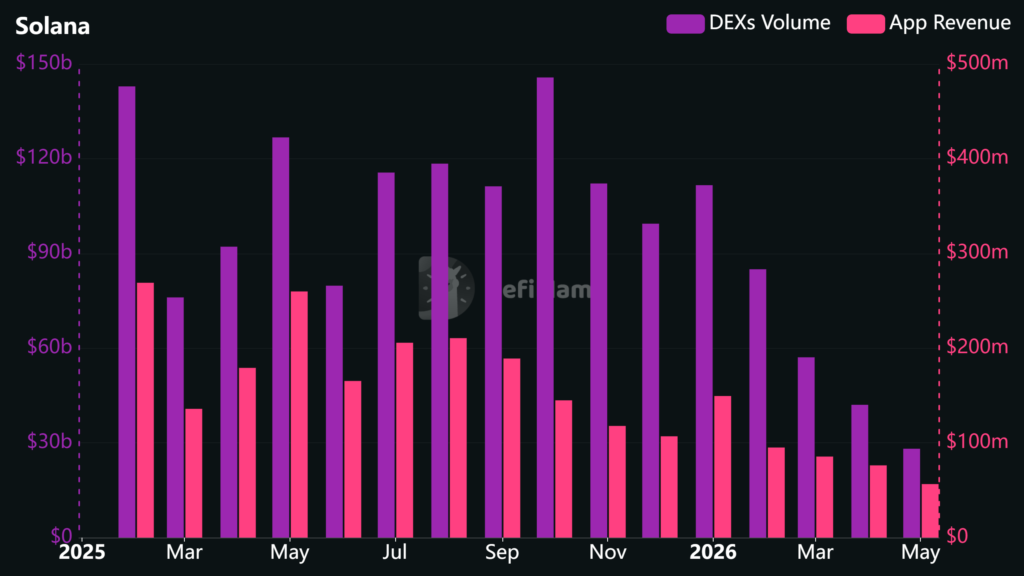
Decentralized exchange activity on Solana has declined considerably since January. Weekly DEX volume fell to $11 billion from an earlier average of $25 billion, representing a 56% drop over the period. Weekly DApp revenue also slowed to around $20 million compared with January’s average of $35 million. The cooling activity reduced demand across parts of the ecosystem and contributed to weaker sentiment surrounding SOL.
Despite the slowdown, Solana continues to remain the leading blockchain for DApp revenue generation. Analysts said the network’s ability to maintain strong revenue leadership during weaker trading conditions highlights that user activity and liquidity remain deeply embedded within the ecosystem. Pump, Axiom Pro, Phantom, and Jupiter accounted for nearly 65% of Solana’s DApp revenue over the past 30 days.
Those projects continued driving activity across trading, wallet infrastructure, and decentralized finance. The decline in DApp engagement has not been isolated to Solana alone. Broader market appetite for speculative trading activity has weakened in recent months, particularly after the memecoin frenzy that fueled large transaction volumes earlier this year. However, Solana has felt the slowdown more directly because it was one of the primary networks benefiting from that surge in trading demand.
Are Hyperliquid and Base Increasing Competitive Pressure?
Competition among blockchain networks has intensified as newer platforms attempt to capture market share in trading and decentralized finance. Hyperliquid has emerged as a direct challenger in perpetual futures trading by integrating core trading infrastructure directly into its consensus layer. Its high-throughput architecture has attracted traders looking for specialized derivatives functionality.
Meanwhile, Base continued expanding through its integration with the Coinbase ecosystem, which analysts said provides easier onboarding for retail users and developers. Even with rising competition, Solana remains one of the strongest networks in decentralized finance. The blockchain currently holds around $5.905 billion in total value locked, down 0.59% over the past 24 hours, ahead of BNB Chain at $5.482 billion and Base at $4.456 billion, which slipped 0.15% during the same period.
Ethereum remains the dominant network overall with approximately $43.162 billion in TVL, despite a 0.62% decline over the past 24 hours. Protocols including Jupiter, Kamino, Sanctum, and Raydium continue anchoring Solana’s DeFi ecosystem. Analysts noted that while Hyperliquid and Base are gaining traction in specific segments, Solana still maintains a major share of overall ecosystem value and activity rather than being displaced outright.
Did Automated Trading Activity Raise Questions About Solana Network Volume?
Additional scrutiny emerged after X user Luke Cannon shared analysis tied to activity on PreStocks, a synthetic asset platform operating on Solana. The analysis claimed that more than 1,600 wallet addresses were responsible for nearly 63% of the platform’s reported trading volume, estimated at around $760 million. The addresses reportedly displayed balanced buy and sell activity, high-frequency execution patterns, and relatively small losses. Those characteristics are often associated with arbitrage trading strategies, though they also raised questions about possible volume spoofing activity.
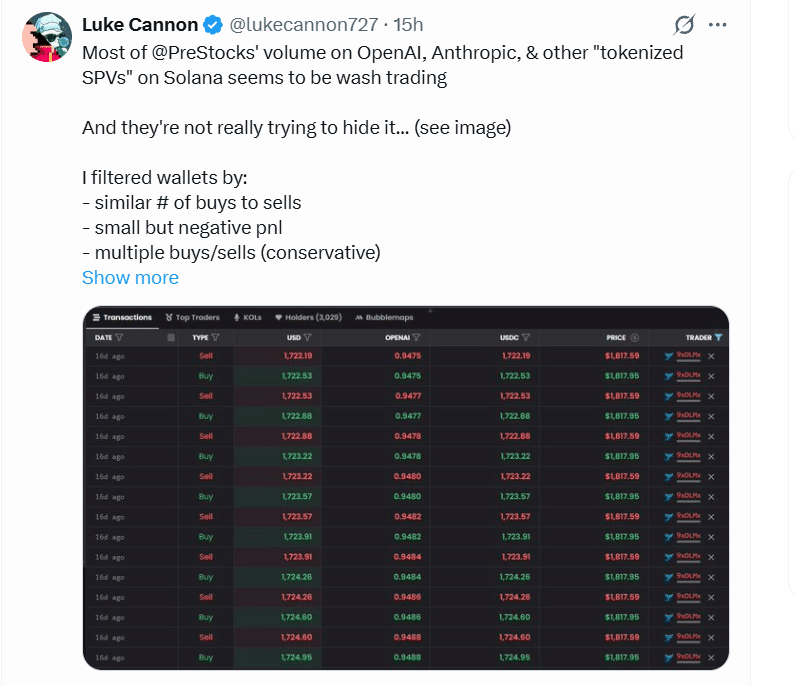
Analysts tracking the discussion noted that Solana’s low transaction costs make the network attractive for automated trading systems and maximal extractable value strategies. However, the available data does not conclusively prove wash trading or manipulation. Without more detailed counterparty and order flow information, the activity remains open to multiple interpretations. The concerns surfaced as the Solana futures funding rate continued reflecting increased bearish positioning in derivatives markets.
Could SOL Still Avoid a Retest of $78?
SOL’s recent correction has intensified discussion about whether the token could revisit the $78 range recorded earlier this year. However, analysts said current market signals still stop short of confirming an immediate move toward that level. The Solana futures funding rate shows that traders are increasingly defensive in the short term, but market structure has not fully broken down.

SOL managed to stabilize after briefly retesting the $83 level during the recent correction, while broader ecosystem metrics still place Solana among the leading blockchain networks by revenue and locked value. A recovery in decentralized exchange activity or renewed speculative demand could improve sentiment toward the token. At the same time, continued weakness in trading volumes may keep bearish pressure elevated in the near term. SOL is currently trading around $84.83, down 0.51% over the past 24 hours.
Conclusion
Solana futures funding rate trends currently reflect rising caution among derivatives traders as network activity cools and rival chains continue expanding. Lower DEX volume and softer DApp revenue have weighed on market sentiment, particularly after SOL failed to hold above $98 earlier this month. Still, Solana continues to rank among the strongest blockchain ecosystems in decentralized finance.
The network remains the leading chain for DApp revenue while holding second place in total value locked. Although competitive pressure from Hyperliquid and Base has intensified, Solana’s ecosystem scale and infrastructure presence continue to provide important support as traders assess whether the recent correction deepens further. For now, the market appears to be repricing growth expectations rather than abandoning the Solana ecosystem altogether.
Glossary
Solana Futures Funding Rate: Metric tracking trader sentiment in SOL futures markets.
Perpetual Futures: Crypto futures contracts with no expiration date.
Funding Rate: Payment between traders to balance futures prices.
DApp Revenue: Income generated from blockchain application activity.
Leverage Trading: Using borrowed funds to amplify trading exposure.
Frequently Asked Questions About Solana Futures Funding Rate
Why did the Solana funding rate turn negative?
The funding rate turned negative because more traders opened bearish positions on SOL.
Why did SOL price fall recently?
SOL price dropped after failing to hold above the $98 resistance level.
How much has Solana DEX activity declined?
Solana weekly DEX volume has fallen by around 56% since January.
Can negative funding rates lead to a price rebound?
Yes, negative funding rates can sometimes trigger short-covering rallies if sentiment changes.
What projects are driving Solana’s ecosystem activity?
Projects like Jupiter, Phantom, Kamino, and Raydium continue supporting Solana’s ecosystem growth.